


Effects of a caffeine-containing energy drink on simulated soccer performance
- PMID: 22348079
- PMCID: PMC3279366
- DOI: 10.1371/journal.pone.0031380
Effects of a caffeine-containing energy drink on simulated soccer performance
Abstract
Background: To investigate the effects of a caffeine-containing energy drink on soccer performance during a simulated game. A second purpose was to assess the post-exercise urine caffeine concentration derived from the energy drink intake.
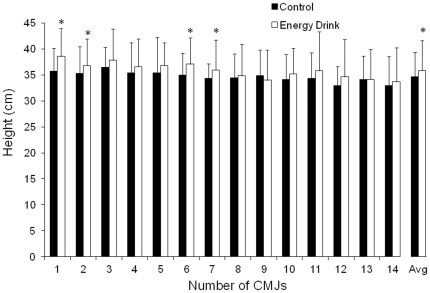
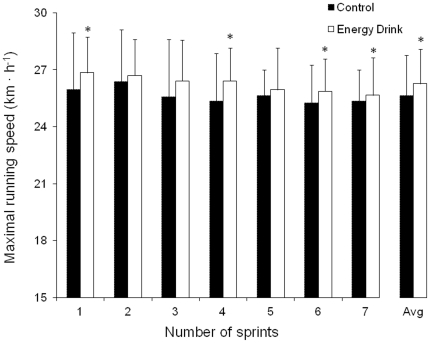
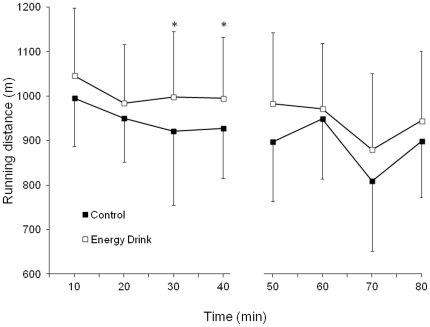
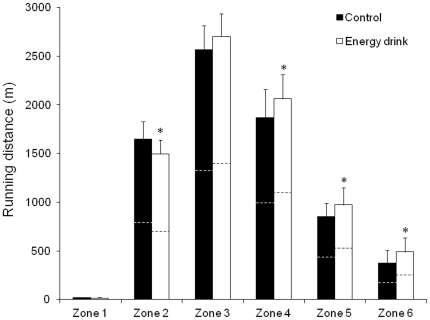
Methodology/principal findings: Nineteen semiprofessional soccer players ingested 630 ± 52 mL of a commercially available energy drink (sugar-free Red Bull®) to provide 3 mg of caffeine per kg of body mass, or a decaffeinated control drink (0 mg/kg). After sixty minutes they performed a 15-s maximal jump test, a repeated sprint test (7 × 30 m; 30 s of active recovery) and played a simulated soccer game. Individual running distance and speed during the game were measured using global positioning satellite (GPS) devices. In comparison to the control drink, the ingestion of the energy drink increased mean jump height in the jump test (34.7 ± 4.7 v 35.8 ± 5.5 cm; P<0.05), mean running speed during the sprint test (25.6 ± 2.1 v 26.3 ± 1.8 km · h(-1); P<0.05) and total distance covered at a speed higher than 13 km · h(-1) during the game (1205 ± 289 v 1436 ± 326 m; P<0.05). In addition, the energy drink increased the number of sprints during the whole game (30 ± 10 v 24 ± 8; P<0.05). Post-exercise urine caffeine concentration was higher after the energy drink than after the control drink (4.1 ± 1.0 v 0.1 ± 0.1 µg · mL(-1); P<0.05).
Conclusions/significance: A caffeine-containing energy drink in a dose equivalent to 3 mg/kg increased the ability to repeatedly sprint and the distance covered at high intensity during a simulated soccer game. In addition, the caffeinated energy drink increased jump height which may represent a meaningful improvement for headers or when players are competing for a ball.
Conflict of interest statement
Figures
References
-
- Coso JD, Muñoz G, Muñoz-Guerra J. Prevalence of caffeine use in elite athletes following its removal from the World Anti-Doping Agency list of banned substances. Appl Physiol Nutr Metab. 2011;36:555–561. - PubMed
-
- Clauson KA, Shields KM, McQueen CE, Persad N. Safety issues associated with commercially available energy drinks. J Am Pharm Assoc (2003) 2008;48:e55–63; quiz e64–57. - PubMed
-
- Froiland K, Koszewski W, Hingst J, Kopecky L. Nutritional supplement use among college athletes and their sources of information. Int J Sport Nutr Exerc Metab. 2004;14:104–120. - PubMed
-
- Kristiansen M, Levy-Milne R, Barr S, Flint A. Dietary supplement use by varsity athletes at a Canadian university. Int J Sport Nutr Exerc Metab. 2005;15:195–210. - PubMed
-
- Hoffman JR. Caffeine and energy drinks. Strength and Conditioning Journal. 2010;32:15–20.
MeSH terms
Substances
LinkOut - more resources
Full Text Sources
Other Literature Sources
Medical
