Review
. 2012 Apr;177(4):449-66.
doi: 10.1667/rr2530.1. Epub 2012 Feb 21.

Imaging radiation-induced normal tissue injury

Affiliations
Review

Imaging radiation-induced normal tissue injury

Mike E Robbins et al. Radiat Res. 2012 Apr.

Abstract

Technological developments in radiation therapy and other cancer therapies have led to a progressive increase in five-year survival rates over the last few decades. Although acute effects have been largely minimized by both technical advances and medical interventions, late effects remain a concern. Indeed, the need to identify those individuals who will develop radiation-induced late effects, and to develop interventions to prevent or ameliorate these late effects is a critical area of radiobiology research. In the last two decades, preclinical studies have clearly established that late radiation injury can be prevented/ameliorated by pharmacological therapies aimed at modulating the cascade of events leading to the clinical expression of radiation-induced late effects. These insights have been accompanied by significant technological advances in imaging that are moving radiation oncology and normal tissue radiobiology from disciplines driven by anatomy and macrostructure to ones in which important quantitative functional, microstructural, and metabolic data can be noninvasively and serially determined. In the current article, we review use of positron emission tomography (PET), single photon emission tomography (SPECT), magnetic resonance (MR) imaging and MR spectroscopy to generate pathophysiological and functional data in the central nervous system, lung, and heart that offer the promise of, (1) identifying individuals who are at risk of developing radiation-induced late effects, and (2) monitoring the efficacy of interventions to prevent/ameliorate them.


Figures

FIG. 1
FIG. 1
Coronal brain slices of a male Fischer 344 × Brown Norway rat. Panel A: Fractional Anisotropy (FA) indicates the directional water diffusion within a voxel. Fractional anisotropy values approaching 1 (aqua arrowhead) have high directional flow and can be seen within white matter tracts throughout the rat brain. Panel B: Fractional anisotropy can be colored to represent the direction of flow throughout the 3D image. In this example, blue defines flow between anterior (A) and posterior (P), red defines flow between left (L) and right (R), and green defines flow between superior (S) and inferior (I). Colors in between these axes represent the entire color spectrum applied in 360°. Panel C: To compare voxel-wise and region of interest (ROI) analysis, a medial region of the lower panel from part B has been magnified. Voxel analysis will compare across individuals the area of tissue that is contained within each voxel and relies on voxels being in the same region across all subjects. As can be seen, structures are split across voxels creating partial volumes, which contain two or more tissue types or anatomical regions. ROI analysis relies on an individual or automated segmentation to delineate particular structures such as the cingulum bundles (a) or corpus callosum (b). Both methods have limitations and benefits, and should be used with a clear understanding of the assumptions of the methodology whether alone or in combination.
FIG. 2
FIG. 2
Prospective human MR DTI study to assess changes in normal appearing white matter following whole-brain radiation therapy (WBRT). Panel A shows an MR T1–weighted axial slice illustrating the different regions of interest defined for each patient including parahippocampal cingulum outlined in green (right hemisphere) and light blue (left hemisphere). Temporal lobe white matter (yellow and blue) regions are also shown. Panel B shows an MRI T1-weighted MR axial slice obtained at baseline prior to WBRT; the parahippocampal cingulum is outlined in white. In panel C, a calculated MR DTI map of λ is shown. Parahippocampal white matter prior to WBRT appears dark on λ images indicating greater diffusion in the direction parallel to the white matter fiber tracts. However, 1 month following 30 Gy WBRT, there is a significant increase in λ indicating early demyelination in the region of the parahippocampal cingulum (panel D).
FIG. 3
FIG. 3
High-resolution T2-weighted control (panel a) and axial (panel b) images illustrating the location of the 5 × 5 × 5 mm voxel used to obtain the MR spectra in the fWBI rat brain (79).
FIG. 4
FIG. 4
[18F]FDG-PET scans of cerebral glucose metabolism 9 months after fWBI. Upper panel: post-irradiation < pre-irradiation. Blue areas in the cuneate cortex and prefrontal cortex exhibited less metabolic activity in fWBI scans obtained 9 months after fWBI than in the scans prior to fWBI. Lower panel: post-irradiation > pre-irradiation: The red areas in the cerebellum and thalamus showed greater metabolic activity in the fWBI scans obtained 9 months after fWBI than in the scans prior to fWBI. The color bar is the degree of intensity difference shown as a scale of t values with P < 0.001 (80).
FIG. 5
FIG. 5
Shows the (panel A) pre- and (panel B) 12-month post-radiation therapy (RT) computed tomography images from an irradiated lung cancer patient. The beam paths are shown (anterior, posterior, oblique). The arrow indicates the region of increased CT density in the irradiated medial left lung following RT. [Adapted from Kocak (102) with permission.]
FIG. 6
FIG. 6
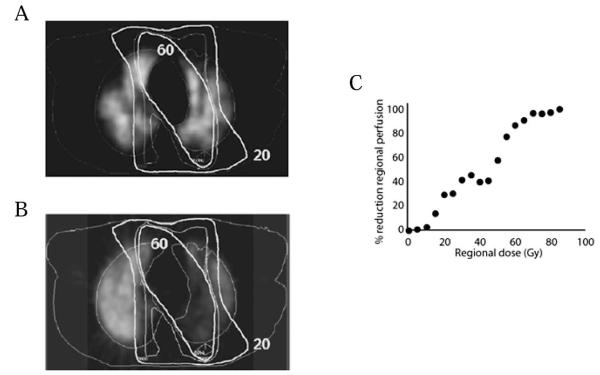
Shows the (panel A) pre- and (panel B) 6-month post-radiation therapy (RT) transverse SPECT perfusion images from an irradiated lung cancer patient. The RT dose distribution, relative to isodose contours, is also shown. Panel C shows the dose-response curve for RT-induced reductions in regional perfusion from the patient’s SPECT scans; post-RT perfusion defects are seen most predominantly within regions of the lung receiving >60 Gy. [Adapted from Kocak (102) with permission.]
FIG. 7
FIG. 7
Dose-dependent reductions in regional SPECT perfusion and ventilation, as well as increases in CT density in patients receiving lung irradiation. [Adapted from Marks (114) with permission; data from Netherlands Cancer Institute (109, 111, 112) and Duke (100, 113).]
FIG. 8
FIG. 8
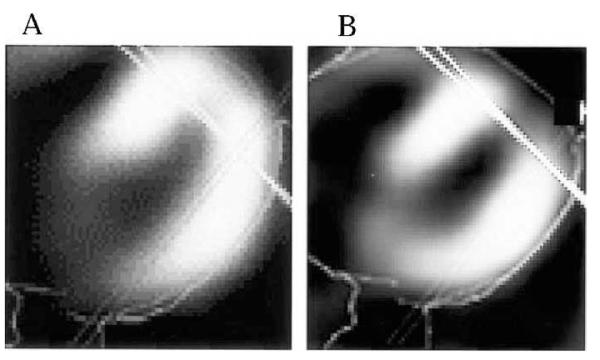
Cardiac SPECT scans showing representative axial images obtained (panel A) pre-RT and (panel B) post-RT. The deep tangent border is shown as the solid line. A new perfusion defect after irradiation is seen in the anterior left ventricle. [Adapted from Marks et al. (134) with permission.]

References

    1. Perez C, Brady LW. Principles and Practice of Radiation Oncology. Lippincott-Raven; Philadelphia: 2003.
    1. Jemal A, Siegel R, Xu J, Ward E. Cancer statistics. Ca. Cancer J. Clin. 2010;60:277–300. - PubMed
    1. Bentzen SM. Preventing or reducing late side effects of radiation therapy: radiobiology meets molecular pathology. Nat. Rev. Cancer. 2006;6:702–713. - PubMed
    1. Rubin P, Finkelstein J, Shapiro D. Molecular biology mechanisms in the radiation induction of pulmonary injury syndromes: Interrelationship between the alveolar macrophages and the septal fibroblast. Int. J. Radiat. Oncol. Biol. Phys. 1992;24:93–101. - PubMed
    1. Tofilon PJ, Fike JR. The radioresponse of the central nervous system: a dynamic process. Radiat. Res. 2000;153:357–370. - PubMed

Publication types

MeSH terms