


Differentiating maturational and training influences on fMRI activation during music processing
- PMID: 22348885
- PMCID: PMC3666326
- DOI: 10.1016/j.neuroimage.2012.01.138
Differentiating maturational and training influences on fMRI activation during music processing
Abstract
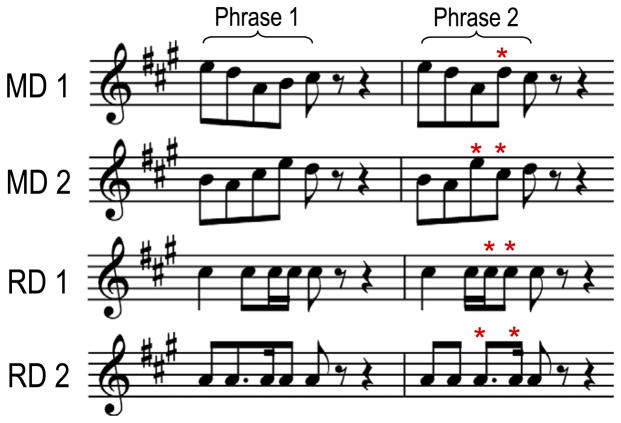
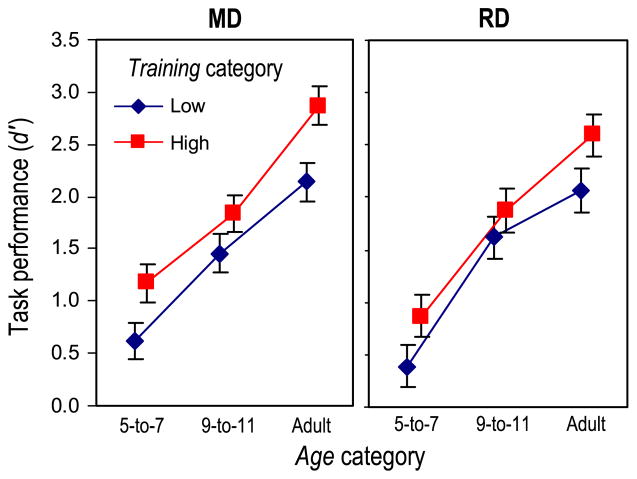
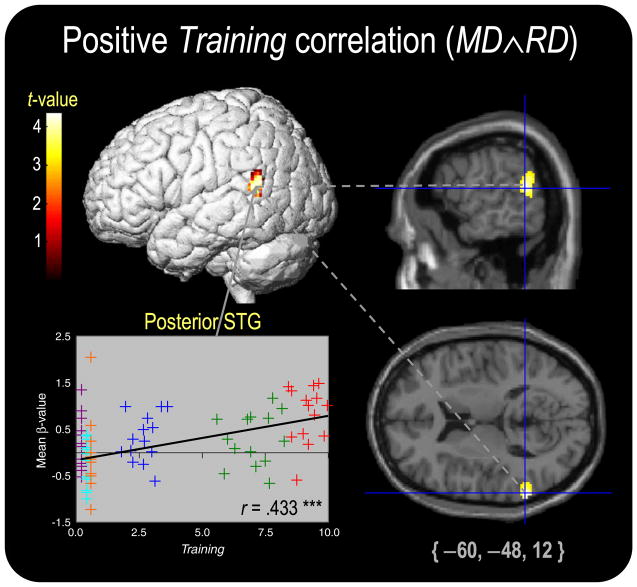
Two major influences on how the brain processes music are maturational development and active musical training. Previous functional neuroimaging studies investigating music processing have typically focused on either categorical differences between "musicians versus nonmusicians" or "children versus adults." In the present study, we explored a cross-sectional data set (n=84) using multiple linear regression to isolate the performance-independent effects of age (5 to 33 years) and cumulative duration of musical training (0 to 21,000 practice hours) on fMRI activation similarities and differences between melodic discrimination (MD) and rhythmic discrimination (RD). Age-related effects common to MD and RD were present in three left hemisphere regions: temporofrontal junction, ventral premotor cortex, and the inferior part of the intraparietal sulcus, regions involved in active attending to auditory rhythms, sensorimotor integration, and working memory transformations of pitch and rhythmic patterns. By contrast, training-related effects common to MD and RD were localized to the posterior portion of the left superior temporal gyrus/planum temporale, an area implicated in spectrotemporal pattern matching and auditory-motor coordinate transformations. A single cluster in right superior temporal gyrus showed significantly greater activation during MD than RD. This is the first fMRI which has distinguished maturational from training effects during music processing.
Copyright © 2012 Elsevier Inc. All rights reserved.
Figures


References
-
- Annett M. A classification of hand preference by association analysis. Br J Psychol. 1970;61 (3):303–321. - PubMed
-
- Baddeley A. Working memory: looking back and looking forward. Nat Rev Neurosci. 2003;4 (10):829–839. - PubMed
-
- Bangert M, Peschel T, Schlaug G, Rotte M, Drescher D, Hinrichs H, Heinze HJ, et al. Shared networks for auditory and motor processing in professional pianists: evidence from fMRI conjunction. NeuroImage. 2006;30 (3):917–926. - PubMed
-
- Bengtsson SL, Ehrsson HH, Forssberg H, Ullén F. Effector-independent voluntary timing: behavioural and neuroimaging evidence. Eur J Neurosci. 2005a;22 (12):3255–3265. - PubMed
-
- Bengtsson S, Nagy Z, Skare S, Forsman L, Forssberg H, Ullen F. Extensive piano practicing has regionally specific effects on white matter development. Nat Neurosci. 2005b;8 (9):1148–1150. - PubMed
Publication types
MeSH terms
Grants and funding
LinkOut - more resources
Full Text Sources
Medical
Miscellaneous
