. 2013 Jun;8(5):523-30.
doi: 10.1093/scan/nss027. Epub 2012 Feb 20.

Frontal theta and beta synchronizations for monetary reward increase visual working memory capacity

Affiliations

Frontal theta and beta synchronizations for monetary reward increase visual working memory capacity

Masahiro Kawasaki et al. Soc Cogn Affect Neurosci. 2013 Jun.

Abstract

Visual working memory (VWM) capacity is affected by motivational influences; however, little is known about how reward-related brain activities facilitate the VWM systems. To investigate the dynamic relationship between VWM- and reward-related brain activities, we conducted time-frequency analyses using electroencephalograph (EEG) data obtained during a monetary-incentive delayed-response task that required participants to memorize the position of colored disks. In case of a correct answer, participants received a monetary reward (0, 10 or 50 Japanese yen) announced at the beginning of each trial. Behavioral results showed that VWM capacity under high-reward condition significantly increased compared with that under low- or no-reward condition. EEG results showed that frontal theta (6 Hz) amplitudes enhanced during delay periods and positively correlated with VWM capacity, indicating involvement of theta local synchronizations in VWM. Moreover, frontal beta activities (24 Hz) were identified as reward-related activities, because delay-period amplitudes correlated with increases in VWM capacity between high-reward and no-reward conditions. Interestingly, cross-frequency couplings between frontal theta and beta phases were observed only under high-reward conditions. These findings suggest that the functional dynamic linking between VWM-related theta and reward-related beta activities on the frontal regions plays an integral role in facilitating increases in VWM capacity.

Keywords: beta; frontal; motivation; theta; visual working memory.


Figures
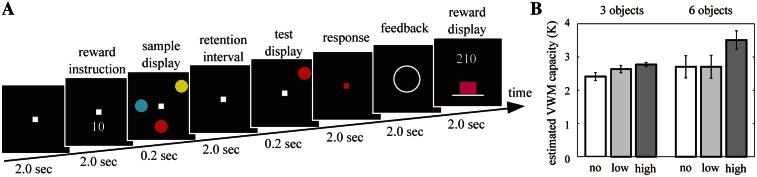
Fig. 1
Fig. 1
(A) Schematic illustration of one trial sequence for the VWM tasks. At the beginning of each trial, the reward value (0, 10 or 50 Japanese yen) was presented in the reward instruction period. This task required the participants to memorize the colors of three or six disks in the sample display, maintain them for the 2-s retention interval, and judge whether a single probe disk in the test display matched one sample disk in the same location. After the judgment, the feedback stimulus, which indicated whether the answer was correct (O) or false (X), was presented, and the total reward was then presented as the purple bar graph. (B) The estimated VWM capacity under conditions of the different numbers of objects (three or six) and reward values (0, 10 or 50). Error bars depict the standard error of the mean.
Fig. 2
Fig. 2
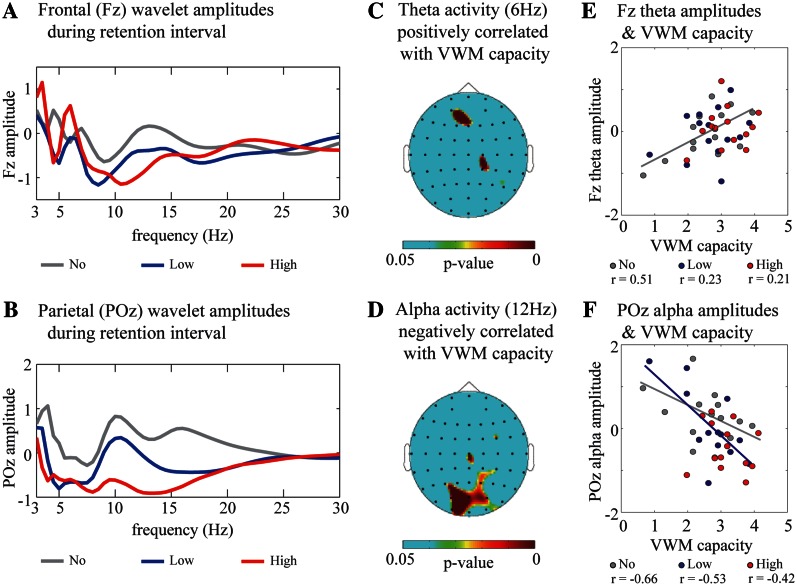
(A and B) Subject-averaged (N = 14) and time-averaged (2-s retention interval) frequency amplitudes under the no- (gray), low- (blue) and high- (red) reward conditions on the frontal (A, Fz electrode) and parietal (B, POz electrode) regions. These values, normalized with respect to the ITI baseline, were averaged across correct trials of all participants. (C and D) Topographic colored scalp maps of the P-values for the theta (C, 6 Hz) and alpha (D, 12 Hz) delay-period amplitudes that were significantly correlated with VWM capacity. (E and F) Scatter plot of VWM capacity and the Fz theta amplitudes (E) and POz alpha amplitudes (F) under the no- (gray), low- (blue) and high- (red) reward conditions, by averaging across VWM load (three and six objects).
Fig. 3
Fig. 3
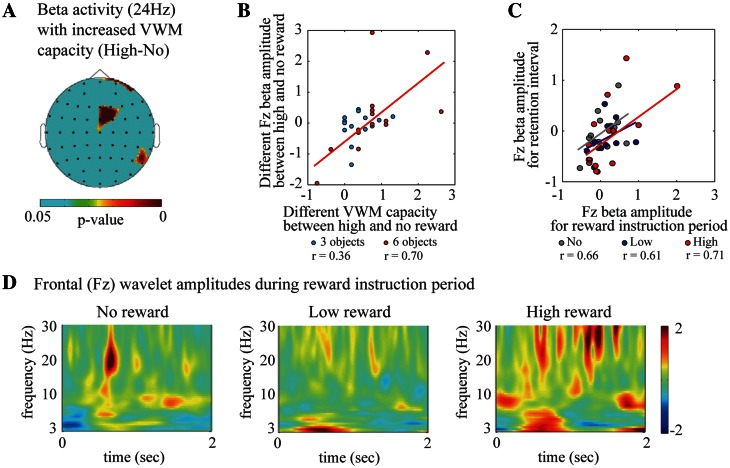
(A) The topographic colored scalp maps of the P-values for the beta delay-period amplitudes, which were significantly correlated with increasing VWM capacity under the high-value compared with no-reward conditions. (B) A scatter plot of VWM capacity difference against Fz beta amplitude differences under the high-value and no-reward conditions when three (cyan) or six objects (red) were presented in the sample display. (C) A scatter plot of the Fz beta amplitude between the reward instruction period and the retention interval under the no- (gray), low- (blue) and high- (red) reward conditions by averaging across VWM load (three and six objects). (D) Subject-averaged time–frequency amplitudes during the reward instruction periods under the no- (left), low- (center) and high-reward (right) conditions on the Fz electrode.
Fig. 4
Fig. 4
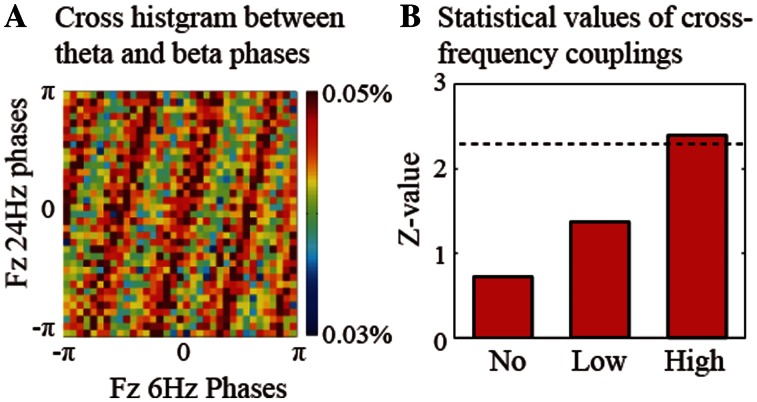
(A) Cross histogram of the probability distributions between the theta (6 Hz) and beta (24 Hz) phases during the retention interval. (B) Z-values of the cross-frequency PSI between the theta and beta phases at Fz during the retention interval. The dotted line denotes the threshold value (P < 0.01).

References

    1. Adcock RA, Thangavel A, Whitfield-Gabrieli S, Knutson B, Gabrieli JD. Reward-motivated learning: mesolimbic activation precedes memory formation. Neuron. 2006;50:507–17. - PubMed
    1. Alexander WH, Brown. JW. Computational models of performance monitoring and cognitive control. Topics in Cognitive Science. 2010;2:658–77. - PMC - PubMed
    1. Alexander WH, Brown JW. Medial prefrontal cortex as an action-outcome predictor. Nature Neuroscience. 2011;14:1338–44. - PMC - PubMed
    1. Beck SM, Locke HS, Savine AC, Jimura K, Braver TS. Primary and secondary rewards differentially modulate neural activity dynamics during working memory. PLoS One. 2010;5(2):e9251. - PMC - PubMed
    1. Bressler SL, Coppola R, Nakamura R. Episodic multiregional cortical coherence at multiple frequencies during visual task performance. Nature. 1993;366:153–6. - PubMed