


Effect of patient- and medication-related factors on inpatient medication reconciliation errors
- PMID: 22350761
- PMCID: PMC3403136
- DOI: 10.1007/s11606-012-2003-y
Effect of patient- and medication-related factors on inpatient medication reconciliation errors
Erratum in
-
Erratum to: effect of patient- and medication-related factors on inpatient medication reconciliation errors.J Gen Intern Med. 2012 Oct;27(10):1393. doi: 10.1007/s11606-012-2149-7. J Gen Intern Med. 2012. PMID: 22836952 Free PMC article. No abstract available.
Abstract
Background: Little research has examined the incidence, clinical relevance, and predictors of medication reconciliation errors at hospital admission and discharge.
Objective: To identify patient- and medication-related factors that contribute to pre-admission medication list (PAML) errors and admission order errors, and to test whether such errors persist in the discharge medication list.
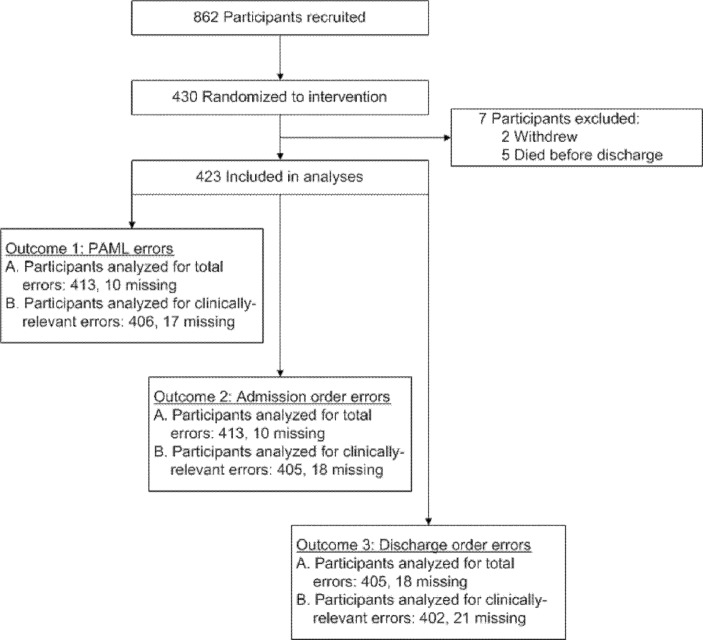
Design, participants: We conducted a cross-sectional analysis of 423 adults with acute coronary syndromes or acute decompensated heart failure admitted to two academic hospitals who received pharmacist-assisted medication reconciliation during the Pharmacist Intervention for Low Literacy in Cardiovascular Disease (PILL-CVD) Study.
Main measures: Pharmacists assessed the number of total and clinically relevant errors in the PAML and admission and discharge medication orders. We used negative binomial regression and report incidence rate ratios (IRR) of predictors of reconciliation errors.
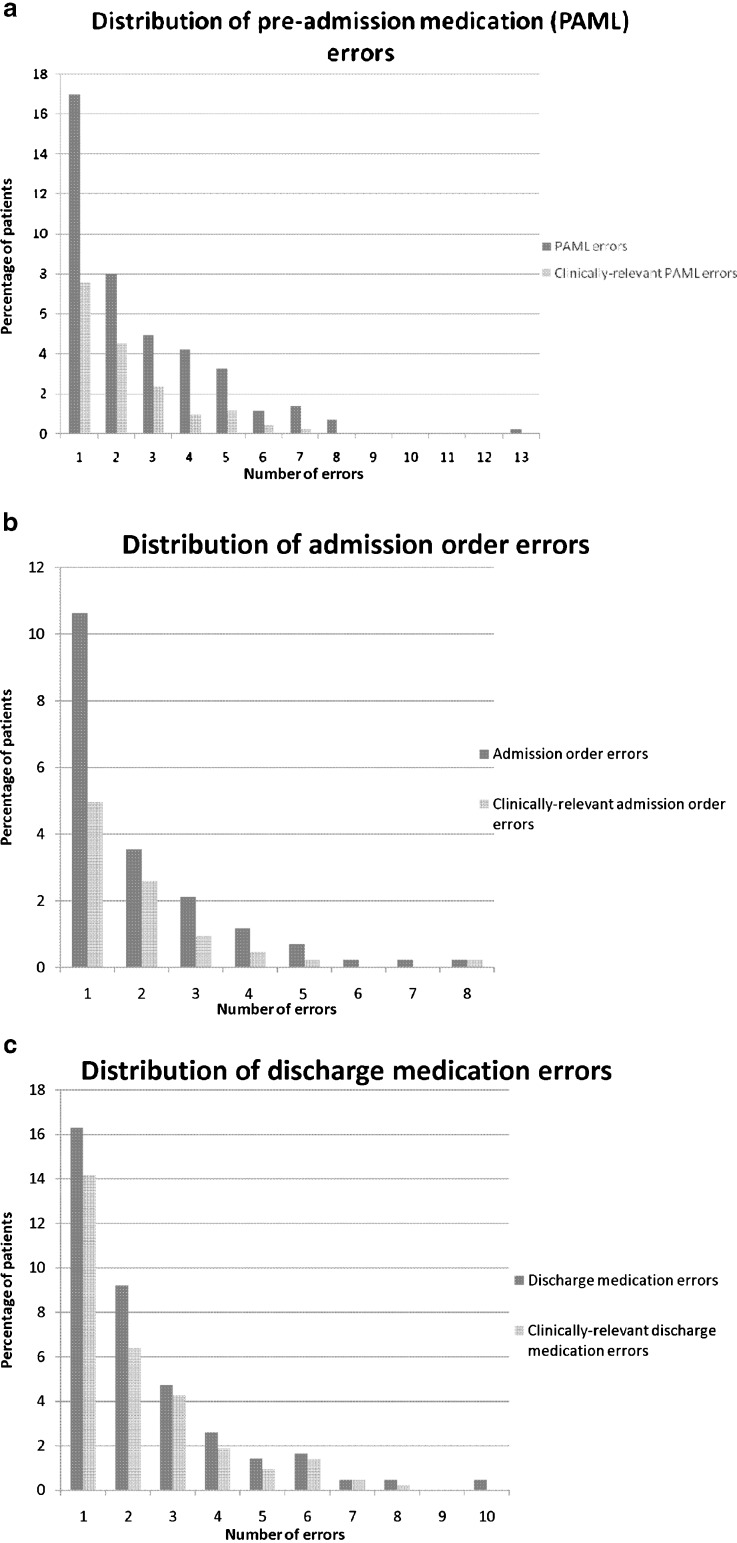
Key results: On admission, 174 of 413 patients (42%) had ≥1 PAML error, and 73 (18%) had ≥1 clinically relevant PAML error. At discharge, 158 of 405 patients (39%) had ≥1 discharge medication error, and 126 (31%) had ≥1 clinically relevant discharge medication error. Clinically relevant PAML errors were associated with older age (IRR = 1.46; 95% CI, 1.00- 2.12) and number of pre-admission medications (IRR = 1.17; 95% CI, 1.10-1.25), and were less likely when a recent medication list was present in the electronic medical record (EMR) (IRR = 0.54; 95% CI, 0.30-0.96). Clinically relevant admission order errors were also associated with older age and number of pre-admission medications. Clinically relevant discharge medication errors were more likely for every PAML error (IRR = 1.31; 95% CI, 1.19-1.45) and number of medications changed prior to discharge (IRR = 1.06; 95% CI, 1.01-1.11).
Conclusions: Medication reconciliation errors are common at hospital admission and discharge. Errors in preadmission medication histories are associated with older age and number of medications and lead to more discharge reconciliation errors. A recent medication list in the EMR is protective against medication reconciliation errors.
Figures
References
-
- Wong JD, Bajcar JM, Wong GG, et al. Medication reconciliation at hospital discharge: evaluating discrepancies. Ann Pharmacother. 2008;42(10):1373–9. - PubMed
-
- Rogers G, Alper E, Brunelle D, et al. Reconciling medications at admission: safe practice recommendations and implementation strategies. Jt Comm J Qual Patient Saf. 2006;32(1):37–50. - PubMed
Publication types
MeSH terms
Grants and funding
LinkOut - more resources
Full Text Sources
Medical
