


An ovary transcriptome for all maturational stages of the striped bass (Morone saxatilis), a highly advanced perciform fish
- PMID: 22353237
- PMCID: PMC3305648
- DOI: 10.1186/1756-0500-5-111
An ovary transcriptome for all maturational stages of the striped bass (Morone saxatilis), a highly advanced perciform fish
Abstract
Background: The striped bass and its relatives (genus Morone) are important fisheries and aquaculture species native to estuaries and rivers of the Atlantic coast and Gulf of Mexico in North America. To open avenues of gene expression research on reproduction and breeding of striped bass, we generated a collection of expressed sequence tags (ESTs) from a complementary DNA (cDNA) library representative of their ovarian transcriptome.
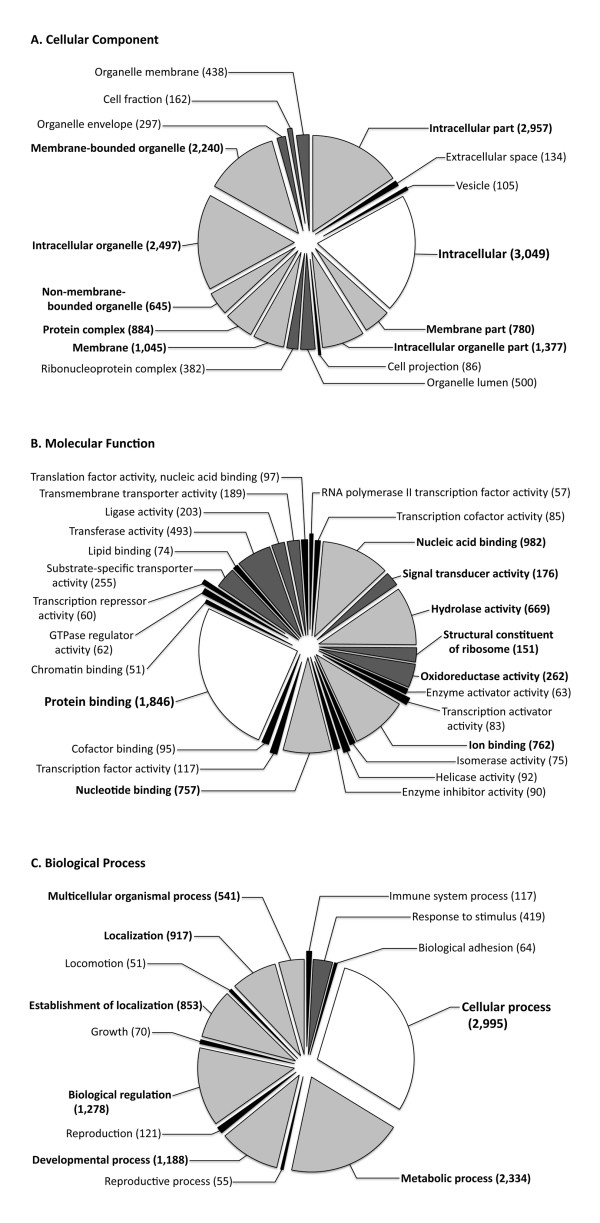
Results: Sequences of a total of 230,151 ESTs (51,259,448 bp) were acquired by Roche 454 pyrosequencing of cDNA pooled from ovarian tissues obtained at all stages of oocyte growth, at ovulation (eggs), and during preovulatory atresia. Quality filtering of ESTs allowed assembly of 11,208 high-quality contigs ≥ 100 bp, including 2,984 contigs 500 bp or longer (average length 895 bp). Blastx comparisons revealed 5,482 gene orthologues (E-value < 10-3), of which 4,120 (36.7% of total contigs) were annotated with Gene Ontology terms (E-value < 10-6). There were 5,726 remaining unknown unique sequences (51.1% of total contigs). All of the high-quality EST sequences are available in the National Center for Biotechnology Information (NCBI) Short Read Archive (GenBank: SRX007394). Informative contigs were considered to be abundant if they were assembled from groups of ESTs comprising ≥ 0.15% of the total short read sequences (≥ 345 reads/contig). Approximately 52.5% of these abundant contigs were predicted to have predominant ovary expression through digital differential display in silico comparisons to zebrafish (Danio rerio) UniGene orthologues. Over 1,300 Gene Ontology terms from Biological Process classes of Reproduction, Reproductive process, and Developmental process were assigned to this collection of annotated contigs.
Conclusions: This first large reference sequence database available for the ecologically and economically important temperate basses (genus Morone) provides a foundation for gene expression studies in these species. The predicted predominance of ovary gene expression and assignment of directly relevant Gene Ontology classes suggests a powerful utility of this dataset for analysis of ovarian gene expression related to fundamental questions of oogenesis. Additionally, a high definition Agilent 60-mer oligo ovary 'UniClone' microarray with 8 × 15,000 probe format has been designed based on this striped bass transcriptome (eArray Group: Striper Group, Design ID: 029004).
Figures
References
-
- Garber AF, Sullivan CV. Selective breeding for the hybrid striped bass (Morone chrysops, Rafinesque x M. saxatilis, Walbaum) industry: status and perspectives. Aquacult Res. 2006;37:319–338.
-
- Richards RA, Rago PJ. A case history of effective fishery management: Chesapeake Bay striped bass. N Am J Fish Manage. 1999;19:356–375.
-
- Couch CR, Garber AF, Rexroad CE III, Abrams JM, Stannard JA, Westerman ME, Sullivan CV. Isolation and characterization of 149 novel microsatellite DNA markers for striped bass, Morone saxatilis, and cross-species amplification in white bass, M. chrysops, and their hybrid. Mol Ecol Notes. 2006;6:667–669.
-
- Rexroad CE III, Vallejo R, Coulibaly I, Westerman ME, Sullivan CV. Identification and characterization of microsatellites for striped bass from repeat-enriched libraries. Conserv Genet. 2006;7:971–982.
-
- Liu S, Rexroad CE, III, Couch CR, Cordes J, Reece K, Sullivan CV. A microsatellite linkage map of striped bass (Morone saxatilis) reveals conserved synteny with the three-spined stickleback (Gasterosteus aculeatus) Mar Biotechnol. in press doi: 10.1007/s10126-011-9407-2. - PubMed
Publication types
MeSH terms
Substances
LinkOut - more resources
Full Text Sources
Research Materials
Miscellaneous
