Review
. 2012 Feb;7(2):222-6.
doi: 10.4161/psb.18765. Epub 2012 Feb 1.

Plant communication: mediated by individual or blended VOCs?

Affiliations
Review

Plant communication: mediated by individual or blended VOCs?

Hirokazu Ueda et al. Plant Signal Behav. 2012 Feb.

Abstract

Plants emit volatile organic compounds (VOCs) as a means to warn other plants of impending danger. Nearby plants exposed to the induced VOCs prepare their own defense weapons in response. Accumulated data supports this assertion, yet much of the evidence has been obtained in laboratories under artificial conditions where, for example, a single VOC might be applied at a concentration that plants do not actually experience in nature. Experiments conducted outdoors suggest that communication occurs only within a limited distance from the damaged plants. Thus, the question remains as to whether VOCs work as a single component or a specific blend, and at which concentrations VOCs elicit insect and pathogen defenses in undamaged plants. We discuss these issues based on available literature and our recent work, and propose future directions in this field.


Figures
None
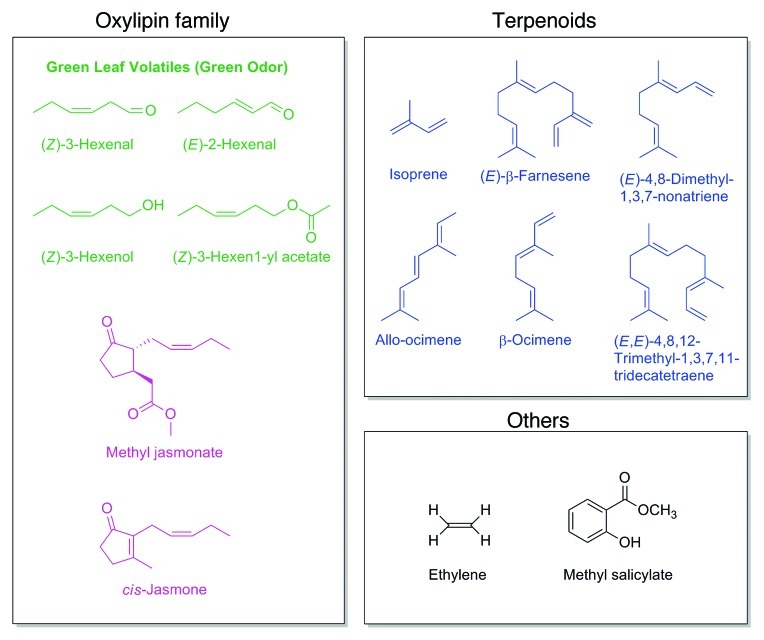
Figure 1. VOCs used for different messages in plant-plant communications. Classified by oxylipin family, terpenoids and others.
None
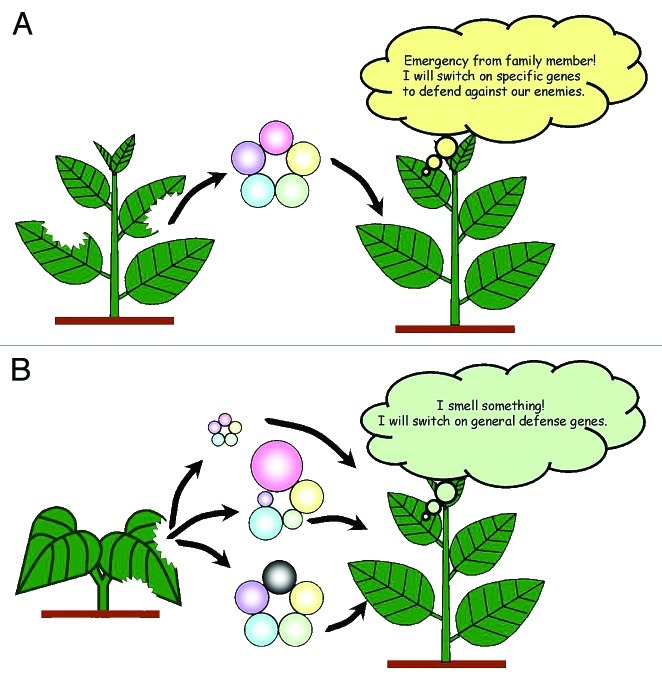
Figure 2. VOCs emitted by injured plants have a specific ratio and concentration of components. Upon receiving a VOC message from their family, plants respond by inducing a particular defense mechanism. For example, the plant might prepare specific secondary metabolites for defense against herbivores (A). The danger signals emitted by the family provide warning that a species-specific enemy (specialist) is nearby. In contrast, plants that receive a VOC message from other families might elicit a general defense response to prevent damage by herbivores (generalists) attacking various plant species (B). By sharing common VOC information across the plant kingdom, plants are able to prevent attack from a broad range of herbivores.

References

    1. Vickers CE, Gershenzon J, Lerdau MT, Loreto F. A unified mechanism of action for volatile isoprenoids in plant abiotic stress. Nat Chem Biol. 2009;5:283–91. doi: 10.1038/nchembio.158. - DOI - PubMed
    1. Heil M, Silva Bueno JC. Within-plant signaling by volatiles leads to induction and priming of an indirect plant defense in nature. Proc Natl Acad Sci U S A. 2007;104:5467–72. doi: 10.1073/pnas.0610266104. - DOI - PMC - PubMed
    1. Baldwin IT, Halitschke R, Paschold A, von Dahl CC, Preston CA. Volatile signaling in plant-plant interactions: “talking trees” in the genomics era. Science. 2006;311:812–5. doi: 10.1126/science.1118446. - DOI - PubMed
    1. Ton J, D’Alessandro M, Jourdie V, Jakab G, Karlen D, Held M, et al. Priming by airborne signals boosts direct and indirect resistance in maize. Plant J. 2007;49:16–26. doi: 10.1111/j.1365-313X.2006.02935.x. - DOI - PubMed
    1. Dudareva N, Negre F, Nagegowda DA, Orlova I. Plant volatiles: recent advances and future perspectives. Crit Rev Plant Sci. 2006;25:417–40. doi: 10.1080/07352680600899973. - DOI

Publication types

Substances

LinkOut - more resources