Comment
. 2012 Mar;122(3):810-3.
doi: 10.1172/JCI62588. Epub 2012 Feb 22.

Popeye proteins: muscle for the aging sinus node

Affiliations
Comment

Popeye proteins: muscle for the aging sinus node

Bastiaan J Boukens et al. J Clin Invest. 2012 Mar.

Abstract

The electrical impulses that dictate the rhythm of the heartbeat in normal situations and during exercise or stress are initiated by a small number of sinus node pacemaker cells. Senescence and dysfunction of the sinus node affects many people later in life, causing physiologically inappropriate heart rates, but the underlying mechanisms are not well understood. In this issue of the JCI, Froese and colleagues show that deficiency in either Popeye domain containing 1 (Popdc1) or Popdc2 leads to sinus node dysfunction under stressed conditions in aged mice. The mechanism reported to underlie the effects of Popdc1/2 deficiency in mice may cause the stress-induced sinus node dysfunction found in many aged individuals and may point to new strategies for therapeutic intervention.


Figures
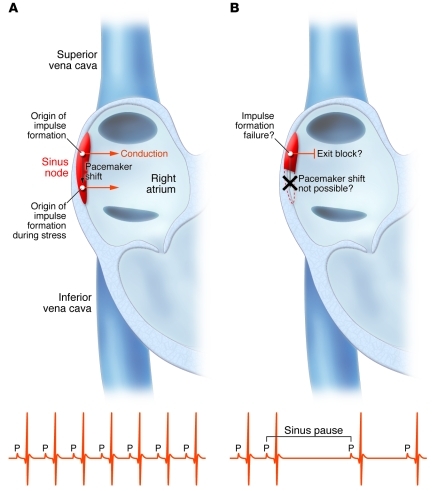
Figure 1
Figure 1. Possible explanations for stress-induced sinus dysfunction in mice mutant for either Popdc1 or Popdc2.
(A) Wild-type sinus node and atrium. The origin of electrical impulse activation shifts upon stimulation of the β-adrenergic receptor to the inferior part of the sinus node. An electrocardiogram with normal activation of the atria is also shown. Note that the PP interval is regular. (B) Sinus node and atrium from a mouse mutant for either Popdc1 or Popdc2. The origin of electrical impulse activation cannot shift to the inferior part of the sinus node, because this part is absent. Furthermore, the sinus node has reduced in size, which may cause exit block or failure of impulse formation. An electrocardiogram during sinus node exit block or failure of impulse formation is also shown. Note that failure of atrial activation leads to an increase in PP interval (a so-called sinus pause).
Figure 2
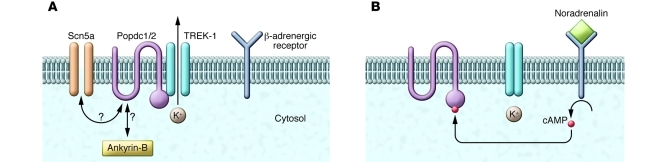
Figure 2. Mechanism of modifying TREK-1 current in rest and during stress.
(A) Mechanism by which Popdc1 and Popdc2 induce a TREK-1 outward current in resting conditions, as suggested by the work of Froese and colleagues (8). Note that we believe it is possible that Popdc1 and Popdc2 also interact with Scn5a or Ankyrin-B. (B) Increased levels of cAMP induced by β-adrenergic receptor stimulation cause Popdc1 or Popdc2 to release TREK-1, resulting in inhibition of the TREK-1 outward current. This mechanism is absent in mice mutant for either Popdc1 or Popdc2, and therefore TREK-1 current is chronically reduced.

Comment on

  • Popeye domain containing proteins are essential for stress-mediated modulation of cardiac pacemaking in mice.
    Froese A, Breher SS, Waldeyer C, Schindler RF, Nikolaev VO, Rinné S, Wischmeyer E, Schlueter J, Becher J, Simrick S, Vauti F, Kuhtz J, Meister P, Kreissl S, Torlopp A, Liebig SK, Laakmann S, Müller TD, Neumann J, Stieber J, Ludwig A, Maier SK, Decher N, Arnold HH, Kirchhof P, Fabritz L, Brand T. Froese A, et al. J Clin Invest. 2012 Mar;122(3):1119-30. doi: 10.1172/JCI59410. Epub 2012 Feb 22. J Clin Invest. 2012. PMID: 22354168 Free PMC article.

References

    1. Keith A, Flack M. The form and nature of the muscular connections between the primary divisions of the vertebrate heart. J Anat Physiol. 1907;41(pt 3):172–189. - PMC - PubMed
    1. Christoffels VM, Smits GJ, Kispert A, Moorman AF. Development of the pacemaker tissues of the heart. Circ Res. 2010;106(2):240–254. doi: 10.1161/CIRCRESAHA.109.205419. - DOI - PubMed
    1. Boyett MR, Honjo H, Kodama I. The sinoatrial node, a heterogeneous pacemaker structure. Cardiovasc Res. 2000;47(4):658–687. doi: 10.1016/S0008-6363(00)00135-8. - DOI - PubMed
    1. Joyner RW, van Capelle FJL. Propagation through electrically coupled cells. How a small SA node drives a large atrium. Biophys J. 1986;50(6):1157–1164. doi: 10.1016/S0006-3495(86)83559-7. - DOI - PMC - PubMed
    1. Mond HG, Proclemer A. The 11th world survey of cardiac pacing and implantable cardioverter-defibrillators: calendar year 2009--a World Society of Arrhythmia’s project. Pacing Clin Electrophysiol. 2011;34(8):1013–1027. doi: 10.1111/j.1540-8159.2011.03150.x. - DOI - PubMed

Publication types

MeSH terms

Substances