


Review
doi: 10.2337/db11-1120.
Chelation: a fundamental mechanism of action of AGE inhibitors, AGE breakers, and other inhibitors of diabetes complications
Affiliations
- PMID: 22354928
- PMCID: PMC3282805
- DOI: 10.2337/db11-1120
Item in Clipboard
Review
Chelation: a fundamental mechanism of action of AGE inhibitors, AGE breakers, and other inhibitors of diabetes complications
Diabetes.
2012 Mar.
Abstract
This article outlines evidence that advanced glycation end product (AGE) inhibitors and breakers act primarily as chelators, inhibiting metal-catalyzed oxidation reactions that catalyze AGE formation. We then present evidence that chelation is the most likely mechanism by which ACE inhibitors, angiotensin receptor blockers, and aldose reductase inhibitors inhibit AGE formation in diabetes. Finally, we note several recent studies demonstrating therapeutic benefits of chelators for diabetic cardiovascular and renal disease. We conclude that chronic, low-dose chelation therapy deserves serious consideration as a clinical tool for prevention and treatment of diabetes complications.
Figures
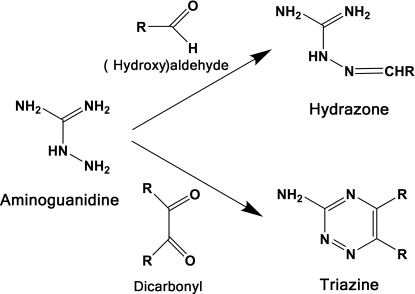
Proposed mechanisms of action of aminoguanidine as a carbonyl and dicarbonyl trap. At the top, aminoguanidine reacts with carbonyl or α-hydroxycarbonyl sugars or intermediates to form a hydrazone. At the bottom, aminoguanidine reacts with a dicarbonyl compound to form a triazine.
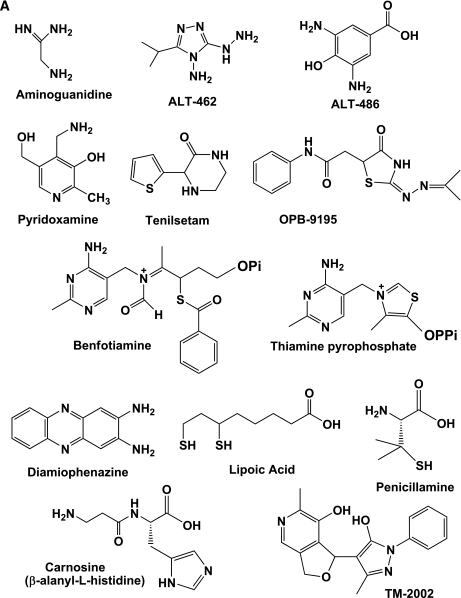
Structures of AGE inhibitors. A: First-generation AGE inhibitors. B: Novel LR compounds (adapted from Rahbar and Figarola [18]).
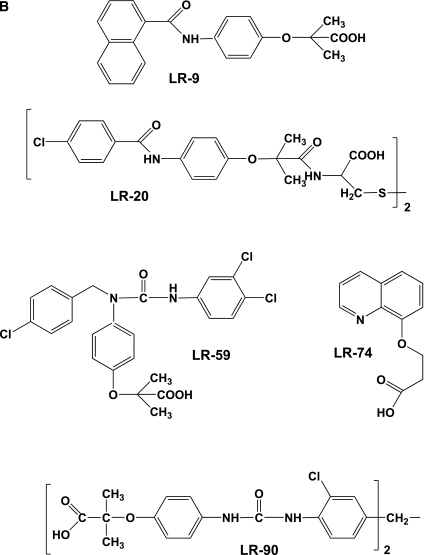
Structures of AGE inhibitors. A: First-generation AGE inhibitors. B: Novel LR compounds (adapted from Rahbar and Figarola [18]).
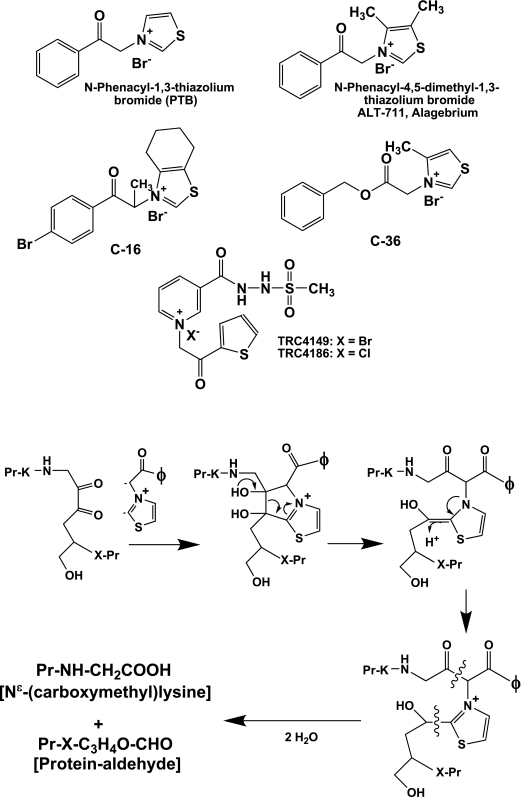
Structures (top panel) and proposed mechanism of action (bottom panel) of AGE breakers. According to this scheme, the dinucleophilic AGE breaker adds across a dicarbonyl AGE cross-link, followed by an internal rearrangement to cleave the dicarbonyl bond, breaking the cross-link. Following hydrolysis, the AGE breaker is regenerated, leaving a chemically inert CML on one peptide and a chemically reactive aldehyde functional group on the other peptide involved in the cross-link. (Adapted from Vasan et al. [33].)
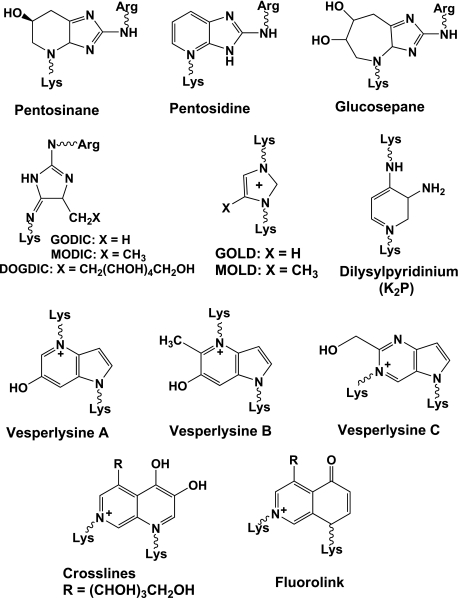
Structures of AGE cross-links identified in tissue proteins. Lys-Arg cross-links are shown in the top panel and Lys-Lys cross-links in the lower panel. Compounds with two or three carbon cross-links, e.g., GODIC, MODIC, GOLD, MOLD, and K2P, may be derived from both carbohydrates and lipids, i.e., they are AGE/ALEs. All of these compounds are considered to be irreversible AGE cross-links in proteins. Pentosidine, the vesperlysines, crosslines, and fluorolink are fluorescent and contribute to the increase in yellow-brown color and fluorescence of collagen in diabetes and aging. GODIC, glyoxal-derived imidazolium cross-link; MODIC, methylglyoxal-derived imidazolium cross-link; GOLD, glyoxal-lysine dimer; MOLD, methylglyoxal-lysine dimer.
References
-
- Goh SY, Cooper ME. Clinical review: the role of advanced glycation end products in progression and complications of diabetes. J Clin Endocrinol Metab 2008;93:1143–1152 - PubMed
-
- Tessier FJ. The Maillard reaction in the human body. The main discoveries and factors that affect glycation. Pathol Biol (Paris) 2010;58:214–219 - PubMed
-
- Baynes JW. Role of oxidative stress in development of complications in diabetes. Diabetes 1991;40:405–412 - PubMed
-
- Reddy VP, Beyaz A. Inhibitors of the Maillard reaction and AGE breakers as therapeutics for multiple diseases. Drug Discov Today 2006;11:646–654 - PubMed
-
- Peyroux J, Sternberg M. Advanced glycation endproducts (AGEs): pharmacological inhibition in diabetes. Pathol Biol (Paris) 2006;54:405–419 - PubMed
Publication types
MeSH terms
Substances
Grants and funding
LinkOut - more resources
Full Text Sources
Other Literature Sources
Medical
Miscellaneous
