Comparative genomics of enterococci: variation in Enterococcus faecalis, clade structure in E. faecium, and defining characteristics of E. gallinarum and E. casseliflavus
- PMID: 22354958
- PMCID: PMC3374389
- DOI: 10.1128/mBio.00318-11
Comparative genomics of enterococci: variation in Enterococcus faecalis, clade structure in E. faecium, and defining characteristics of E. gallinarum and E. casseliflavus
Abstract
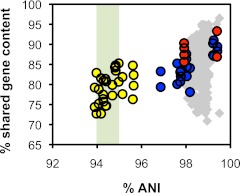
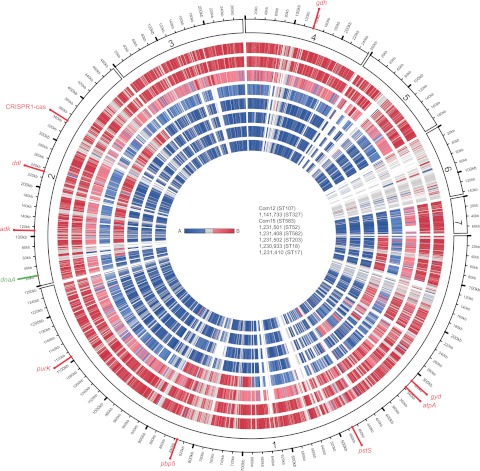
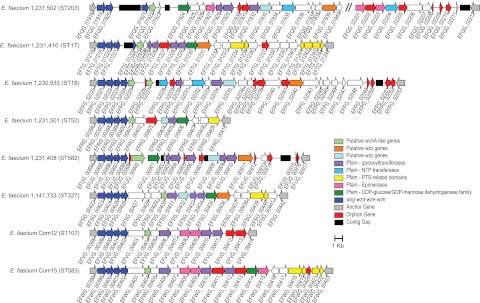
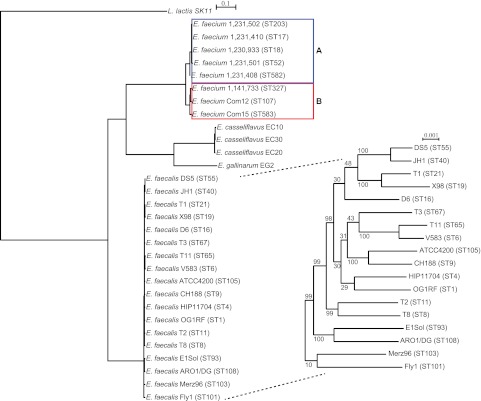
The enterococci are Gram-positive lactic acid bacteria that inhabit the gastrointestinal tracts of diverse hosts. However, Enterococcus faecium and E. faecalis have emerged as leading causes of multidrug-resistant hospital-acquired infections. The mechanism by which a well-adapted commensal evolved into a hospital pathogen is poorly understood. In this study, we examined high-quality draft genome data for evidence of key events in the evolution of the leading causes of enterococcal infections, including E. faecalis, E. faecium, E. casseliflavus, and E. gallinarum. We characterized two clades within what is currently classified as E. faecium and identified traits characteristic of each, including variation in operons for cell wall carbohydrate and putative capsule biosynthesis. We examined the extent of recombination between the two E. faecium clades and identified two strains with mosaic genomes. We determined the underlying genetics for the defining characteristics of the motile enterococci E. casseliflavus and E. gallinarum. Further, we identified species-specific traits that could be used to advance the detection of medically relevant enterococci and their identification to the species level.
Figures
Similar articles
-
Comparative analysis of genetic diversity and incidence of virulence factors and antibiotic resistance among enterococcal populations from raw fruit and vegetable foods, water and soil, and clinical samples.Int J Food Microbiol. 2008 Mar 31;123(1-2):38-49. doi: 10.1016/j.ijfoodmicro.2007.11.067. Epub 2007 Dec 4. Int J Food Microbiol. 2008. PMID: 18180067
-
Comparative genomics of Enterococcus spp. isolated from bovine feces.BMC Microbiol. 2017 Mar 8;17(1):52. doi: 10.1186/s12866-017-0962-1. BMC Microbiol. 2017. PMID: 28270110 Free PMC article.
-
Species, antibiotic susceptibility profiles and van gene frequencies among enterococci isolated from patients at Mulago National Referral Hospital in Kampala, Uganda.BMC Infect Dis. 2019 May 31;19(1):486. doi: 10.1186/s12879-019-4136-7. BMC Infect Dis. 2019. PMID: 31151413 Free PMC article.
-
Pathogenesis and immunity in enterococcal infections.Clin Microbiol Infect. 2010 Jun;16(6):533-40. doi: 10.1111/j.1469-0691.2010.03213.x. Clin Microbiol Infect. 2010. PMID: 20569264 Review.
-
Clinical management of non-faecium non-faecalis vancomycin-resistant enterococci infection. Focus on Enterococcus gallinarum and Enterococcus casseliflavus/flavescens.J Infect Chemother. 2018 Apr;24(4):237-246. doi: 10.1016/j.jiac.2018.01.001. Epub 2018 Feb 1. J Infect Chemother. 2018. PMID: 29396199 Review.
Cited by
-
Genomic Features and Niche-Adaptation of Enterococcus faecium Strains from Korean Soybean-Fermented Foods.PLoS One. 2016 Apr 12;11(4):e0153279. doi: 10.1371/journal.pone.0153279. eCollection 2016. PLoS One. 2016. PMID: 27070419 Free PMC article.
-
Bipartite rgp Locus Diversity in Streptococcus thermophilus Corresponds to Backbone and Side Chain Differences of Its Rhamnose-Containing Cell Wall Polysaccharide.Appl Environ Microbiol. 2022 Dec 13;88(23):e0150422. doi: 10.1128/aem.01504-22. Epub 2022 Nov 9. Appl Environ Microbiol. 2022. PMID: 36350137 Free PMC article.
-
Genomic insights to control the emergence of vancomycin-resistant enterococci.mBio. 2013 Aug 13;4(4):e00412-13. doi: 10.1128/mBio.00412-13. mBio. 2013. PMID: 23943759 Free PMC article.
-
Safety of the surrogate microorganism Enterococcus faecium NRRL B-2354 for use in thermal process validation.Appl Environ Microbiol. 2014 Mar;80(6):1899-909. doi: 10.1128/AEM.03859-13. Epub 2014 Jan 10. Appl Environ Microbiol. 2014. PMID: 24413604 Free PMC article.
-
Enterococcal Linear Plasmids Adapt to Enterococcus faecium and Spread within Multidrug-Resistant Clades.Antimicrob Agents Chemother. 2023 Apr 18;67(4):e0161922. doi: 10.1128/aac.01619-22. Epub 2023 Mar 28. Antimicrob Agents Chemother. 2023. PMID: 36975786 Free PMC article.
References
-
- Aarestrup FM, Butaye P, Witte W. 2002. Nonhuman reservoirs of enterococci, p 55–99 In Gilmore MS, The enterococci: pathogenesis, molecular biology, and antibiotic resistance. ASM Press, Washington, DC
-
- Malani PN, Kauffman CA, Zervos MJ. 2002. Enterococcal disease, epidemiology, and treatment, p 385–408 In Gilmore MS, The enterococci: pathogenesis, molecular biology, and antibiotic resistance. ASM Press, Washington, DC
-
- Tannock GW, Cook G. 2002. Enterococci as members of the intestinal microflora of humans, p 101–132 In Gilmore MS, The enterococci: pathogenesis, molecular biology, and antibiotic resistance. ASM Press, Washington, DC
-
- Paulsen IT, et al. 2003. Role of mobile DNA in the evolution of vancomycin-resistant Enterococcus faecalis. Science 299:2071–2074 - PubMed
Publication types
MeSH terms
Substances
Grants and funding
LinkOut - more resources
Full Text Sources
Other Literature Sources
Molecular Biology Databases