


Altered replication in human cells promotes DMPK (CTG)(n) · (CAG)(n) repeat instability
- PMID: 22354993
- PMCID: PMC3347245
- DOI: 10.1128/MCB.06727-11
Altered replication in human cells promotes DMPK (CTG)(n) · (CAG)(n) repeat instability
Abstract
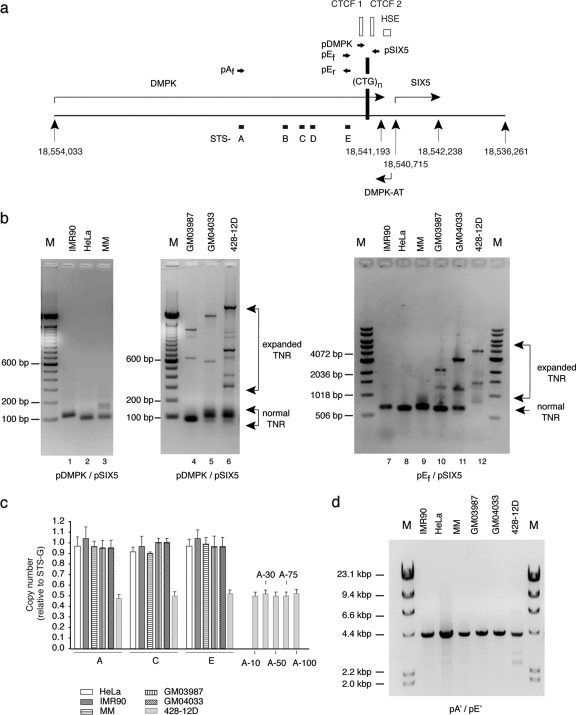
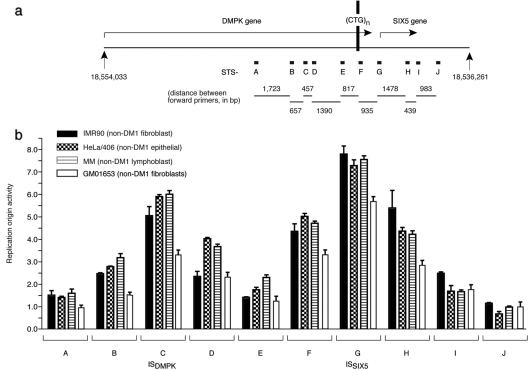
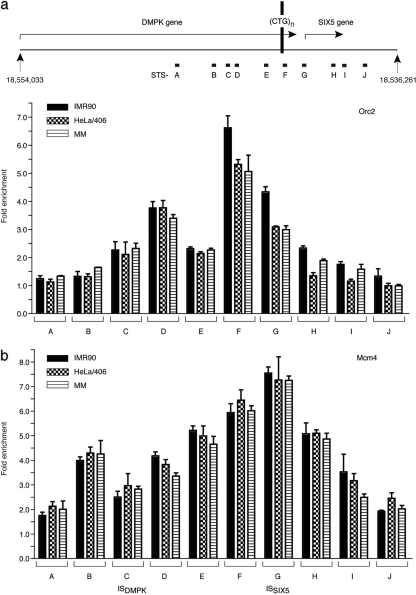
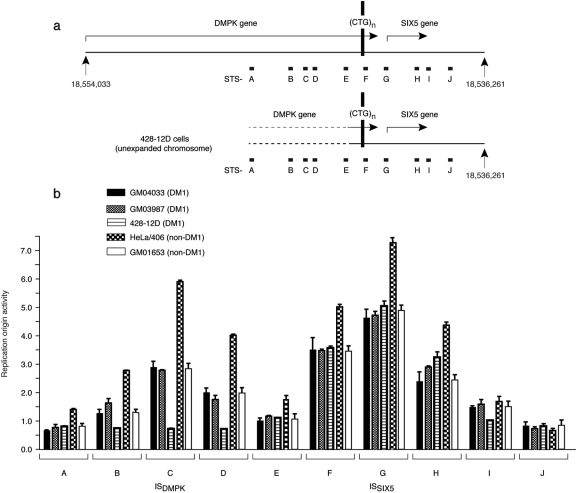
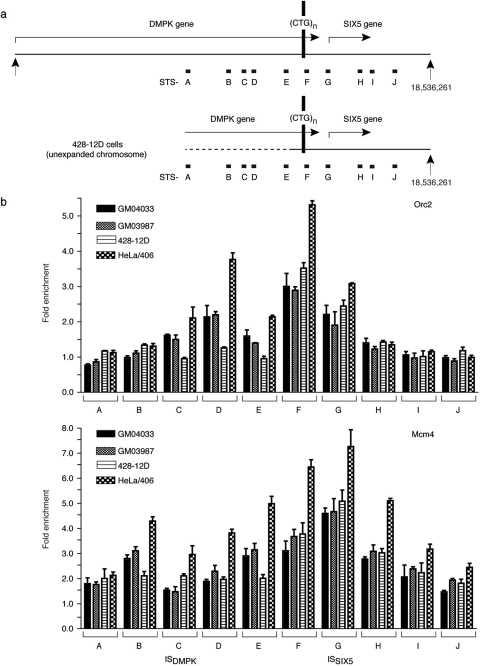
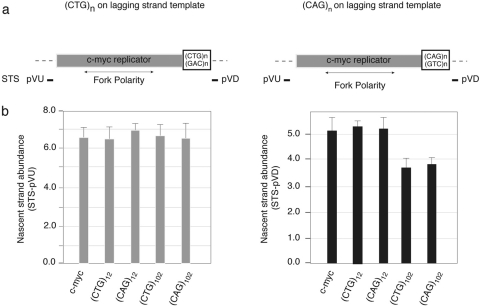
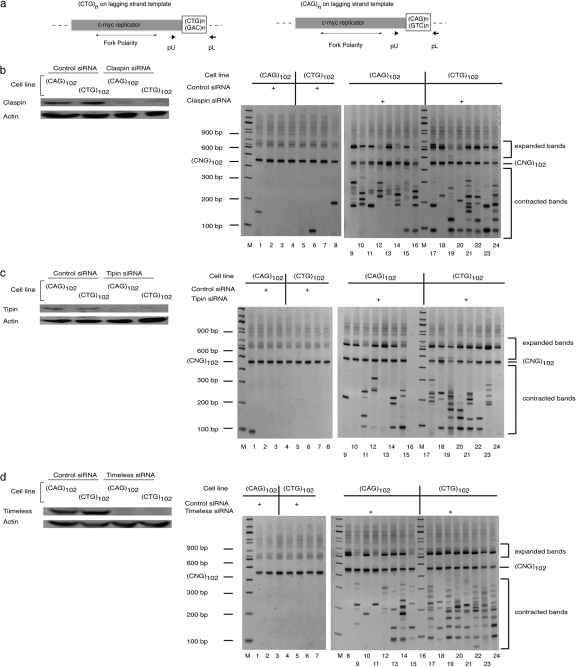
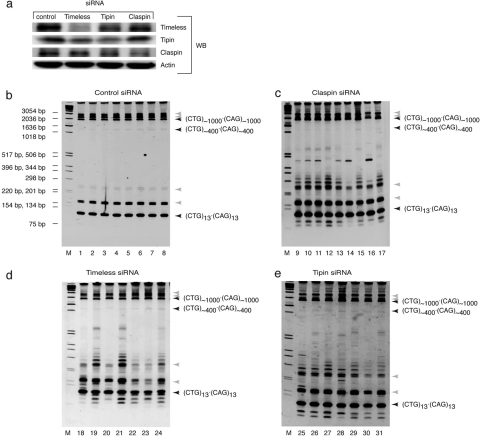
Myotonic dystrophy type 1 (DM1) is associated with expansion of (CTG)(n) · (CAG)(n) trinucleotide repeats (TNRs) in the 3' untranslated region (UTR) of the DMPK gene. Replication origins are cis-acting elements that potentiate TNR instability; therefore, we mapped replication initiation sites and prereplication complex protein binding within the ~10-kb DMPK/SIX5 locus in non-DM1 and DM1 cells. Two origins, IS(DMPK) and IS(SIX5), flanked the (CTG)(n) · (CAG)(n) TNRs in control cells and in DM1 cells. Orc2 and Mcm4 bound near each of the replication initiation sites, but a dramatic change in (CTG)(n) · (CAG)(n) replication polarity was not correlated with TNR expansion. To test whether (CTG)(n) · (CAG)(n) TNRs are cis-acting elements of instability in human cells, model cell lines were created by integration of cassettes containing the c-myc replication origin and (CTG)(n) · (CAG)(n) TNRs in HeLa cells. Replication forks were slowed by (CTG)(n) · (CAG)(n) TNRs in a length-dependent manner independent of replication polarity, implying that expanded (CTG)(n) · (CAG)(n) TNRs lead to replication stress. Consistent with this prediction, TNR instability increased in the HeLa model cells and DM1 cells upon small interfering RNA (siRNA) knockdown of the fork stabilization protein Claspin, Timeless, or Tipin. These results suggest that aberrant DNA replication and TNR instability are linked in DM1 cells.
Figures
References
-
- Aladjem MI. 2007. Replication in context: dynamic regulation of DNA replication patterns in metazoans. Nat. Rev. Genet. 8:588–600 - PubMed
-
- Balakumaran BS, Freudenreich CH, Zakian VA. 2000. CGG/CCG repeats exhibit orientation-dependent instability and orientation-independent fragility in Saccharomyces cerevisiae. Hum. Mol. Genet. 9:93–100 - PubMed
Publication types
MeSH terms
Substances
Grants and funding
LinkOut - more resources
Full Text Sources
