


Adherence to stage-specific treatment guidelines for patients with colon cancer
- PMID: 22355049
- PMCID: PMC3341110
- DOI: 10.1200/JCO.2011.39.6937
Adherence to stage-specific treatment guidelines for patients with colon cancer
Abstract
Purpose: Adherence to evidence-based treatment guidelines has been proposed as a measure of cancer care quality. We sought to determine rates of and factors associated with adherence to the National Comprehensive Cancer Network (NCCN) treatment guidelines for colon cancer.
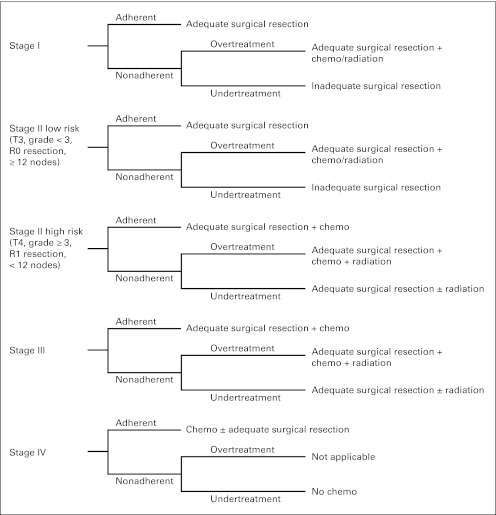
Patients and methods: Patients within the National Cancer Data Base treated for colon adenocarcinoma (2003 to 2007) were identified. Adherence to stage-specific NCCN guidelines was determined based on disease stage. Hierarchical regression analyses were performed to identify factors predictive of adherence, overtreatment, and undertreatment.
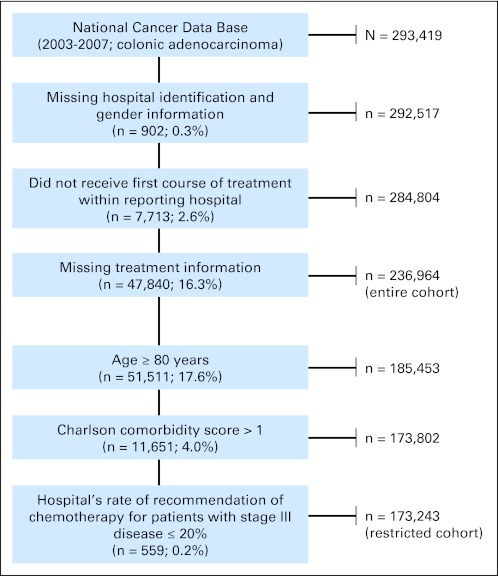
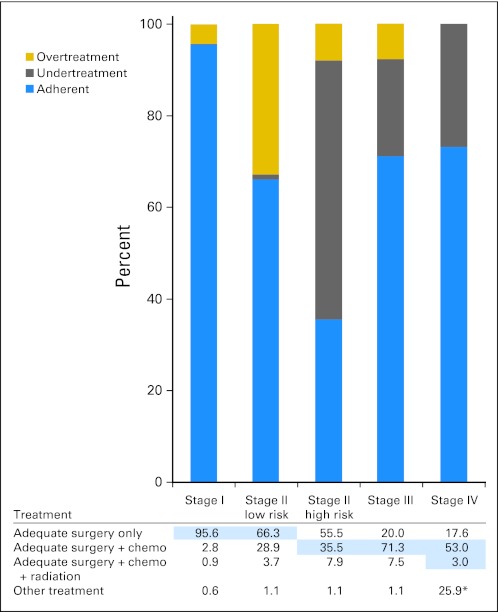
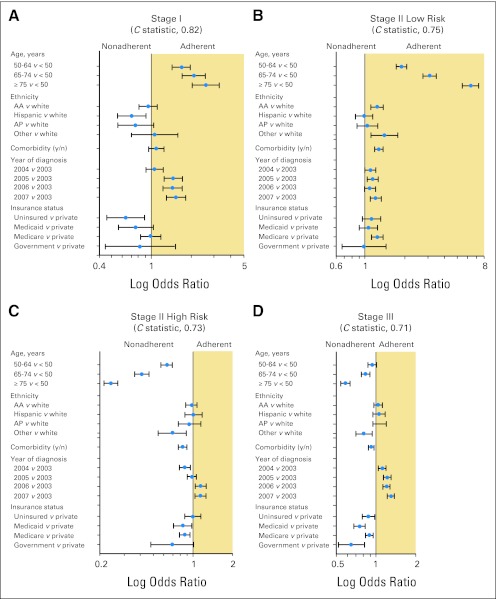
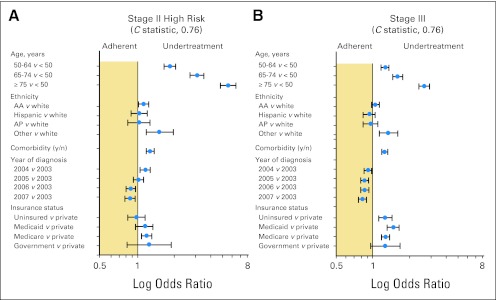
Results: A total of 173,243 patients were included in the final cohort, 123,953 (71%) of whom were treated according to NCCN guidelines. Patients with stage I disease were more likely to receive guideline-based treatment (96%) than patients with stage II (low risk, 66%; high risk, 36%), III (71%), or IV (73%) disease (P < .001). Adherence to consensus-based guidelines increased over time. Factors associated with adherence across all stages included age, Charlson-Deyo comorbidity index score, later year of diagnosis, and insurance status. Among patients with high-risk stage II or stage III disease, older patients with pre-existing comorbidities and patients with lower socioeconomic status were less likely to be offered adjuvant chemotherapy. Among patients with stage I and II disease, young, healthy patients were more likely to be recommended chemotherapy, in discordance with NCCN guidelines.
Conclusion: Significant variation exists in the treatment of colon cancer, particularly in treatment of high-risk stage II and stage III disease. The impact of nonadherence to guidelines on patient outcomes needs to be further elucidated.
Conflict of interest statement
Authors' disclosures of potential conflicts of interest and author contributions are found at the end of this article.
Figures
References
-
- Hewitt ME, Simone JV. National Cancer Policy Board: Ensuring Quality Cancer Care. Washington, DC: National Academy Press; 1999.
-
- Somerfield MR, Einhaus K, Hagerty KL, et al. American Society of Clinical Oncology clinical practice guidelines: Opportunities and challenges. J Clin Oncol . 2008;26:4022–4026. - PubMed
-
- Desch CE, McNiff KK, Schneider EC, et al. American Society of Clinical Oncology/National Comprehensive Cancer Network Quality Measures. J Clin Oncol . 2008;26:3631–3637. - PubMed
-
- National Quality Forum Measure Details: National Voluntary Consensus Standards for Quality of Cancer Care. http://www.qualityforum.org/Publications/2009/05/National_Voluntary_Cons....
-
- Blayney DW, McNiff K, Hanauer D, et al. Implementation of the Quality Oncology Practice Initiative at a university comprehensive cancer center. J Clin Oncol . 2009;27:3802–3807. - PubMed
Publication types
MeSH terms
Grants and funding
LinkOut - more resources
Full Text Sources
