. 2012 Apr;18(4):844-55.
doi: 10.1261/rna.029413.111. Epub 2012 Feb 21.

The crucial role of PNPase in the degradation of small RNAs that are not associated with Hfq

Affiliations

The crucial role of PNPase in the degradation of small RNAs that are not associated with Hfq

José M Andrade et al. RNA. 2012 Apr.

Abstract

The transient existence of small RNAs free of binding to the RNA chaperone Hfq is part of the normal dynamic lifecycle of a sRNA. Small RNAs are extremely labile when not associated with Hfq, but the mechanism by which Hfq stabilizes sRNAs has been elusive. In this work we have found that polynucleotide phosphorylase (PNPase) is the major factor involved in the rapid degradation of small RNAs, especially those that are free of binding to Hfq. The levels of MicA, GlmY, RyhB, and SgrS RNAs are drastically increased upon PNPase inactivation in Hfq(-) cells. In the absence of Hfq, all sRNAs are slightly shorter than their full-length species as result of 3'-end trimming. We show that the turnover of Hfq-free small RNAs is growth-phase regulated, and that PNPase activity is particularly important in stationary phase. Indeed, PNPase makes a greater contribution than RNase E, which is commonly believed to be the main enzyme in the decay of small RNAs. Lack of poly(A) polymerase I (PAP I) is also found to affect the rapid degradation of Hfq-free small RNAs, although to a lesser extent. Our data also suggest that when the sRNA is not associated with Hfq, the degradation occurs mainly in a target-independent pathway in which RNase III has a reduced impact. This work demonstrated that small RNAs free of Hfq binding are preferably degraded by PNPase. Overall, our data highlight the impact of 3'-exonucleolytic RNA decay pathways and re-evaluates the degradation mechanisms of Hfq-free small RNAs.


Figures
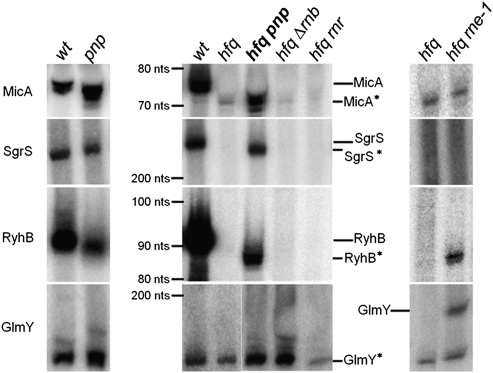
FIGURE 1.
FIGURE 1.
PNPase strongly affects the levels of several small RNAs that are not bound to Hfq. Small RNA expression was analyzed by Northern blot. (Left) The levels of MicA, SgrS, Ryhb, and GlmY were analyzed in the wild-type (hfq+ pnp+) and a PNPase mutant (hfq+ pnp). Total RNA was extracted from stationary-phase cultures grown at 37°C as mentioned in the Materials and Methods. (Middle) Hfq mutants lacking one of the 3′–5′ exoribonucleases PNPase (pnp), RNase II (rnb), and RNase R (rnr) were compared with wild-type (wt) and hfq single mutant. (Right) To study the impact of the essential RNase E (rne), the double hfq rne-1 mutant was grown at 30°C until it reached stationary phase and then shifted to the nonpermissive temperature of 44°C for inactivation of the thermosensitive RNase E. Samples were withdrawn after 5 min of incubation. For comparison, the single hfq mutant was treated in the same conditions. Specific [32P]-labeled probes were used to detect the small RNAs. Full-length small RNAs are clearly detected on wild type (except for GlmY), showing the expected sizes: MicA (74 nt), RyhB (90 nt), GlmY (180 nt), and SgrS (227 nt), as estimated from markers run along the gels. Small RNAs detected on hfq mutants (namely, in the hfq pnp) are slightly shorter than the corresponding full-length sRNAs; these shorter small RNAs are designated by an asterisk (*). The positions of both the full-length and the shorter small RNAs are indicated. 5S RNA or tmRNA were used as loading controls.
FIGURE 2.
FIGURE 2.
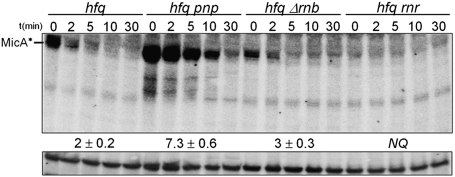
PNPase is the major exoribonuclease involved in the degradation of MicA*. Samples from stationary-phase cultures of hfq and its derivative exoribonuclease mutants (hfq pnp, hfq Δrnb, and hfq rnr) grown at 37°C were withdrawn after inhibition of transcription (timepoints are shown in minutes) and total RNA was analyzed by Northern blot. A specific riboprobe for MicA was used. A nonspecific band that cross-hybridized with the antisense MicA probe was used as loading control. This band migrates above MicA and disappears with a more stringent washing step of the membrane without affecting MicA signal (Andrade and Arraiano 2008). Hybridization with a 5S RNA riboprobe gave identical results. Only the MicA* RNA species is detected in the absence of Hfq. Half-lives were determined after PhosphorImager densitometry quantification showing that PNPase is the major exoribonuclease involved in the degradation of the Hfq-unprotected MicA*. (NQ) Not quantifiable.
FIGURE 3.
FIGURE 3.
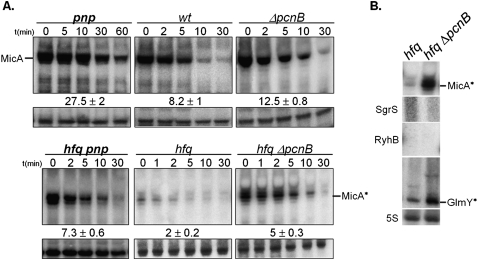
Lack of poly(A) polymerase I results in increasing levels of MicA*. (A) Impact of poly(A) polymerase I (pcnB) in the degradation of the small MicA RNA in Hfq+ or Hfq cells. Stationary-phase cultures of wild type and its derivatives pnp, ΔpcnB, hfq pnp, hfq, and hfq ΔpcnB strains were treated with rifampicin, and total RNA was analyzed by Northern blot. MicA was detected by use of a specific riboprobe. Only the shorter MicA* RNA is visible in the Hfq cells. A nonspecific band cross-reacting with MicA probe was used as loading control. (B) The steady-state levels of several small RNAs from stationary-phase cultures of hfq and hfq ΔpcnB mutants were evaluated by Northern blot.
FIGURE 4.
FIGURE 4.
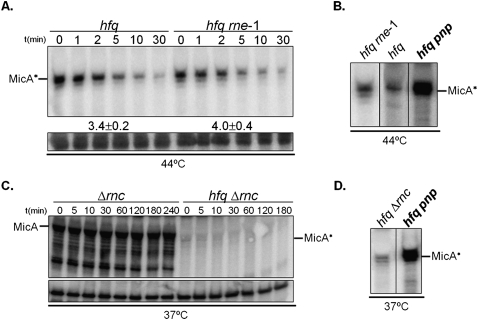
PNPase, but not RNase E or RNase III, degrades the Hfq-free MicA* RNA. (A) Northern blot detection of MicA RNA in Hfq cells harboring or not harboring the rne-1 allele. Stationary-phase cultures were treated at 44°C for inactivation of the thermosensitive RNase E (as mentioned before). MicA RNA stability was analyzed by Northern blot with a specific riboprobe. (B) Northern blot analysis of MicA in Hfq cells deficient in RNase E or PNPase. The double hfq rne-1 mutant was grown at 30°C until stationary phase and then incubated at 44°C to inactivate RNase E. For comparison, the hfq and hfq pnp were treated in the same conditions. (C) Northern blot detection of MicA in stationary-phase cultures of Hfq cells harboring or not harboring RNase III (rnc), respectively. A loading control corresponding to a nonspecific band that cross-reacted with MicA probe is shown in below. (D) Comparison of MicA* RNA steady-levels in Hfq stationary-phase cells deficient in RNase III or PNPase grown at 37°C.
FIGURE 5.
FIGURE 5.
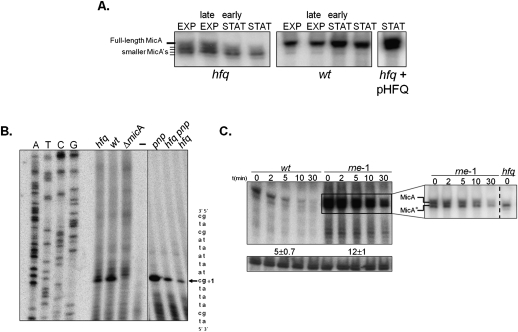
Hfq is required for the expression of the full-length MicA RNA. (A) Steady-state levels of MicA RNA along the growth curve. Culture samples of wild-type or hfq mutant bacteria were collected at exponential (EXP), late exponential, early stationary, and stationary phase (STAT) (corresponding to OD600 values of ∼0.3, ∼1.7, ∼2.5, and ∼5.5 for the wild-type and ∼0.3, ∼0.8, ∼1.6, and ∼2.3 for the hfq mutant, respectively). The growth curves for the wild-type and the hfq mutant strain are given in Supplemental Figure S2. A specific antisense MicA riboprobe was used to detect MicA. Stationary-phase cultures of the hfq mutant transformed with the overexpressing pHFQ plasmid show complementation and do not exhibit the heterogeneous population of MicA's typically found in the hfq single mutant. (B) Determination of the 5′-end of MicA. Total RNA from stationary-phase cells of wild-type, hfq, pnp, and hfq pnp strains was analyzed by primer extension with the [32P]-labeled primer MicA-PE. The same primer extension product (indicated by an arrow) is detected on all strains and absent from the deletion micA strain (ΔmicA) and the negative control reaction (−) done without RNA. Part of the DNA sequence is indicated on the right. The transcription start site of MicA is indicated (+1) and is identical to the site described by Udekwu et al. (2005). The intensity of the primer extension product obtained is higher in the wild-type rather than the hfq mutant, in agreement with the higher amount of MicA detected in the wild-type strain (see Fig. 5A). (C) Northern blot detection of MicA in stationary-phase cultures of Hfq+ cells upon inactivation of RNase E. Cultures of wild-type and an RNase E mutant strain were grown at 30°C until they reached stationary phase, and then shifted to the nonpermissive temperature of 44°C. After 5 min, transcription was blocked with the addition of rifampicin, and samples were withdrawn at times indicated. A specific riboprobe was used to detect MicA RNA. A nonspecific band that cross-hybridized with the antisense MicA probe was used as loading control. The inset corresponds to a shorter exposure of the membrane in which it is visible that both the full-length MicA and the shorter MicA* RNA are detected and stabilized upon inactivation of RNase E in Hfq+ cells. The hfq mutant was used here as a control to clearly identify MicA* RNA.
FIGURE 6.
FIGURE 6.
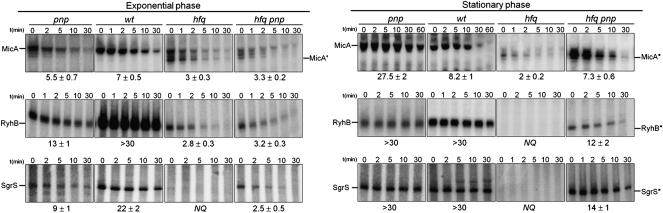
Growth-phase regulation of Hfq-free small RNAs by PNPase. Northern blot determination of MicA, RyhB, and SgrS RNA stabilities between the wild-type and its isogenic pnp, hfq, and hfq pnp mutants either in exponential-phase or stationary-phase cultures. Total RNA was extracted from culture samples withdrawn after inhibition of transcription with rifampicin (timepoints are shown in minutes). MicA, RyhB, and SgrS RNAs were detected by the use of specific radiolabeled probes and quantified by PhosphorImager analysis. The full-length small RNAs or their respective shorter forms (where detected) are indicated on the gels. (NQ) Not quantifiable.

References

    1. Afonyushkin T, Vecerek B, Moll I, Blasi U, Kaberdin VR 2005. Both RNase E and RNase III control the stability of sodB mRNA upon translational inhibition by the small regulatory RNA RyhB. Nucleic Acids Res 33: 1678–1689 - PMC - PubMed
    1. Aiba H 2007. Mechanism of RNA silencing by Hfq-binding small RNAs. Curr Opin Microbiol 10: 134–139 - PubMed
    1. Ali Azam T, Iwata A, Nishimura A, Ueda S, Ishihama A 1999. Growth phase-dependent variation in protein composition of the Escherichia coli nucleoid. J Bacteriol 181: 6361–6370 - PMC - PubMed
    1. Andrade JM, Arraiano CM 2008. PNPase is a key player in the regulation of small RNAs that control the expression of outer membrane proteins. RNA 14: 543–551 - PMC - PubMed
    1. Andrade JM, Cairrão F, Arraiano CM 2006. RNase R affects gene expression in stationary-phase: regulation of ompA. Mol Microbiol 60: 219–228 - PubMed

Publication types

MeSH terms

LinkOut - more resources