


Virologic failures on initial boosted-PI regimen infrequently possess low-level variants with major PI resistance mutations by ultra-deep sequencing
- PMID: 22355307
- PMCID: PMC3280244
- DOI: 10.1371/journal.pone.0030118
Virologic failures on initial boosted-PI regimen infrequently possess low-level variants with major PI resistance mutations by ultra-deep sequencing
Abstract
Background: It is unknown whether HIV-positive patients experiencing virologic failure (VF) on boosted-PI (PI/r) regimens without drug resistant mutations (DRM) by standard genotyping harbor low-level PI resistant variants. CASTLE compared the efficacy of atazanavir/ritonavir (ATV/r) with lopinavir/ritonavir (LPV/r), each in combination with TVD in ARV-naïve subjects.
Objective: To determine if VF on an initial PI/r-based regimen possess low-level resistant variants that may affect a subsequent PI-containing regimen.
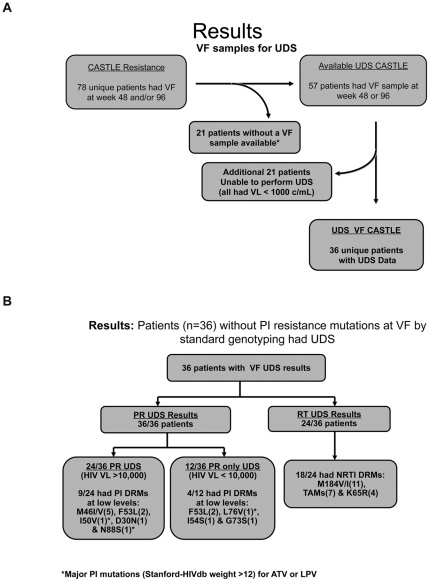
Methods/results: Patients experiencing VF on a Tenofovir/Emtricitabine+PI/r regimen were evaluated by ultra deep sequencing (UDS) for mutations classified/weighted by Stanford HIVdb. Samples were evaluated for variants to 0.4% levels. 36 VF subjects were evaluated by UDS; 24 had UDS for PI and RT DRMs. Of these 24, 19 (79.2%) had any DRM by UDS. The most common UDS-detected DRM were NRTI in 18 subjects: M184V/I (11), TAMs(7) & K65R(4); PI DRMs were detected in 9 subjects: M46I/V(5), F53L(2), I50V(1), D30N(1), and N88S(1). The remaining 12 subjects, all with VLs<10,000, had protease gene UDS, and 4 had low-level PI DRMs: F53L(2), L76V(1), I54S(1), G73S(1). Overall, 3/36(8.3%) subjects had DRMs identified with Stanford-HIVdb weights >12 for ATV or LPV: N88S (at 0.43% level-mutational load 1,828) in 1 subject on ATV; I50V (0.44%-mutational load 110) and L76V (0.52%-mutational load 20) in 1 subject each, both on LPV. All VF samples remained phenotypically susceptible to the treatment PI/r.
Conclusion: Among persons experiencing VF without PI DRMs with standard genotyping on an initial PI/r regimen, low-level variants possessing major PI DRMs were present in a minority of cases, occurred in isolation, and did not result in phenotypic resistance. NRTI DRMs were detected in a high proportion of subjects. These data suggest that PIs may remain effective in subjects experiencing VF on a PI/r-based regimen when PI DRMs are not detected by standard or UDS genotyping.
Conflict of interest statement
Figures
References
-
- Panel on Antiretroviral Guidelines for Adult and Adolescents. Guidelines for the use of antiretroviral agents in HIV-1 infected adults and adolescents. 2008. Department of Health and Human Services. January 29, 2008; 1–128. Available: http://www.aidsinfo.nih.gov/ContentFiles/AdultandAdolescentGL.pdf. Accessed 2010 Aug 22.
-
- Synovate HIV Market Research. all rights reserved. 2009
-
- MacArthur RD, Novak RM, Peng G, Xiang Y, Huppler Hullsiek K, et al. Long-Term Clinical and Immunologic Outcomes Are Similar in HIV-Infected Persons Randomized to NNRTI versus PI versus NNRTI+PI-based Antiretroviral Regimens as Initial Therapy: Results of the CPCRA 058 FIRST Study. LANCET. 2006;368:2125–2135.
-
- Kozal MJ, Hullsiek KHuppler, Macarthur RD, Berg-Wolf M, Peng G, et al. The Incidence of HIV Drug Resistance and Its Impact on Progression of HIV Disease Among Antiretroviral Naïve Participants Started on Three Different Antiretroviral Therapy Strategies. HIV ClinTrials. 2007;6(6):357–370. PMID: 18042501. - PubMed
-
- Molina JM, Andrade-Villanueva J, Echevarria J, Ploenchan C, Corral J, et al. Once-daily atazanavir/ritonavir versus twice-daily lopinavir/ritonavir, each in combination with tenofovir and emtricitabine, for management of antiretroviral-naive HIV-1-infected patients: 48 week efficacy and safety results of the CASTLE study. LANCET. 2008;372(9639):646–655. - PubMed
Publication types
MeSH terms
Substances
LinkOut - more resources
Full Text Sources
Medical
Research Materials
Miscellaneous
