


Posture as index for approach-avoidance behavior
- PMID: 22355355
- PMCID: PMC3280282
- DOI: 10.1371/journal.pone.0031291
Posture as index for approach-avoidance behavior
Abstract
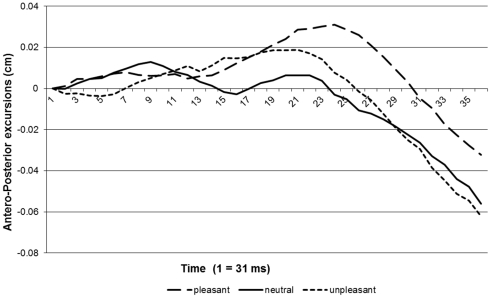
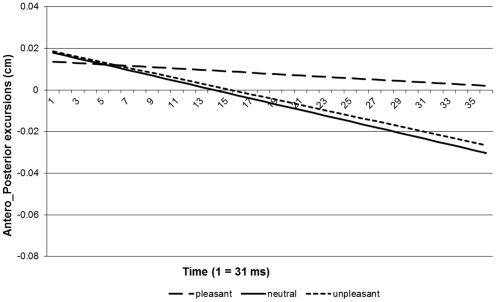
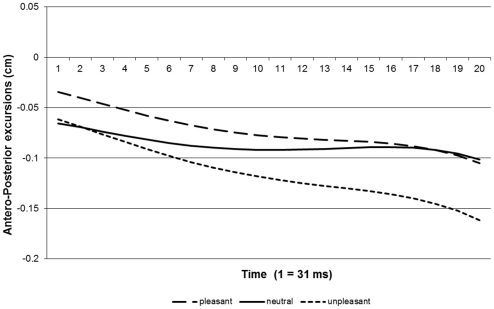
Approach and avoidance are two behavioral responses that make people tend to approach positive and avoid negative situations. This study examines whether postural behavior is influenced by the affective state of pictures. While standing on the Wii™ Balance Board, participants viewed pleasant, neutral, and unpleasant pictures (passively viewing phase). Then they had to move their body to the left or the right (lateral movement phase) to make the next picture appear. We recorded movements in the anterior-posterior direction to examine approach and avoidant behavior. During passively viewing, people approached pleasant pictures. They avoided unpleasant ones while they made a lateral movement. These findings provide support for the idea that we tend to approach positive and avoid negative situations.
Conflict of interest statement
Figures

References
-
- Frijda NH. The Emotions. London: Cambridge University Press; 1986.
-
- Elliot AJ, Covington MV. Approach and avoidance motivation. Educ Psychol Rev. 2001;13:73–92.
-
- Rutherford HJV, Lindell AK. Thriving and surviving: Approach and avoidance motivation and lateralization. Emotion Rev. 2011;3:333–343.
-
- Solarz A. Latency of instrumental responses as a function of compatibility with the meaning of eliciting verbal signs. J Exp Psychol. 1960;59:239–245. - PubMed
-
- Bargh J, Chartrand T. The unbearable automaticity of being. Am Psychol. 1999;54:462–479.
MeSH terms
LinkOut - more resources
Full Text Sources
Medical
