


White Band Disease (type I) of endangered caribbean acroporid corals is caused by pathogenic bacteria
- PMID: 22355526
- PMCID: PMC3216495
- DOI: 10.1038/srep00007
White Band Disease (type I) of endangered caribbean acroporid corals is caused by pathogenic bacteria
Abstract
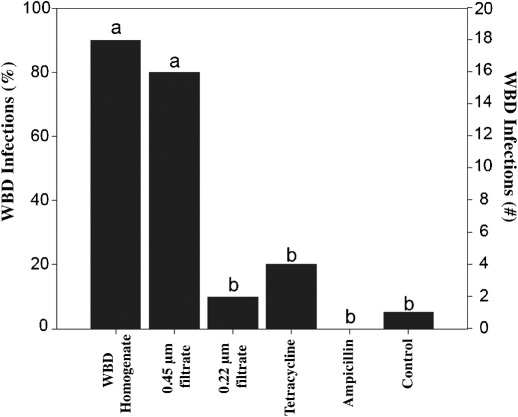
Diseases affecting coral reefs have increased exponentially over the last three decades and contributed to their decline, particularly in the Caribbean. In most cases, the responsible pathogens have not been isolated, often due to the difficulty in isolating and culturing marine bacteria. White Band Disease (WBD) has caused unprecedented declines in the Caribbean acroporid corals, resulting in their listings as threatened on the US Threatened and Endangered Species List and critically endangered on the IUCN Red List. Yet, despite the importance of WBD, the probable pathogen(s) have not yet been determined. Here we present in situ transmission data from a series of filtrate and antibiotic treatments of disease tissue that indicate that WBD is contagious and caused by bacterial pathogen(s). Additionally our data suggest that Ampicillin could be considered as a treatment for WBD (type I).
Figures

References
-
- Hughes T. P., Szmant A. M., Steneck R., Carpenter R. & Miller S. Algal blooms on coral reefs: What are the causes? Limnol. Oceanogr. 44, 1583–1586 (1999).
-
- Jackson J. B. C. et al. Historical overfishing and the recent collapse of coastal ecosystems. Science 293, 629–638 (2001). - PubMed
-
- Hughes T. P. et al. Climate change, human impacts, and the resilience of coral reefs. Science 301, 929–933 (2003). - PubMed
-
- Bellwood D. R., Hughes T. P., Folke C. & Nystrom M. Confronting the coral reef crisis. Nat. 429, 827–833 (2004). - PubMed
-
- Gardner T. A., Cote I. M., Gill J. A., Grant A. & Watkinson A. R. Long-term region-wide declines in Caribbean corals. Science 301, 958–960 (2003). - PubMed
Publication types
MeSH terms
LinkOut - more resources
Full Text Sources
