


Locations of marine animals revealed by carbon isotopes
- PMID: 22355540
- PMCID: PMC3216509
- DOI: 10.1038/srep00021
Locations of marine animals revealed by carbon isotopes
Abstract
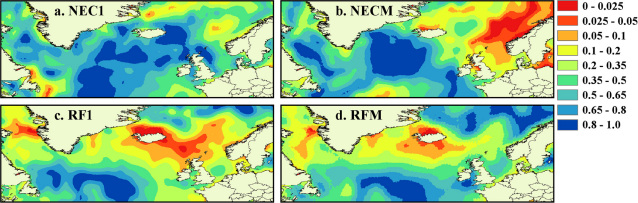
Knowing the distribution of marine animals is central to understanding climatic and other environmental influences on population ecology. This information has proven difficult to gain through capture-based methods biased by capture location. Here we show that marine location can be inferred from animal tissues. As the carbon isotope composition of animal tissues varies with sea surface temperature, marine location can be identified by matching time series of carbon isotopes measured in tissues to sea surface temperature records. Applying this technique to populations of Atlantic salmon (Salmo salar L.) produces isotopically-derived maps of oceanic feeding grounds, consistent with the current understanding of salmon migrations, that additionally reveal geographic segregation in feeding grounds between individual philopatric populations and age-classes. Carbon isotope ratios can be used to identify the location of open ocean feeding grounds for any pelagic animals for which tissue archives and matching records of sea surface temperature are available.
Figures
References
-
- Pauly D., Christensen V., Dalsgaard J., Froese R. & Torres F. Fishing down marine food webs. Science 279, 860–863 (1998). - PubMed
-
- Myers R. A. & Worm B. Rapid worldwide depletion of predatory fish communities. Nature 423, 280–283 (2003). - PubMed
-
- Begg G. A. Friedland K. D. & Pearce J. B. Stock identification and its role in stock assessment and fisheries management: an overview. Fish. Res. 43, 1–8 (1999).
-
- Wright P. J., Neat F. C., Gibb F. M. & Thordarson H. Evidence for metapopulation structuring in cod from the west of Scotland and North Sea. J. Fish Biol. 69, 181–199 (2006).
Publication types
MeSH terms
Substances
LinkOut - more resources
Full Text Sources
Other Literature Sources
Research Materials
