


Youngsters do not pay attention to conversational rules: is this so for nonhuman primates?
- PMID: 22355541
- PMCID: PMC3216510
- DOI: 10.1038/srep00022
Youngsters do not pay attention to conversational rules: is this so for nonhuman primates?
Abstract
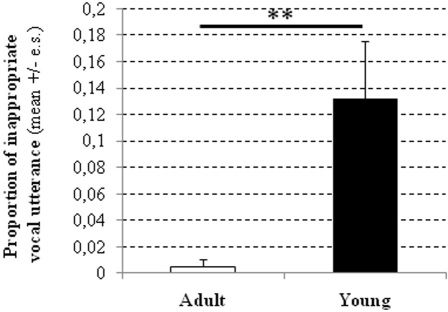
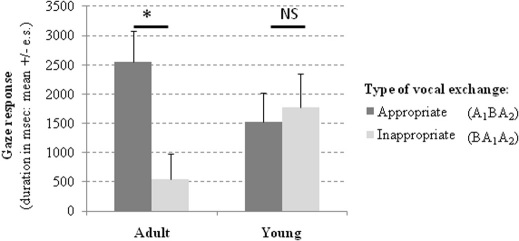
The potentiality to find precursors of human language in nonhuman primates is questioned because of differences related to the genetic determinism of human and nonhuman primate acoustic structures. Limiting the debate to production and acoustic plasticity might have led to underestimating parallels between human and nonhuman primates. Adult-young differences concerning vocal usage have been reported in various primate species. A key feature of language is the ability to converse, respecting turn-taking rules. Turn-taking structures some nonhuman primates' adult vocal exchanges, but the development and the cognitive relevancy of this rule have never been investigated in monkeys. Our observations of Campbell's monkeys' spontaneous vocal utterances revealed that juveniles broke the turn-taking rule more often than did experienced adults. Only adults displayed different levels of interest when hearing playbacks of vocal exchanges respecting or not the turn-taking rule. This study strengthens parallels between human conversations and nonhuman primate vocal exchanges.
Figures
References
-
- Hauser M., Chomsky N. & Fitch W. T. The faculty of language: what is it, who has it, and how did it evolve? Science 298, 1569–1579 (2002). - PubMed
-
- Fitch T. The evolution of language. Cambridge: Cambridge University Press; 2010.
-
- Lemasson A. What can forest guenons « tell » us about the origin of language? In: Primate Communication and Human Language: Vocalisation, gestures, imitation and deixis in humans and non-humans. Edited by Vilain, A., Schwartz, J. L., Abry, C., Vauclair J. Amsterdam: John Benjamins Publishing Company; 39–70 (2011).
-
- Cheney D. L. & Seyfarth R. M. How monkeys see the world. Chicago: University of Chicago Press; 1990.
-
- Roush R. S. & Snowdon C. T. Food transfer and development of feeding behaviour and food-associated vocalization in Cotton-top tamarins. Ethology 107, 415–429 (2001).
Publication types
MeSH terms
LinkOut - more resources
Full Text Sources
Medical
