


Silicon uptake by sponges: a twist to understanding nutrient cycling on continental margins
- PMID: 22355549
- PMCID: PMC3216517
- DOI: 10.1038/srep00030
Silicon uptake by sponges: a twist to understanding nutrient cycling on continental margins
Abstract
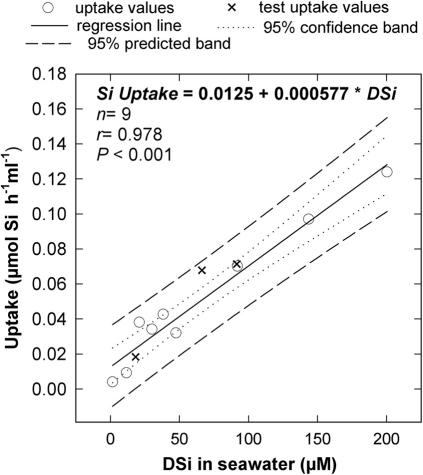
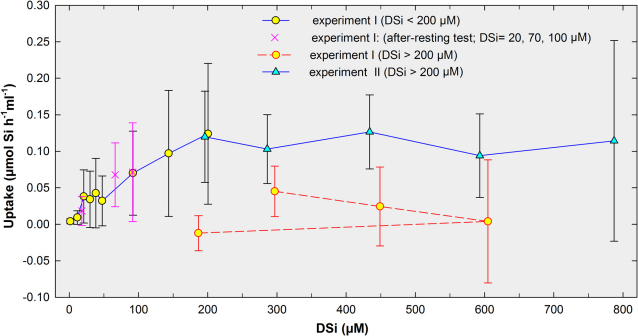
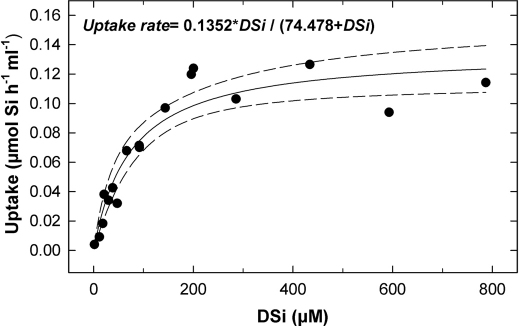
About 75% of extant sponge species use dissolved silicon (DSi) to build a siliceous skeleton. We show that silicon (Si) uptake by sublittoral Axinella demosponges follows an enzymatic kinetics. Interestingly, maximum uptake efficiency occurs at experimental DSi concentrations two orders of magnitude higher than those in the sponge habitats, being unachievable in coastal waters of modern oceans. Such uptake performance appears to be rooted in a former condition suitable to operate at the seemingly high DSi values characterizing the pre-Tertiary (>65 mya) habitats where this sponge lineage diversified. Persistence of ancestral uptake systems causes sponges to be outcompeted by the more efficient uptake of diatoms at the low ambient DSi levels characterizing Recent oceans. Yet, we show that sublittoral sponges consume substantial coastal DSi (0.01-0.90 mmol Si m(-2) day(-1)) at the expenses of the primary-production circuit. Neglect of that consumption hampers accurate understanding of Si cycling on continental margins.
Figures
References
-
- Nelson D. M., Tréguer P., Brzezinski M. A., Leynaert A. & Quéguiner B. Production and dissolution of biogenic silica in the ocean: revised global estimates, comparison with regional data and relationship to biogenic sedimentation. Global Biogeochem. Cycles 9, 359–372 (1995).
-
- Ragueneau O. et al. A review of the Si cycle in the modern ocean: recent progress and missing gaps in the application of biogenic opal as paleoproductivity proxy. Global Planet. Change 26, 317–365 (2000).
-
- Sarmiento J. & Gruber N. Ocean biogeochemical dynamics. (Princeton University Press, 2006).
-
- Siever R. in Scientists on Gaia eds S. H. Scheneider & P. J. Boston) 287–295 (MIT Press, 1991).
-
- Harrison K. G. The role of increased marine silica input on paleo-pCO2 levels. Paleoceanography 15, 292–298 (2000).
Publication types
MeSH terms
Substances
LinkOut - more resources
Full Text Sources
