. 2011:1:69.
doi: 10.1038/srep00069. Epub 2011 Aug 19.

Disclosure of cholesterol recognition motifs in transmembrane domains of the human nicotinic acetylcholine receptor

Affiliations

Disclosure of cholesterol recognition motifs in transmembrane domains of the human nicotinic acetylcholine receptor

Carlos J Baier et al. Sci Rep. 2011.

Abstract

Cholesterol influences ion-channel function, distribution and clustering in the membrane, endocytosis, and exocytic sorting of the nicotinic acetylcholine receptor (AChR). We report the occurrence of a cholesterol recognition motif, here coined "CARC", in the transmembrane regions of AChR subunits that bear extensive contact with the surrounding lipid, and are thus optimally suited to convey cholesterol-mediated signaling from the latter. Three cholesterol molecules could be docked on the transmembrane segments of each AChR subunit, rendering a total of 15 cholesterol molecules per AChR molecule. The CARC motifs contribute each with an energy of interaction between 35 and 52 kJ.mol(-1), adding up to a total of about 200 kJ.mol(-1) per receptor molecule, i.e. ∼40% of the lipid solvation free energy/ AChR molecule. The CARC motif is remarkably conserved along the phylogenetic scale, from prokaryotes to human, suggesting that it could be responsible for some of the above structural/functional properties of the AChR.


Figures
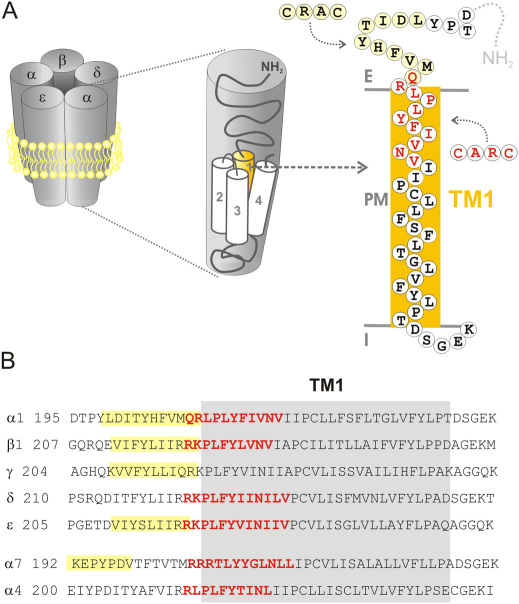
Figure 1
Figure 1. (A) Scheme depicting the whole AChR protein molecule inserted in the plasma membrane (left), an individual subunit of the pentamer, showing the four (TM1 to TM4) transmembrane segments (middle), and the amino acid sequence of a single TM domain, corresponding to the human muscle TM1 (right).
All subunits possess a relatively large extracellular amino terminal domain, four TM segments (TM1 to TM4), a large intracellular loop between TM3 and TM4, and a short extracellular C-terminus portion. The CRAC and CARC regions are indicated in the scheme. (B) Alignment of the TM1 (highlighted in gray) amino acid sequences of human muscle and neuronal (α7 and α4) AChR subunits. The cholesterol recognition/interaction amino acid consensus (CRAC) motif [−L/V−(X)(1−5)−Y−(X)(1−5)−R/K−] is highlighted in yellow. CARC, the inverted CRAC sequence, ([−R/K−(X)(1−5)−Y−(X)(1−5)−L/V−]) is indicated by bold red letters. See text for details.
Figure 2
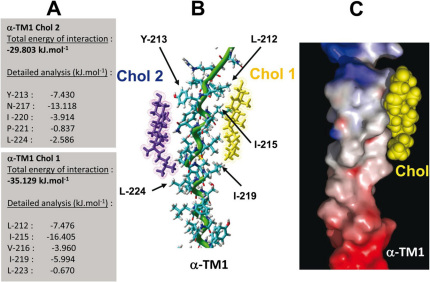
Figure 2. Docking of two cholesterol molecules on human AChR α-TM1.
Two cholesterol molecules (Chol 1 and Chol 2) were docked on the αTM1 domain of the human AChR as described in Materials and Methods. A detailed analysis of the energy of interaction of each cholesterol-TM1 complex is shown on the left panel (A). A tube rendering of the model is shown in (B). The α-helix of the TM domain is colored in green. The apolar part of Chol 1 (in yellow) interacts with Ile212, Ile215, and Ile219 (van der Waals interactions), whereas its polar part (the OH group) is located at the apolar-polar interface of the membrane where it can interact with water molecules. The OH group of Chol 2 (in violet) forms an H-bond with the phenolic OH of Tyr213. The surface complementarity between the α-TM1 domain and Chol 2 (in yellow) is illustrated by a surface view of the complex (C). The electrostatic surface of the α-TM1 domain is rendered in blue for positive, red for negative, and grey for neutral regions, respectively.
Figure 3
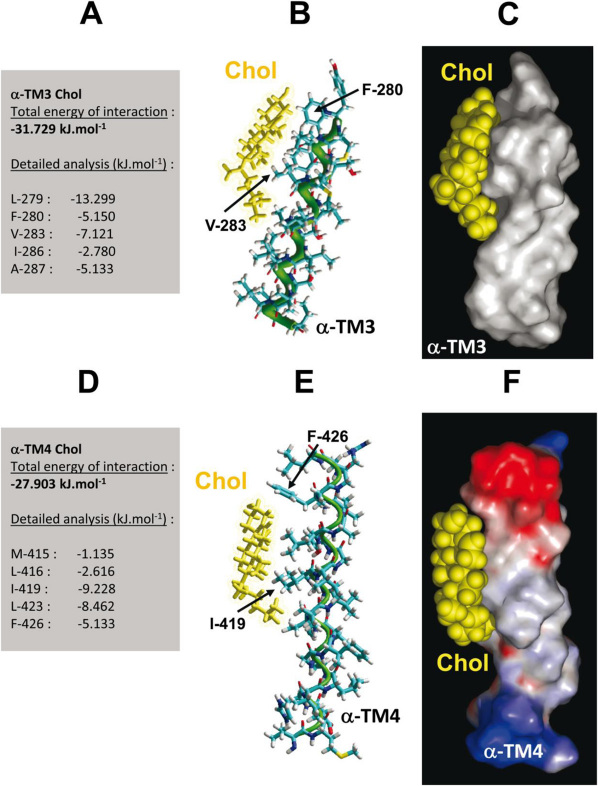
Figure 3. Docking of cholesterol on α-TM3 and α-TM4 domains of the human AChR.
The predicted interaction between cholesterol and α-TM3 relies exclusively on van der Waals interactions involving aliphatic residues (Leu279, Val283) and the aromatic Phe280 (A). The geometry of the iso-octyl chain of cholesterol is consistent with a bend that is necessary to adapt the form of the lipid molecule to the crevices of the α-TM3 domain as shown in both the tube (B) and surface renderings (C). In the α-TM4/cholesterol complex, cholesterol is not only bent but also twisted on its main axis, allowing an optimal fit for α-TM4 (E, F). As for α-TM3, this complex is chiefly stabilized by van der Waals interactions involving both aliphatic (Ile419, Leu423) and aromatic (Phe426) residues (D).
Figure 4
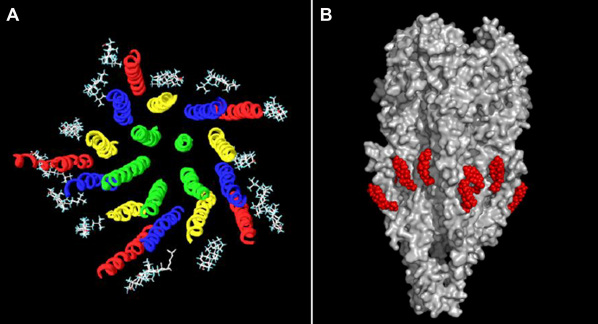
Figure 4. Docking of 15 cholesterol molecules onto the whole human AChR.
(A) End-on view ribbon rendering of the human AChR (α2βδε) with 15 cholesterol molecules (grey), in contact with the outer ring, made up of TM4 segments (red), and middle ring, made up up TM1 (yellow) and TM3 (blue) transmembrane segments. Note that the inner ring, which lines the walls of the ion channel (TM2 domains, green), does not establish contact with cholesterol molecules. (B) Side view of the human AChR (in grey) with energy-minimized cholesterol molecules (red) docked on the surface of its transmembrane region.

References

    1. Taly A., Corringer P. J., Guedin D., Lestage P., & Changeux J. P. Nicotinic receptors: allosteric transitions and therapeutic targets in the nervous system. Nat. Rev Drug Discov. 8, 733–750 (2009). - PubMed
    1. Barrantes F. J. Structural basis for lipid modulation of nicotinic acetylcholine receptor function. Brain Res. Brain Res. Rev. 47, 71–95 (2004). - PubMed
    1. Barrantes F. J. Cholesterol effects on nicotinic acetylcholine receptor: cellular aspects. Subcell. Biochem. 51, 467–487 (2010). - PubMed
    1. Criado M., Eibl H., & Barrantes F. J. Functional properties of the acetylcholine receptor incorporated in model lipid membranes. Differential effects of chain length and head group of phospholipids on receptor affinity states and receptor-mediated ion translocation. J Biol. Chem. 259, 9188–9198 (1984). - PubMed
    1. Borroni V. et al.. Cholesterol depletion activates rapid internalization of submicron-sized acetylcholine receptor domains at the cell membrane. Mol. Membr. Biol. 24, 1–15 (2007). - PubMed

Publication types