


Galantamine improves olfactory learning in the Ts65Dn mouse model of Down syndrome
- PMID: 22355654
- PMCID: PMC3216618
- DOI: 10.1038/srep00137
Galantamine improves olfactory learning in the Ts65Dn mouse model of Down syndrome
Abstract
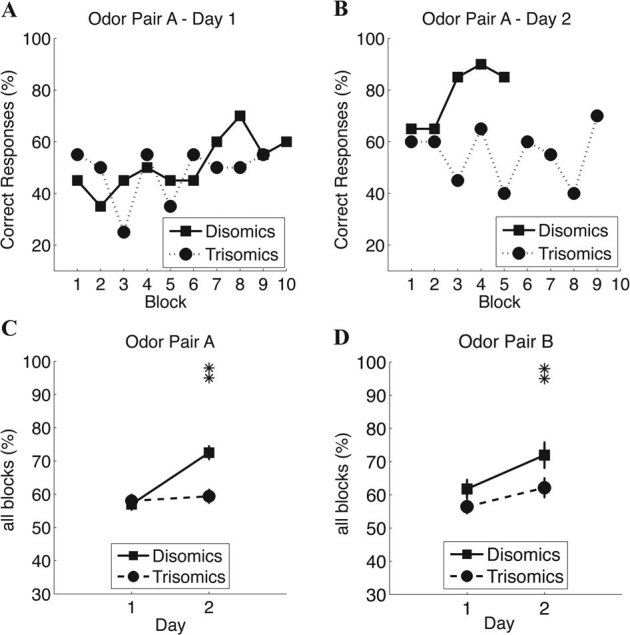
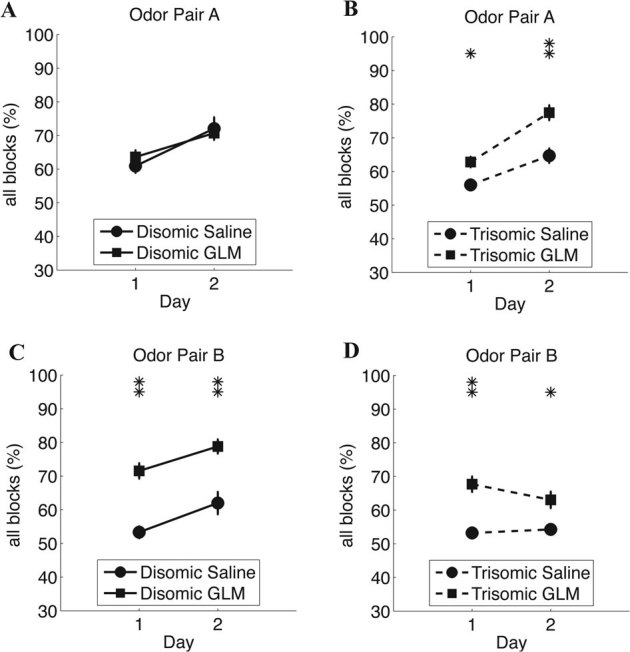
Down syndrome (DS) is the most common form of congenital intellectual disability. Although DS involves multiple disturbances in various tissues, there is little doubt that in terms of quality of life cognitive impairment is the most serious facet and there is no effective treatment for this aspect of the syndrome. The Ts65Dn mouse model of DS recapitulates multiple aspects of DS including cognitive impairment. Here the Ts65Dn mouse model of DS was evaluated in an associative learning paradigm based on olfactory cues. In contrast to disomic controls, trisomic mice exhibited significant deficits in olfactory learning. Treatment of trisomic mice with the acetylcholinesterase inhibitor galantamine resulted in a significant improvement in olfactory learning. Collectively, our study indicates that olfactory learning can be a sensitive tool for evaluating deficits in associative learning in mouse models of DS and that galantamine has therapeutic potential for improving cognitive abilities.
Figures
References
-
- Roizen N. J. & Patterson D. Down's syndrome. Lancet 361, 1281–1289 (2003). - PubMed
-
- Antonarakis S. E., Lyle R., Dermitzakis E. T., Reymond A. & Deutsch S. Chromosome 21 and down syndrome: from genomics to pathophysiology. Nat Rev Genet 5, 725–738 (2004). - PubMed
-
- Hick R. F., Botting N. & Conti-Ramsden G. Short-term memory and vocabulary development in children with Down syndrome and children with specific language impairment. Dev Med Child Neurol 47, 532–538 (2005). - PubMed
-
- Hunter C. L., Bimonte H. A. & Granholm A. C. Behavioral comparison of 4 and 6 month-old Ts65Dn mice: age-related impairments in working and reference memory. Behavioural brain research 138, 121–131 (2003). - PubMed
-
- Benavides-Piccione R. et al.. On dendrites in Down syndrome and DS murine models: a spiny way to learn. Progress in neurobiology 74, 111–126 (2004). - PubMed
Publication types
MeSH terms
Substances
Grants and funding
LinkOut - more resources
Full Text Sources
Other Literature Sources
Medical
