. 2012:2:246.
doi: 10.1038/srep00246. Epub 2012 Feb 3.

Cross priming amplification: mechanism and optimization for isothermal DNA amplification

Affiliations

Cross priming amplification: mechanism and optimization for isothermal DNA amplification

Gaolian Xu et al. Sci Rep. 2012.

Abstract

CPA is a class of isothermal amplification reactions that is carried out by a strand displacement DNA polymerase and does not require an initial denaturation step or the addition of a nicking enzyme. At the assay temperature of 63°C, the formation of a primer-template hybrid at transient, spontaneous denaturation bubbles in the DNA template is favored over re-annealing of the template strands by the high concentration of primer relative to template DNA. Strand displacement is encouraged by the annealing of cross primers with 5' ends that are not complementary to the template strand and the binding of a displacement primer upstream of the crossing primer. The resulting exponential amplification of target DNA is highly specific and highly sensitive, producing amplicons from as few as four bacterial cells. Here we report on the basic CPA mechanism - single crossing CPA - and provide details on alternative mechanisms.


Figures
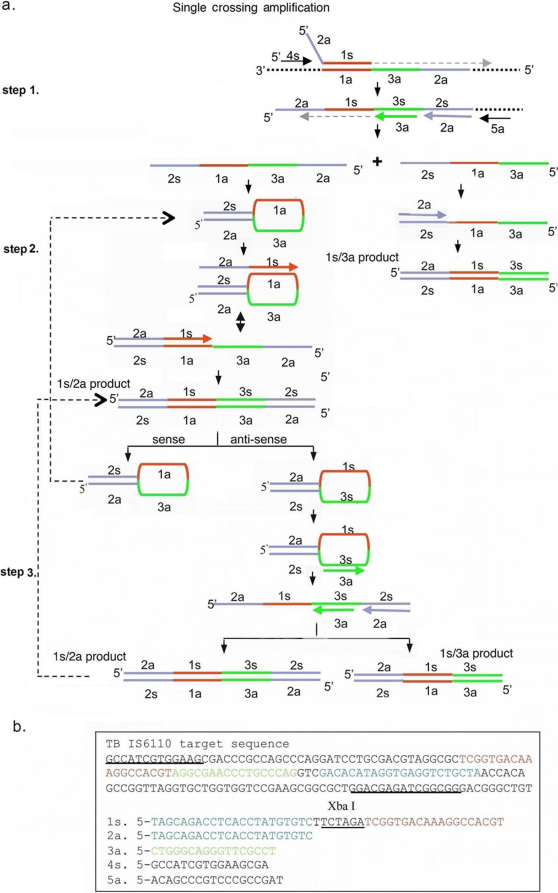
Figure 1
Figure 1. Single crossing CPA mechanism and primer design.
(a) Schematic showing the mechanism of single crossing CPA. (b) Target sequence, primer locations and primer design. Note that an Xba I site (TCTAGA) was inserted into the cross primer between 1s and 2a.
Figure 2
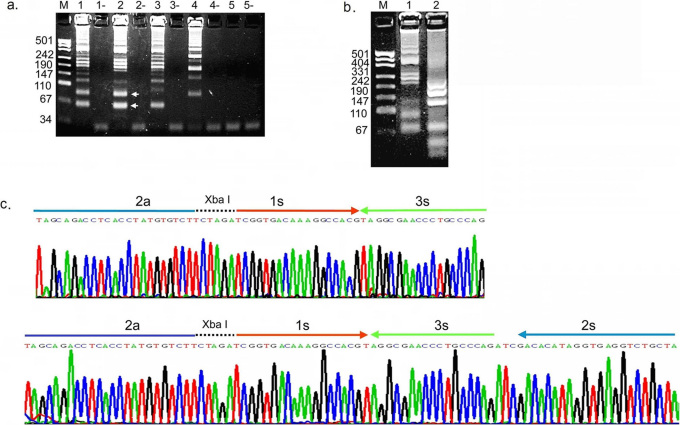
Figure 2. Agarose gel and sequencing analysis of single crossing CPA amplified TB IS6110 DNA.
(a) An agarose gel showing the amplification products obtained by single crossing CPA carried out with different primer combinations. Lane 1: 1s, 2a and 3a; Lane 2: 1s, 2a, 3a, 4s and 5a; Lane 3: 1s, 3a, 4s and 5a; Lane 4: 1s, 2a, 4s and 5a; Lane 5: 2a, 3a, 4s and 5a; (-) indicates no target control for the corresponding reaction. (b) An agarose gel demonstrating that the single crossing CPA products can be digested by the restriction enzyme Xba I. Lane1, single crossing CPA product prior to digestion; Lane 2, single crossing CPA product that has been digested by Xba I. (c) Sequencing of single crossing CPA products. The two bands indicated by the arrows in (a) were excised, cloned and sequenced.
Figure 3
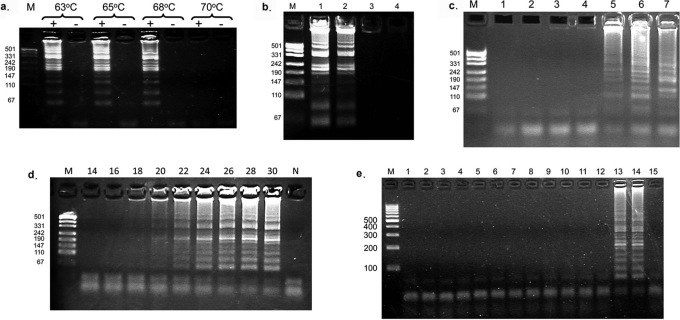
Figure 3. Optimization of the single crossing CPA assay.
(a) Effect of assay temperature on single crossing CPA. Agarose gel of single crossing CPA amplification products as a function of the reaction temperatures indicated above the lanes. A (+) denotes a reaction containing template, and (-) denotes a reaction without template. (b) Effect of template concentration on CPA. Agarose gel of single crossing CPA amplification products as a function of template concentration. M, size markers; lane 1, 40 M. tuberculosis cells; lane 2, 4 M. tuberculosis cells; lane 3, 0.4 M. tuberculosis cells; lane 4, buffer (60 minute reaction). (c) Effect of assay time on production of non-specific amplification products. Agarose gel showing products of single crossing CPA assays carried out in the absence of template. Lane 1, 60 mins; lane 2, 90 mins; lane 3,120 mins; lane 4, 150 mins; lane 5, 180 mins; lane 6, 210 mins; lane 7, positive control reaction with template incubated for 60 mins. Non specific amplification products appeared after 180 minutes (lane 5 and 6). Note that the gel patterns in these lanes are different from the pattern of CPA products obtained with the intended TB template (lane 7). (d) Time course of the single crossing CPA assay. Agarose gel showing the products of single crossing amplification reactions using 104 copies of a cloned TB plasmid as template. The assay time was varied from 14–30 minutes as indicated above each lane. M: marker; N: Negative control reaction lacking a template incubated for 60 minutes. (e) Test of the specificity of the single crosing CPA assay. M, size marker; lane 1, Mycobacterium marinum; lane 2, M. gordonae; lane 3, M. Simiae; lane 4, M. scrofulaceum; lane 5, M. ranae; lane 6, M. intracellulare; lane 7, M. Phlei ; lane 8, M. smegmatis; lane 9, M. vaccae; lane 10, M. fortuitmn; lane 11, M. chelonae subs.abscessus ; lane 12, M. chelonae subs.chelonae; lane 13, M. tuberculosis; lane 14, plasmid template containing the target TB sequence; lane 15, no template. Non-tuberculosis mycobacterium strains were purchased from China National Institute for the Control of Pharmaceutical and Biological Products.
Figure 4
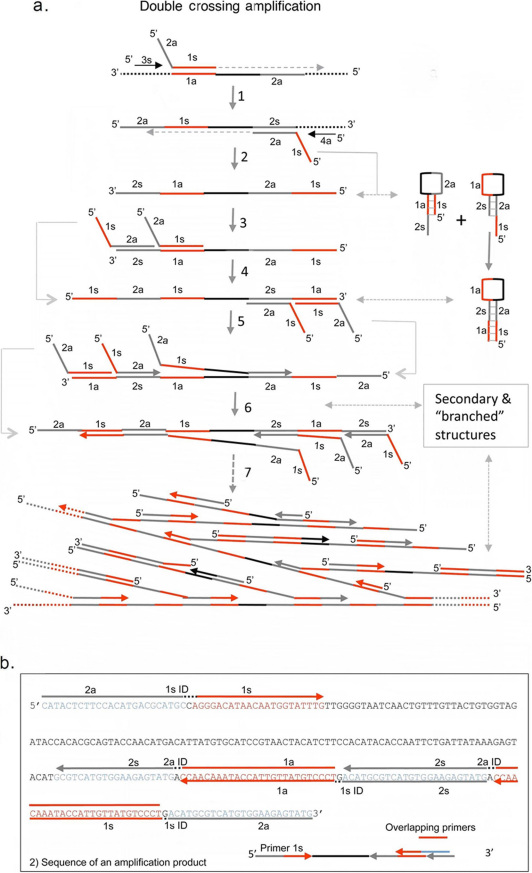
Figure 4. Double crossing CPA mechanism and primer design.
(a) Schematic of Double Crossing CPA. The sequential series of primer extensions and products leading to amplification of the target HPV DNA. (b) Sequence of a representative amplification product with overlaid primer locations.

Similar articles

Cited by

References

    1. Saiki R. K. et al. Enzymatic amplification of beta-globin genomic sequences and restriction site analysis for diagnosis of sickle cell anemia. Science 230, 1350–4 (1985). - PubMed
    1. Walker G. T. et al. Strand displacement amplification--an isothermal, in vitro DNA amplification technique. Nucleic Acids Res 20, 1691–6 (1992). - PMC - PubMed
    1. Walker G. T., Little M. C., Nadeau J. G. & Shank D. D. Isothermal in vitro amplification of DNA by a restriction enzyme/DNA polymerase system. Proc Natl Acad Sci U S A 89, 392–6 (1992). - PMC - PubMed
    1. Sooknanan R. & Malek L. T. NASBA. Nat Biotechnol 13, 563–564 (1995).
    1. Fahy E., Kwoh D. Y. & Gingeras T. R. Self-sustained sequence replication (3SR): an isothermal transcription-based amplification system alternative to PCR. Genome Res 1, 25–33 (1991). - PubMed

Publication types

MeSH terms