Dehiscence and fenestration in patients with different vertical growth patterns assessed with cone-beam computed tomography
- PMID: 22356702
- PMCID: PMC8823119
- DOI: 10.2319/111211-702.1
Dehiscence and fenestration in patients with different vertical growth patterns assessed with cone-beam computed tomography
Abstract
Objective: To test the null hypothesis that the presence of alveolar defects (dehiscence and fenestration) was not different among patients with different vertical growth patterns.
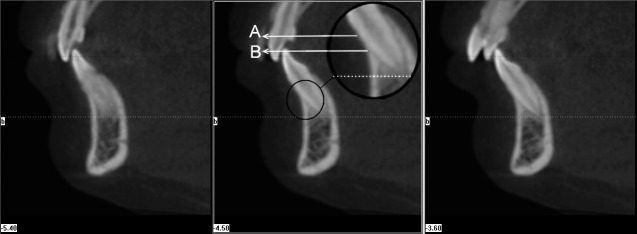
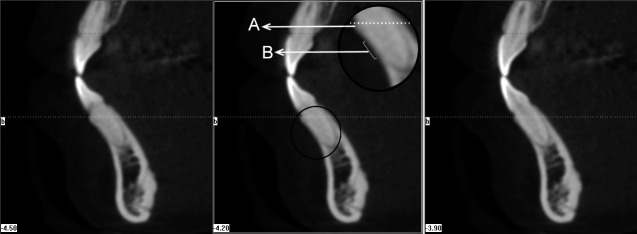
Materials and methods: A total of 1872 teeth in 26 hyper-divergent (mean age: 24.4 ± 4.8 years), 27 hypo-divergent (mean age: 25.1 ± 4.5 years), and 25 normo-divergent (mean age: 23.6 ± 4.1 years) patients with no previous orthodontic treatment were evaluated using cone-beam computed tomography. Axial and cross-sectional views were evaluated with regard to whether dehiscence and/or fenestration on buccal and lingual surfaces existed or not. For statistical analysis, the Pearson chi-square test was used at a P < .05 significance level.
Results: According to the statistical analysis, the hypo-divergent group (6.56%) had lower dehiscence prevalence than the hyper-divergent (8.35%) and normo-divergent (8.18%) groups (P = .004). Higher prevalences of dehiscence and fenestration were found on buccal sides in all vertical growth patterns. While fenestration was a common finding for the maxillary alveolar region, dehiscence was a common finding in the mandible in all groups.
Conclusion: The null hypothesis was rejected. Although the prevalence of fenestrations was not different, significant differences for dehiscences were found in patients with different vertical growth patterns.
Figures
References
-
- Handelman C. S. The anterior alveolus: its importance in limiting orthodontic treatment and its influence on the occurrence of iatrogenic sequelae. Angle Orthod. 1996;66:95–109. - PubMed
-
- Årtun J, Krogstad O. Periodontal status of mandibular incisors following excessive proclination: a study in adults with surgically treated mandibular prognathism. Am J Orthod Dentofacial Orthop. 1987;91:225–232. - PubMed
-
- Lindhe J, Karring T, Araujo M. The anatomy of periodontal tissues. In: Lindhe J, Karring T, Lang N. P, editors. Clinical Periodontology and Implant Dentistry 4th ed. Copenhagen, Denmark: Blackwell Munksgaard; 2003. pp. 3–48.
-
- Reitan F, Rygh P. Biomechanical principles and reactions. In: Graber T. M, Vandarsdall R. L, editors. Orthodontics Current Principles and Techniques 2nd ed. St Louis, Mo: Mosby-Year Book; 1994. pp. 96–192.
-
- Evangelista K, Vasconcelos K. F, Bumann A, Hirsch E, Nitka M, Silva M. A. G. Dehiscence and fenestration in patients with Class I and Class II Division 1 malocclusion assessed with cone-beam computed tomography. Am J Orthod Dentofacial Orthop. 2010;138:133e1–133e7. - PubMed
MeSH terms
LinkOut - more resources
Full Text Sources