


Active-Q: validation of the web-based physical activity questionnaire using doubly labeled water
- PMID: 22356755
- PMCID: PMC3374527
- DOI: 10.2196/jmir.1974
Active-Q: validation of the web-based physical activity questionnaire using doubly labeled water
Abstract
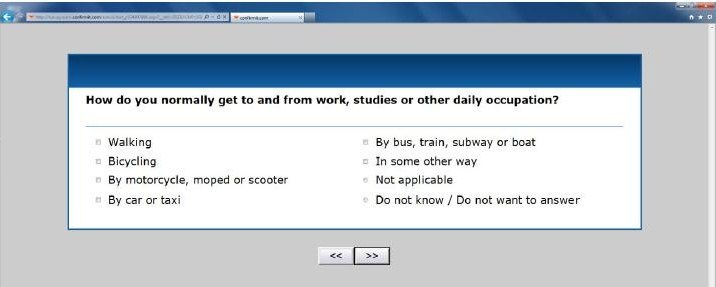
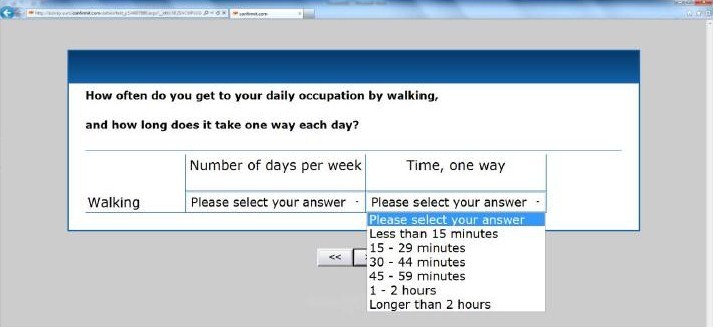
Background: Increased use of the Internet provides new opportunities for collecting data in large studies. The aim of our new Web-based questionnaire, Active-Q, is to assess total physical activity and inactivity in adults. Active-Q assesses habitual activity during the past year via questions in four different domains: (1) daily occupation, (2) transportation to and from daily occupation, (3) leisure time activities, and (4) sporting activities.
Objective: The objective of our study is to validate Active-Q's energy expenditure estimates using the doubly labeled water (DLW) method, and to assess the reproducibility of Active-Q by comparing the results of the questionnaire completed by the same group on two occasions.
Methods: The validity and reproducibility of Active-Q were assessed in a group of 37 individuals, aged 20 to 65 years. Active-Q was distributed via email to the participants. The total energy expenditure of the participants was assessed using DLW for 11 consecutive days.
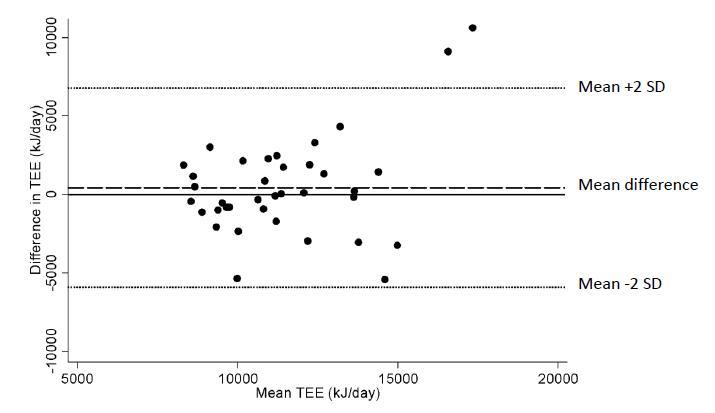
Results: The median time to complete Active-Q was 6.1 minutes. The majority of participants (27/37, 73%) reported that the questionnaire was "easy" or "very easy" to answer. On average, Active-Q overestimated the total daily energy expenditure by 440 kJ compared with the DLW. The Spearman correlation between the two methods was r = 0.52 (P < .001). The intraclass correlation coefficient for total energy expenditure between the results of Active-Q completed on two occasions was 0.83 (95% CI 0.73-0.93).
Conclusions: Active-Q is a valid and reproducible method of assessing total energy expenditure. It is also a user-friendly method and suitable for Web-based data collection in large epidemiological studies.
Figures

References
-
- Bälter KA, Bälter O, Fondell E, Lagerros YT. Web-based and mailed questionnaires: a comparison of response rates and compliance. Epidemiology. 2005 Jul;16(4):577–9.00001648-200507000-00024 - PubMed
-
- De Vera MA, Ratzlaff C, Doerfling P, Kopec J. Reliability and validity of an internet-based questionnaire measuring lifetime physical activity. Am J Epidemiol. 2010 Nov 15;172(10):1190–8. doi: 10.1093/aje/kwq273. http://aje.oxfordjournals.org/cgi/pmidlookup?view=long&pmid=20876666kwq273 - DOI - PMC - PubMed
Publication types
MeSH terms
Substances
LinkOut - more resources
Full Text Sources
Miscellaneous
