


Selective upregulation of lipid metabolism in skeletal muscle of foraging juvenile king penguins: an integrative study
- PMID: 22357259
- PMCID: PMC3350679
- DOI: 10.1098/rspb.2011.2664
Selective upregulation of lipid metabolism in skeletal muscle of foraging juvenile king penguins: an integrative study
Abstract
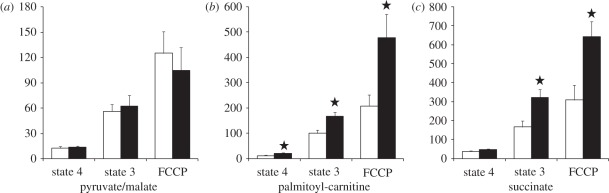
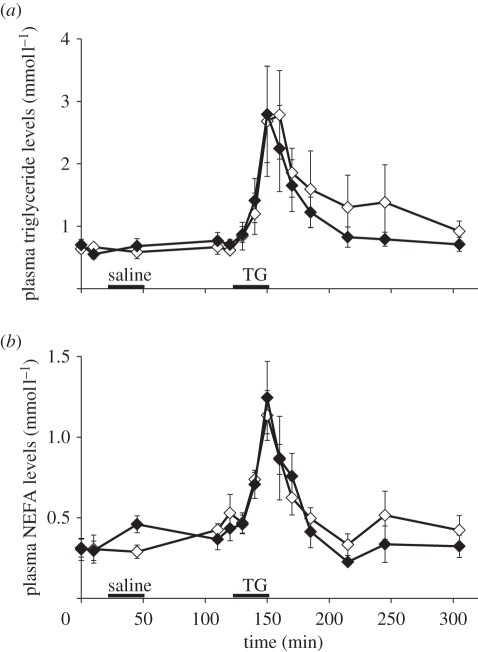
The passage from shore to marine life of juvenile penguins represents a major energetic challenge to fuel intense and prolonged demands for thermoregulation and locomotion. Some functional changes developed at this crucial step were investigated by comparing pre-fledging king penguins with sea-acclimatized (SA) juveniles (Aptenodytes patagonicus). Transcriptomic analysis of pectoralis muscle biopsies revealed that most genes encoding proteins involved in lipid transport or catabolism were upregulated, while genes involved in carbohydrate metabolism were mostly downregulated in SA birds. Determination of muscle enzymatic activities showed no changes in enzymes involved in the glycolytic pathway, but increased 3-hydroxyacyl-CoA dehydrogenase, an enzyme of the β-oxidation pathway. The respiratory rates of isolated muscle mitochondria were much higher with a substrate arising from lipid metabolism (palmitoyl-L-carnitine) in SA juveniles than in terrestrial controls, while no difference emerged with a substrate arising from carbohydrate metabolism (pyruvate). In vivo, perfusion of a lipid emulsion induced a fourfold larger thermogenic effect in SA than in control juveniles. The present integrative study shows that fuel selection towards lipid oxidation characterizes penguin acclimatization to marine life. Such acclimatization may involve thyroid hormones through their nuclear beta receptor and nuclear coactivators.
Figures

References
-
- Ducharme M. B., Lounsbury D. S. 2007. Self-rescue swimming in cold water: the latest advice. Appl. Physiol. Nutr. Metab. 32, 799–807 10.1139/H07-042 (doi:10.1139/H07-042) - DOI - PubMed
-
- Charrassin J., Bost C. 2001. Utilisation of the oceanic habitat by king penguins over the annual cycle. Mar. Ecol. Prog. Ser. 221, 285–298 10.3354/meps221285 (doi:10.3354/meps221285) - DOI
-
- Pütz K. 2002. Spatial and temporal variability in the foraging areas of breeding king penguins. Condor 104, 528–538 10.1650/0010-5422(2002)104[0528:SATVIT]2.0.CO;2 (doi:10.1650/0010-5422(2002)104[0528:SATVIT]2.0.CO;2) - DOI
-
- Cherel Y., Durant J. M., Lacroix A. 2004. Plasma thyroid hormone pattern in king penguin chicks: a semi-altricial bird with an extended posthatching developmental period. Gen. Comp. Endocrinol. 136, 398–405 10.1016/j.ygcen.2004.02.003 (doi:10.1016/j.ygcen.2004.02.003) - DOI - PubMed
-
- Corbel H., Morlon F., Groscolas R. 2008. Is fledging in king penguin chicks related to changes in metabolic or endocrinal status? Gen. Comp. Endocrinol. 155, 804–813 10.1016/j.ygcen.2007.11.006 (doi:10.1016/j.ygcen.2007.11.006) - DOI - PubMed
Publication types
MeSH terms
Substances
LinkOut - more resources
Full Text Sources
Molecular Biology Databases
