. 2012 Feb 23;31(1):16.
doi: 10.1186/1756-9966-31-16.

Short-term anti-vascular endothelial growth factor treatment elicits vasculogenic mimicry formation of tumors to accelerate metastasis

Affiliations

Short-term anti-vascular endothelial growth factor treatment elicits vasculogenic mimicry formation of tumors to accelerate metastasis

Yuan Xu et al. J Exp Clin Cancer Res. .

Abstract

Background: Antiangiogenic therapy is one of the most significant advances in anticancer treatment. The benefits of antiangiogenic therapies of late-stage cancers have been investigated but are still too limited.

Methods: We used an ovarian cancer model to test the effect of short-term bevacizumab treatment on metastasis as measured by bioluminescence. Western blotting and CD34-PAS dual staining were performed to assess hypoxia-inducible transcription factor-1α (HIF-1α) expression and vasculogenic mimicry(VM) formation. Cell viability was examined by a CCK8 assay.

Results: Bevacizumab demonstrated antitumor effects in models of ovarian cancer, but also accelerated metastasis together, with marked hypoxia and VM formation in mice receiving short-term therapy. Bevacizumab treatment did not affect SKOV3 cell viability and the amount of VM in three-dimensional culture.

Conclusion: These results suggest that antiangiogenic therapy may potentially influence the progression of metastatic disease, which has been linked to the hypoxic response and VM formation.


Figures
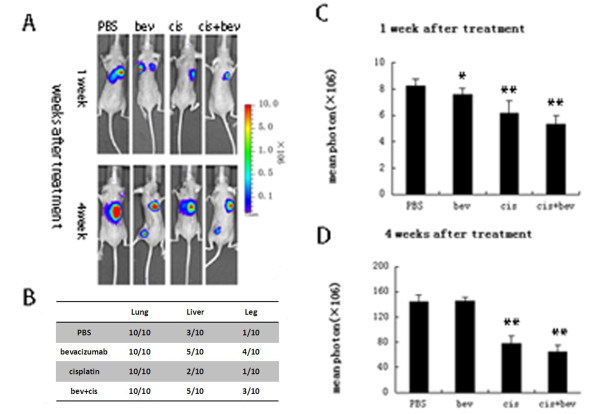
Figure 1
Figure 1
Increased metastasis after short-term treatment with bevacizumab. Forty mice were assigned into four groups (PBS, bevacizumab, cisplatin and bevacizumab + cisplatin). Mean photon counts of each group were quantified. (A) Tumor growth and metastasis were monitored by bioluminescence at 1 and 4 weeks after treatment. A representative experiment is shown. (B) Short-term bevacizumab treatment resulted in accelerated extrapulmonary metastasis at 4 weeks after treatment. Extrapulmonary metastases were found in the livers and legs. The ratio of metastasis of each group was measured. (C) Quantification of bioluminescence showed inhibited tumor growth in bevacizumab and/or cisplatin treatment groups at 1 week after treatment, compared with that of the PBS group. Bevacizumab + cisplatin treatment inhibited tumor growth, compared with that of cisplatin at 1 week after treatment. (D) Quantification of bioluminescence showed no significant difference in tumor growth between bevacizumab and PBS groups 4 weeks after treatment. Bevacizumab + cisplatin treatment inhibited tumor growth compared with that of cisplatin at 4 weeks after treatment. *P < 0.05, **P < 0.01.
Figure 2
Figure 2
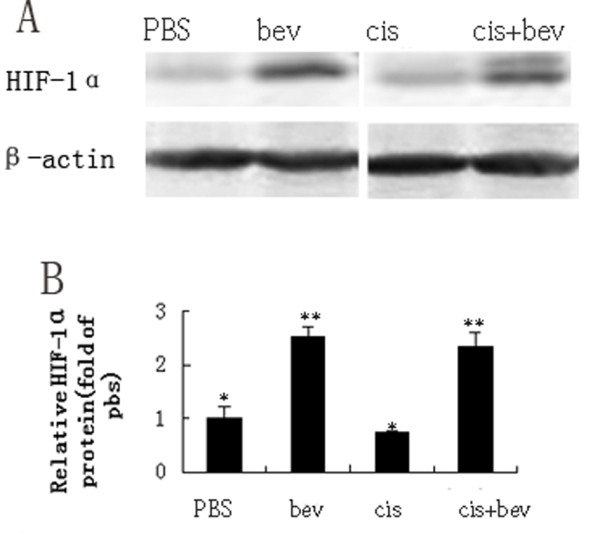
Hypoxia is implicated in the adaptive response after short-term bevacizumab treatment. Expression of HIF-1α in pulmonary tumor nodules of the four groups. (A) A representative western blot is shown. β-actin was used as a loading control. (B) While most tumors showed little expression of HIF-1α protein in PBS and cisplatin groups, mice that received bevacizumab and bevacizumab + cisplatin therapy showed a markedly increased level of HIF-1α expression.. *P < 0.05, **P < 0.01.
Figure 3
Figure 3
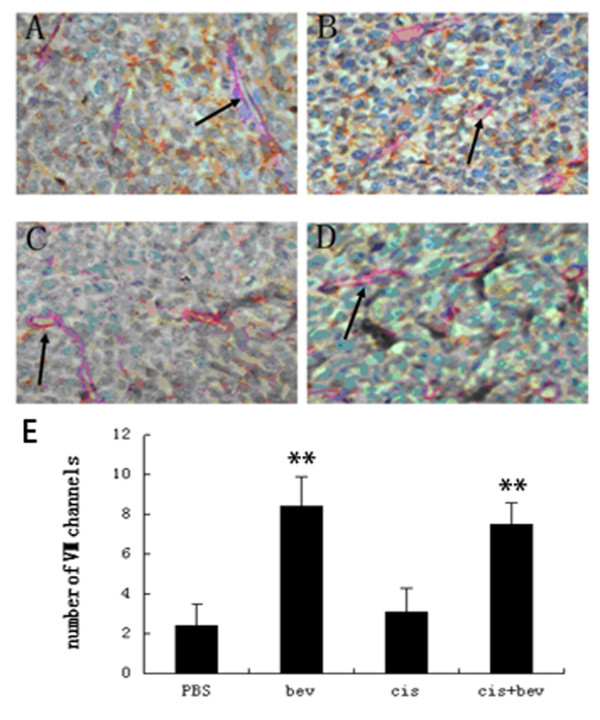
Anti-VEGF treatment induces increased VM. Comparison of VM channels in mice with various treatments. VM channels were positive for PAS staining and negative for CD34 staining in sections (arrow, ×400). (A) PBS (B) bevacizumab (C) cisplatinp and(D) bevacizumab + cisplatin groups. (E) Comparison of VM channels in A, B, C and D. Tumors in the bevacizumab group formed more VM channels than that of PBS and cisplatin, and bevacizumab + cisplatin groups. **P < 0.01.
Figure 4
Figure 4
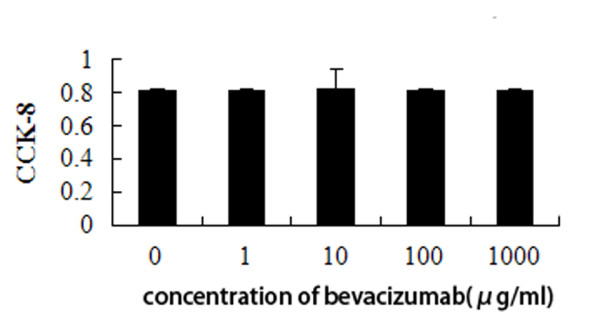
Bevacizumab treatment did not affect SKOV3 cell viability. Bevacizumab treatment (0, 1, 10, 100 and 1000 μg/ml) does not affect SKOV3 cell viability in 3D culture. There were no statistically significant difference (P > 0.05).
Figure 5
Figure 5
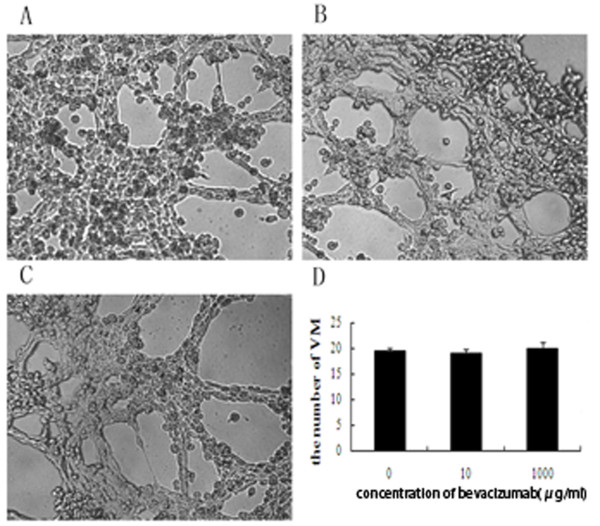
Bevacizumab treatment did not affect the number of tubules. The effect of bevacizumab (0, 10 and 1000 μg/ml) on the formation of VM channels (× 100). (A) Bevacizumab at 0/(B) 10/(C) 1000 μg/ml. (D) Bevacizumab treatment did not affect the number of tubules (P > 0.05).

References

    1. Folkman J. Tumor angiogenesis: therapeutic implications. N Engl J Med. 1971;285:1182–1186. doi: 10.1056/NEJM197111182852108. - DOI - PubMed
    1. Samaranayake H, Määttä AM, Pikkarainen J, Ylä-Herttuala S. Future prospects and challenges of antiangiogenic cancer gene therapy. Hum Gene Ther. 2010;21(4):381–96. doi: 10.1089/hum.2010.017. - DOI - PubMed
    1. Kerbel RS. Tumor angiogenesis. N Engl J Med. 2008;358:2039–2049. doi: 10.1056/NEJMra0706596. - DOI - PMC - PubMed
    1. Jain RK. Normalization of tumor vasculature: an emerging concept in antiangiogenic therapy. Science. 2005;307:58–62. doi: 10.1126/science.1104819. - DOI - PubMed
    1. Qu B, Guo L, Ma J, Lv Y. Antiangiogenesis therapy might have the unintended effect of promoting tumor metastasis by increasing an alternative circulatory system. Med Hypotheses. 2010;74(2):360–361. doi: 10.1016/j.mehy.2009.08.020. - DOI - PubMed

MeSH terms

Substances

LinkOut - more resources