Review
. 2012 Mar;22(3):457-72.
doi: 10.1038/cr.2012.13. Epub 2012 Jan 17.

Understanding cancer stem cell heterogeneity and plasticity

Affiliations
Review

Understanding cancer stem cell heterogeneity and plasticity

Dean G Tang. Cell Res. 2012 Mar.

Abstract

Heterogeneity is an omnipresent feature of mammalian cells in vitro and in vivo. It has been recently realized that even mouse and human embryonic stem cells under the best culture conditions are heterogeneous containing pluripotent as well as partially committed cells. Somatic stem cells in adult organs are also heterogeneous, containing many subpopulations of self-renewing cells with distinct regenerative capacity. The differentiated progeny of adult stem cells also retain significant developmental plasticity that can be induced by a wide variety of experimental approaches. Like normal stem cells, recent data suggest that cancer stem cells (CSCs) similarly display significant phenotypic and functional heterogeneity, and that the CSC progeny can manifest diverse plasticity. Here, I discuss CSC heterogeneity and plasticity in the context of tumor development and progression, and by comparing with normal stem cell development. Appreciation of cancer cell plasticity entails a revision to the earlier concept that only the tumorigenic subset in the tumor needs to be targeted. By understanding the interrelationship between CSCs and their differentiated progeny, we can hope to develop better therapeutic regimens that can prevent the emergence of tumor cell variants that are able to found a new tumor and distant metastases.


Figures
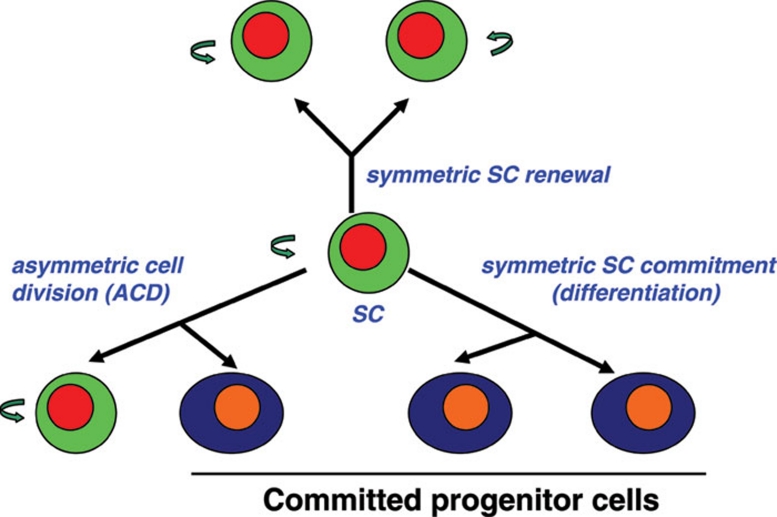
Figure 1
Figure 1
Relationship between stem cell self-renewal and differentiation (or commitment). The stem cell (SC) self-renewal is indicated by curved arrows. Only a uni-potent progenitor cell is depicted. See text for discussion.
Figure 2
Figure 2
A cartoon depicting the heterogeneous nature of human hematopoietic stem/progenitor cell pool. Illustrated are three subsets (i.e., CD34+, CD90+, and CD49f+) of progenitors inside the Lin-CD38CD45RA population. Combined sorting of triple marker-positive (i.e., CD34+CD90+CD49f+; shaded) blood cells (in either bone marrow or cord blood) greatly enriches HSCs with long-term repopulating activity.
Figure 3
Figure 3
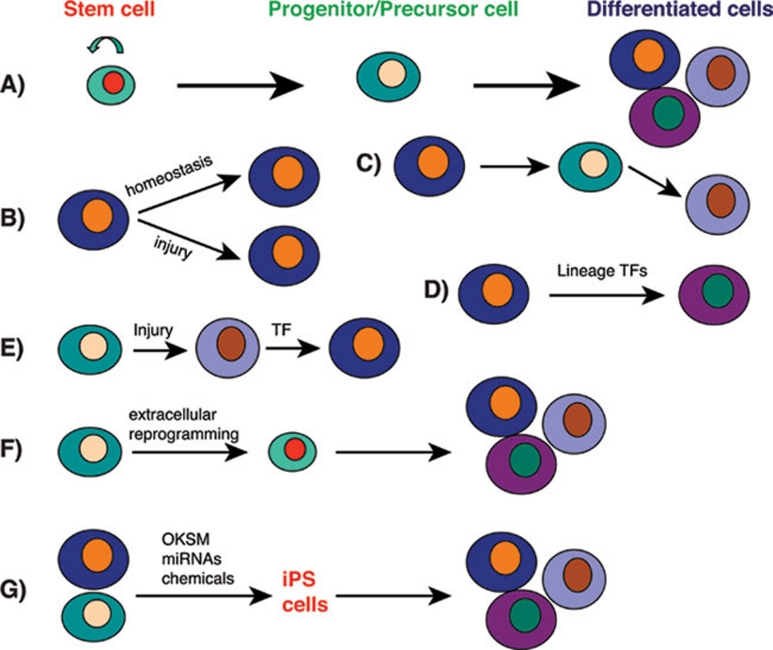
Stem cell development under normal (physiological) conditions (A) and different forms of plasticity of the stem cell progeny during injury and upon induction (B–G).In (A), a self-renewing, relatively quiescent stem cell gives rises to a proliferative progenitor cell (sometimes called a precursor cell), which then develops into non-proliferative terminally differentiated cells. Stem cells, progenitors, and differentiated cells are illustrated in different colors and sizes. As an example, this progenitor cell is depicted to generate three different differentiated cells. (B) A differentiated cell directly generates another differentiated cell of the same type. The best example is mouse pancreatic β-cells. (C–D) Plasticity by which one differentiated cell type is converted (C) or directly converts (D) to another differentiated cell type. (E) A progenitor cell gives rise to a specialized cell type upon injury, which is then transdifferentiated into another specialized cell type by a lineage-specific TF. (F–G) Plasticity by which progenitor (or differentiated) cells are reprogrammed to a more primitive cell, which then develops into various specialized cells. See text for individual examples.
Figure 4
Figure 4
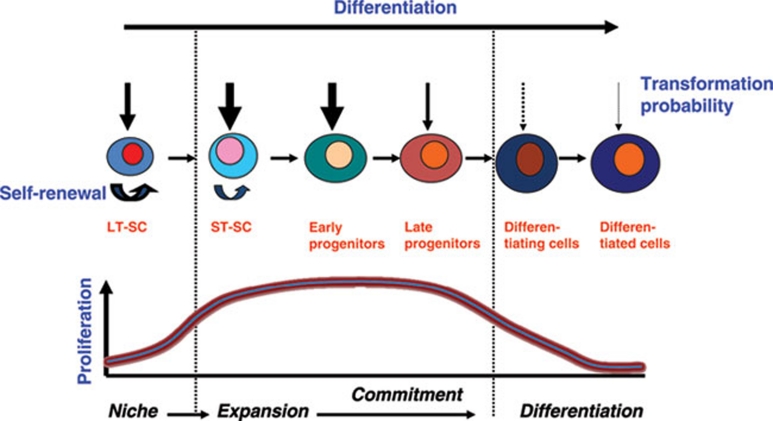
Stem cell proliferation, self-renewal, differentiation, and transformation. Depicted here is a hypothetical long-term stem cell (LT-SC), which has the greatest self-renewal activity and is quiescent in its niche (bottom). LT-SC develops into a short-term stem cell (ST-SC), which shows reduced self-renewal activity but increased proliferation. The ST-SC then gives rise to early progenitor cells that may have lost self-renewal capacity, but probably represent the most proliferative cell population. Early progenitors generate late progenitor cells that begin to commit to differentiate by expressing lineage-specific differentiation markers and these late progenitor cells gradually develop into fully differentiated cells that once again lose proliferative potential (i.e., post-mitotic). From the standpoint of transformation probability, the ST-SC that retains self-renewal activity and progenitor cells that are highly proliferative (demarcated by two vertical thick lines) theoretically could represent the best targets for tumorigenic transformation.
Figure 5
Figure 5
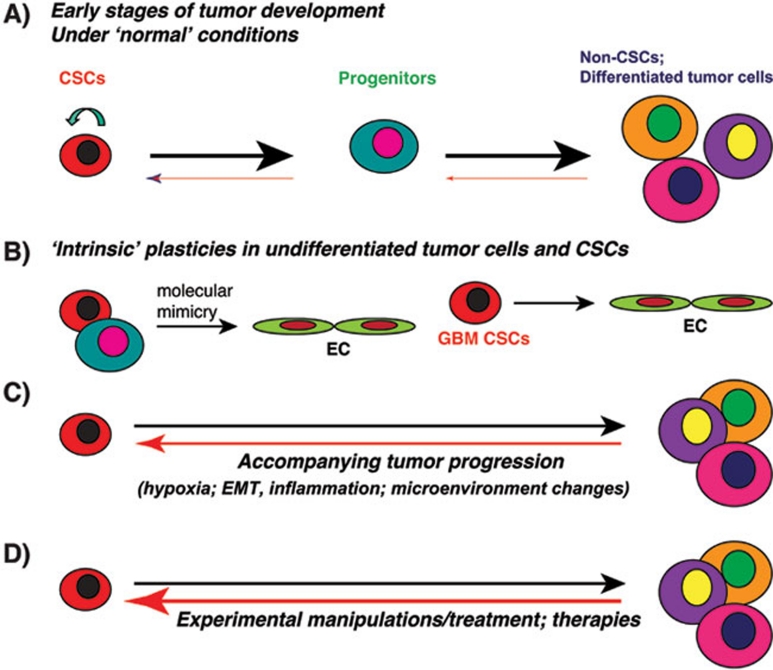
Intrinsic and induced plasticity in CSCs and their progeny. (A) In untreated or early-stage tumors, self-renewing CSCs generate rapidly proliferating tumor progenitors, which may in turn develop into differentiated tumor cells or non-CSCs. This hypothetical developmental pathway perhaps represents the major pathway (indicated by thick arrows) although low levels of spontaneous (or intrinsic) dedifferentiation (indicated by thin arrows) may occur. This model predicts that in the untreated or early-stage tumors, most tumor cells will be partially differentiated tumor progenitors and differentiated tumor cells, with undifferentiated cells representing a minority. The great majority of untreated low-grade breast and prostate cancers, for example, fit this model. (B) Intrinsic plasticity in CSCs manifested as 'molecular mimicry' or GBM CSC transdifferentiation into endothelial cells (EC). (C) During tumor progression, microenvironmental changes, hypoxia, accumulation of inflammatory mediators, together with resultant EMT, may all promote dedifferentiation of non-CSCs (indicated by the thickened reverse arrow). This scenario predicts that in advanced tumors, the undifferentiated, CSC-enriched tumor cells would be in a dynamic equilibrium with more differentiated tumor cells. (D) In vitro experimental manipulations (e.g., mimicking hypoxic conditions, treating cells with EMT-inducers such as cytokines or anti-cancer drugs, overexpressing oncogenic molecules, etc) or persistent tumor therapy in vivo may accentuate dedifferentiation of non-CSCs to stem-like cancer cells (indicated by further thickened reverse arrow) resulting in increased abundance of CSCs.

References

    1. Fuchs E, Horsley V. Ferreting out stem cells from their niches. Nature Cell Biol. 2011;13:513–518. - PMC - PubMed
    1. Medema JP, Vermulen L. Microenvironmental regulation of stem cells in intestinal homeostasis and cancer. Nature. 2011;474:318–326. - PubMed
    1. Simons BD, Clevers H. Strategies for homeostatic stem cell self-renewal in adult tissues. Cell. 2011;145:851–862. - PubMed
    1. Li L, Clevers H. Coexistence of quiescent and active adult stem cells in mammals. Science. 2010;327:542–545. - PMC - PubMed
    1. Cotsarelis G, Cheng SZ, Dong G, Sun TT, Lavker RM. Existence of slow-cycling limbal epithelial basal cells that can be preferentially stimulated to proliferate: Implications on epithelial stem cells. Cell. 1989;57:201–209. - PubMed

Publication types