. 2012 Jun 1;302(11):F1447-54.
doi: 10.1152/ajprenal.00436.2011. Epub 2012 Feb 22.

Modulation of spontaneous activity in the overactive bladder: the role of P2Y agonists

Affiliations

Modulation of spontaneous activity in the overactive bladder: the role of P2Y agonists

C H Fry et al. Am J Physiol Renal Physiol. .

Abstract

Spinal cord transection (SCT) leads to an increase in spontaneous contractile activity in the isolated bladder that is reminiscent of an overactive bladder syndrome in patients with similar damage to the central nervous system. An increase in interstitial cell number in the suburothelial space between the urothelium and detrusor smooth muscle layer occurs in SCT bladders, and these cells elicit excitatory responses to purines and pyrimidines such as ATP, ADP, and UTP. We have investigated the hypothesis that these agents underlie the increase in spontaneous activity. Rats underwent lower thoracic spinal cord transection, and their bladder sheets or strips, with intact mucosa except where specified, were used for experiments. Isometric tension was recorded and propagating Ca(2+) and membrane potential (E(m)) waves were recorded by fluorescence imaging using photodiode arrays. SCT bladders were associated with regular spontaneous contractions (2.9 ± 0.4/min); ADP, UTP, and UDP augmented the amplitude but not their frequency. With strips from such bladders, a P2Y(6)-selective agonist (PSB0474) exerted similar effects. Fluorescence imaging of bladder sheets showed that ADP or UTP increased the conduction velocity of Ca(2+)/E(m) waves that were confined to regions of the bladder wall with an intact mucosa. When transverse bladder sections were used, Ca(2+)/E(m) waves originated in the suburothelial space and propagated to the detrusor and urothelium. Analysis of wave propagation showed that the suburothelial space exhibited properties of an electrical syncitium. These experiments are consistent with the hypothesis that P2Y-receptor agonists increase spontaneous contractile activity by augmenting functional activity of the cellular syncitium in the suburothelial space.


Figures
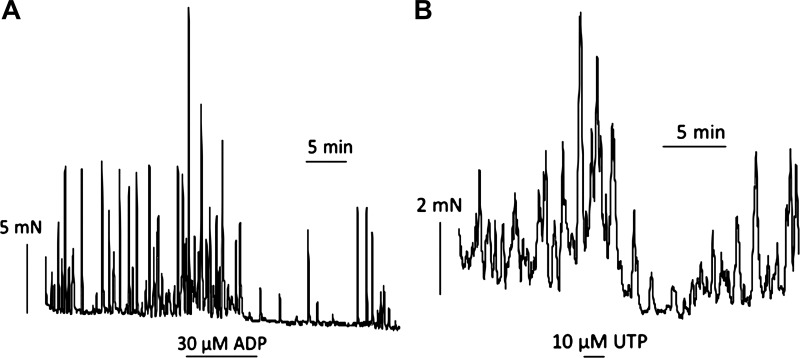
Fig. 1.
Fig. 1.
Spontaneous contractile activity from spinal cord transected (SCT) rat bladder sheets from an intact mucosa. A: exposure to 30 μM ADP. B: exposure to 10 μM UTP for durations as indicated by the lengths of the horizontal bars.
Fig. 2.
Fig. 2.
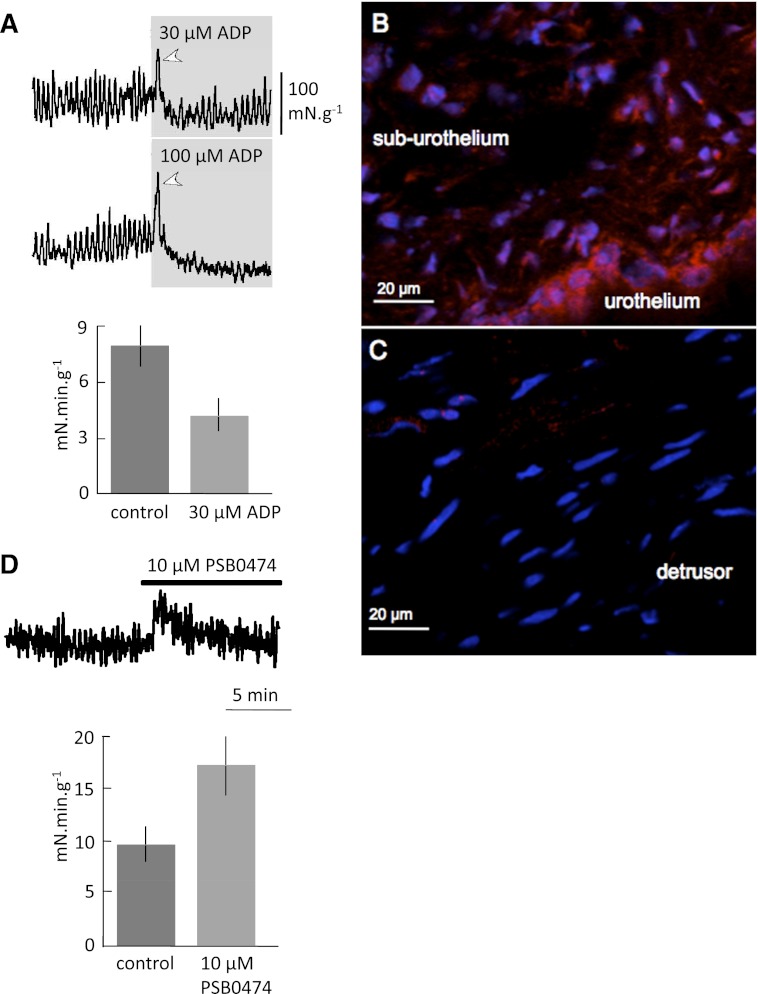
A: Spontaneous contractile activity from detrusor strips, with mucosa removed, of SCT rat bladders. Top traces show response to 30 and 100 μM ADP added for the duration shown in the grey boxes. The bar chart shows the tension integral in baseline conditions and in the presence of 30 μM ADP. B: P2Y6 receptor labeling (red) in the rat mucosa; nuclei are labeled with TO-PRO-3 (blue). C: P2Y6 and TO-PRO-3 labeling in the detrusor layer. D: detrusor strips with intact mucosa. Top trace shows response to 10 μM PSB0474, added for the duration of the thick bar above the trace. The bar chart shows the tension integral in baseline conditions and in the presence of 10 μM PSB0474.
Fig. 3.
Fig. 3.
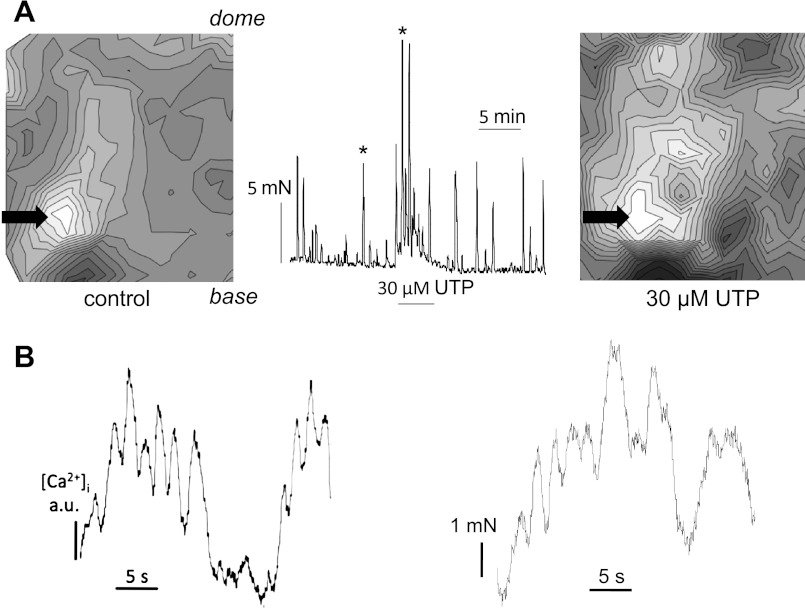
Ca2+ wave maps from bladder sheets with an intact mucosa (isochronal interval 100 ms). The base and dome regions of the sheets are indicated in the left-hand maps. A: SCT rat bladder. Maps show sheets in the baseline condition (left) and in the presence of 30 μM UTP (right). The tension trace corresponding to the experiment from which the maps were constructed is shown. Arrows mark the spontaneous contractions corresponding to the 2 maps. UTP was added for the duration of the bar below the trace. The arrows indicate the origins of the propagating wave. B: correspondence between the time course of a Ca2+ transient from a single pixel and contractile activity in a bladder preparation during exposure to 30 μM ADP.
Fig. 4.
Fig. 4.
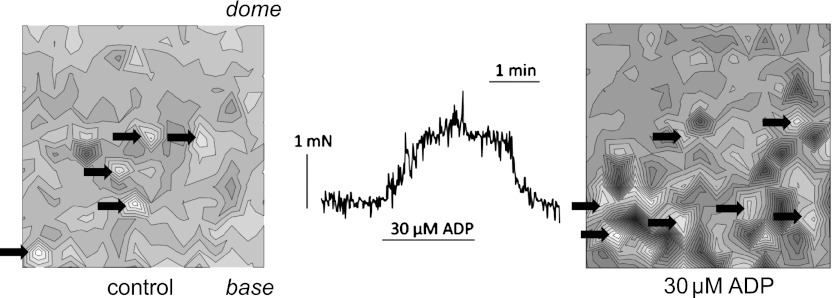
Ca2+ wave maps for a bladder sheet from an unoperated animal. Maps show the sheet in baseline solution (left) and in the presence of 30 μM ADP (right) and the corresponding tension trace. ADP was added for the duration of the bar below the trace. Arrows mark focal origins of activity.
Fig. 5.
Fig. 5.
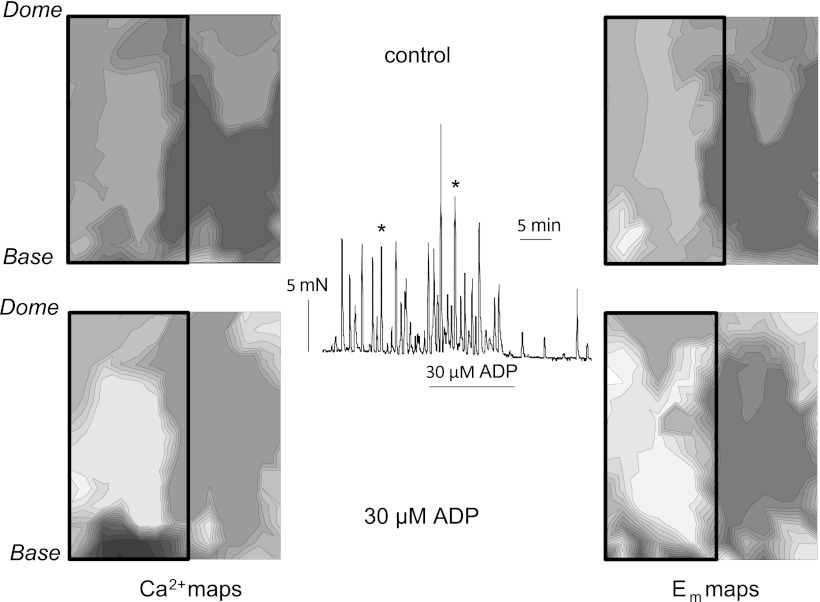
Ca2+ (left) and membrane potential (Em; right) maps from a SCT rat bladder sheet. The mucosa was removed from the right-hand side of the sheet; the box marks the area of intact mucosa. Maps were obtained before (top) and during (bottom) the application of 30 μM ADP. Arrows on the tension trace mark the spontaneous contractions corresponding to the maps. ADP was added for the duration of the bar below the trace.
Fig. 6.
Fig. 6.
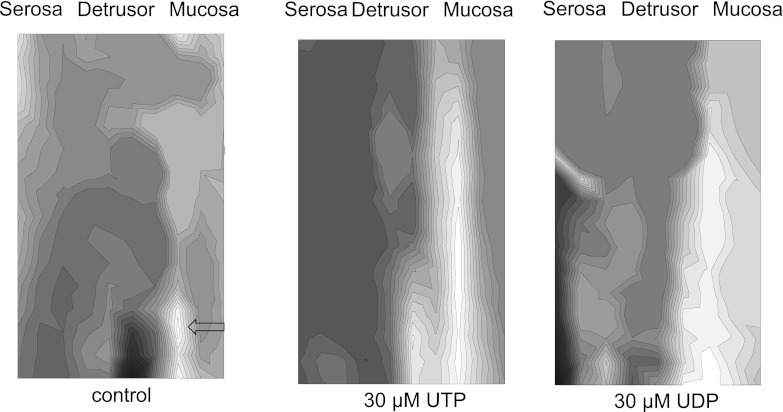
Ca2+ maps from a transverse section of a SCT rat bladder in the baseline condition (left) and during the subsequent application of 30 μM UTP and 30 μM UDP. The positions of 2 loci for Ca2+ waves are indicated by the black arrow on the baseline map. The UTP map was obtained immediately after the baseline map. The UDP map was obtained after 15-min washout of UTP.
Fig. 7.
Fig. 7.
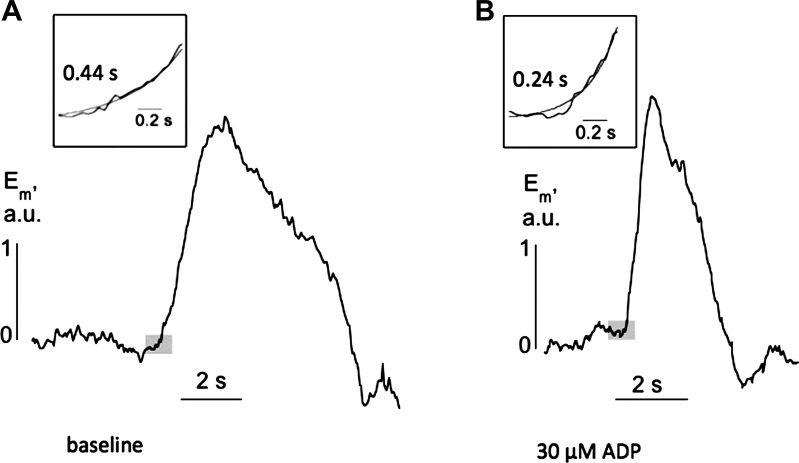
Individual propagating membrane potential transients from a transverse section of a SCT rat: A: in baseline conditions. B: in the presence of 30 μM ADP. Insets: basal regions of the transients used to calculate the variable τ*. Shaded boxes show the regions from which the insets were analyzed.

References

    1. Abrams P. Describing bladder storage function: overactive bladder syndrome and detrusor overactivity. Urology 62: 28–37: 2003 - PubMed
    1. Aronsson P, Andersson M, Ericsson T, Giglio D. Assessment and characterization of purinergic contractions and relaxations in the rat urinary bladder. Basic Clin Pharmacol Toxicol 107: 603–613, 2010 - PubMed
    1. Biers SM, Reynard JM, Doore T, Brading AF. The functional effects of a c-kit tyrosine inhibitor on guinea-pig and human detrusor. BJU Int 97: 612–616, 2006 - PubMed
    1. Birder LA, Ruan HZ, Chopra B, Xiang Z, Barrick S, Buffington CA, Roppolo JR, Ford AP, de Groat WC, Burnstock G. Alterations in P2X and P2Y purinergic receptor expression in urinary bladder from normal cats and cats with interstitial cystitis. Am J Physiol Renal Physiol 287: F1084–F1091, 2004 - PubMed
    1. Bolego C, Pinna C, Abbracchio MP, Cattabeni F, Puglisi L. The biphasic response of rat vesical smooth muscle to ATP. Br J Pharmacol 114: 1557–1562, 1995 - PMC - PubMed

Publication types

MeSH terms

Substances