


Comment
doi: 10.1038/482474a.
Cell biology: Collagen secretion explained
- PMID: 22358830
- PMCID: PMC3566552
- DOI: 10.1038/482474a
Item in Clipboard
Comment
Cell biology: Collagen secretion explained
Nature.
.
Abstract
Cells package proteins into vesicles for secretion to the extracellular milieu. A study shows that an enzyme modifies the packaging machinery to encapsulate unusually large proteins such as collagen.
Figures
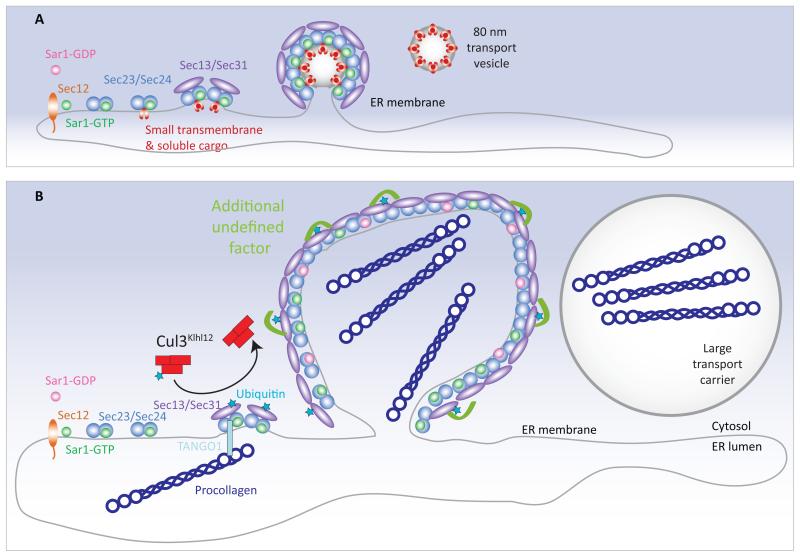
a, Soluble proteins targeted for secretion, together with small transmembrane proteins, are packaged at the endoplasmic reticulum into vesicles that are coated by the COPII protein cage. Proteins that will form the inner layer of the COPII coat associate in an ordered fashion, and then recruit the proteins Sec13 and Sec31, which will form the outer layer. This leads to membrane deformation and ultimately scission of 60-80 nm transport vesicles. b, Large proteins such as procollagen (the collagen precursor) do not fit within these typical vesicles. Jin et al. report that, to encapsulate these large cargoes, the enzyme Cul2Klhl12 attaches one copy of the small protein ubiquitin to Sec31, and that this process facilitates collagen export. An additional unknown protein might further stabilize lateral Sec13-Sec31 interactions. Although it is not known whether collagen synthesis directly triggers Cul2Klhl12 activity, the transmembrane protein TANGO1 — which couples collagen in the endoplasmic reticulum to the assembling coat on the cytosolic face — might have a role in the process.
Comment on
-
Ubiquitin-dependent regulation of COPII coat size and function.Nature. 2012 Feb 22;482(7386):495-500. doi: 10.1038/nature10822. Nature. 2012. PMID: 22358839 Free PMC article.
References
Publication types
MeSH terms
Substances
Grants and funding
LinkOut - more resources
Full Text Sources
