


Trends in notifiable infectious diseases in China: implications for surveillance and population health policy
- PMID: 22359565
- PMCID: PMC3281048
- DOI: 10.1371/journal.pone.0031076
Trends in notifiable infectious diseases in China: implications for surveillance and population health policy
Abstract
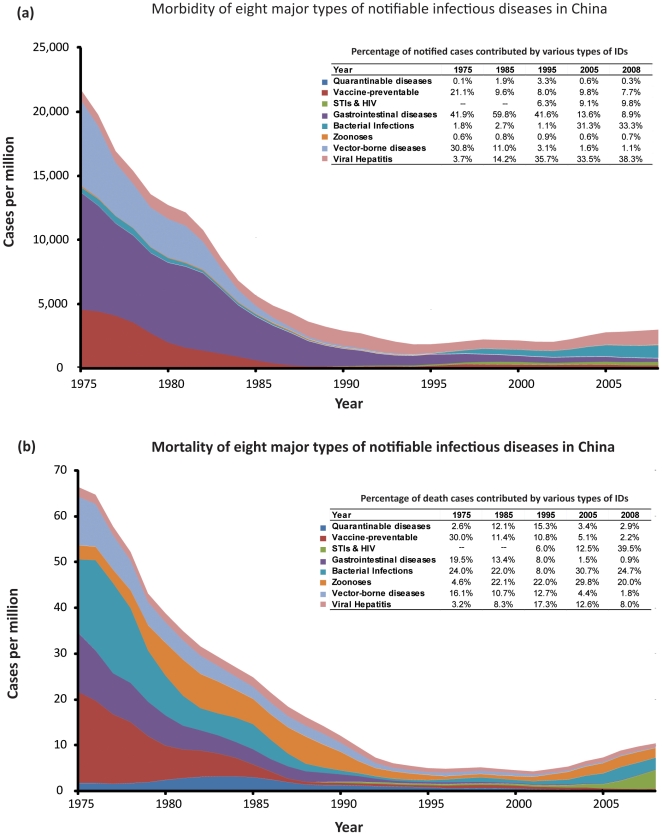
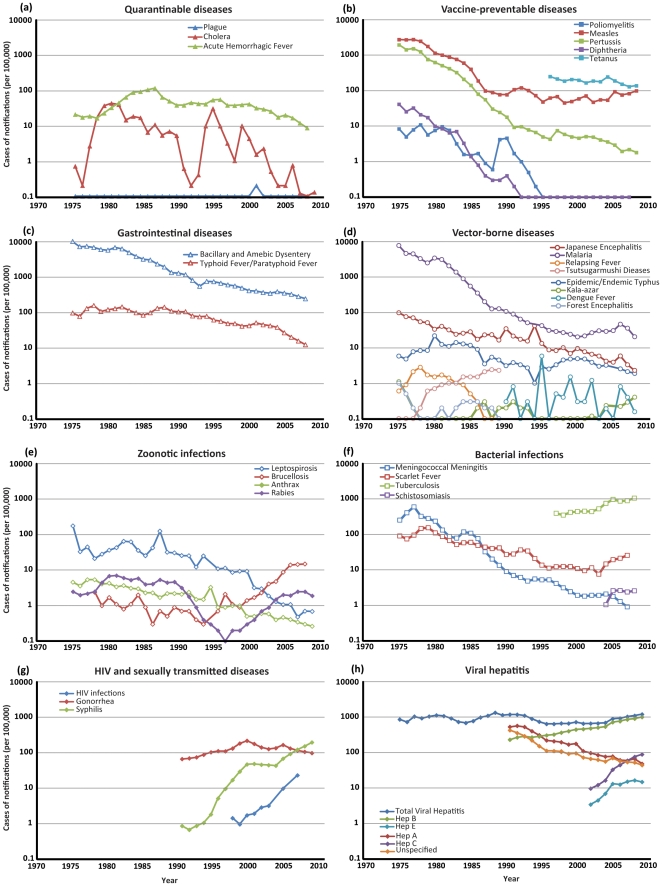
This study aimed to analyse trends in notifiable infectious diseases in China, in their historical context. Both English and Chinese literature was searched and diseases were categorised according to the type of disease or transmission route. Temporal trends of morbidity and mortality rates were calculated for eight major infectious diseases types. Strong government commitment to public health responses and improvements in quality of life has led to the eradication or containment of a wide range of infectious diseases in China. The overall infectious diseases burden experienced a dramatic drop during 1975-1995, but since then, it reverted and maintained a gradual upward trend to date. Most notifiable diseases are contained at a low endemic level; however, local small-scale outbreaks remain common. Tuberculosis, as a bacterial infection, has re-emerged since the 1990s and has become prevalent in the country. Sexually transmitted infections are in a rapid, exponential growth phase, spreading from core groups to the general population. Together human immunodeficiency virus (HIV), they account for 39% of all death cases due to infectious diseases in China in 2008. Zoonotic infections, such as severe acute respiratory syndrome (SARS), rabies and influenza, pose constant threats to Chinese residents and remain the most deadly disease type among the infected individuals. Therefore, second-generation surveillance of behavioural risks or vectors associated with pathogen transmission should be scaled up. It is necessary to implement public health interventions that target HIV and relevant coinfections, address transmission associated with highly mobile populations, and reduce the risk of cross-species transmission of zoonotic pathogens.
Conflict of interest statement
Figures
References
-
- Ci W. Establishment and amelioration of planned immunization in China. China Journal of Preventive Medicine. 2000;34:67–68. - PubMed
-
- Zhang S. Study on the strategy for Shanghai Disease control and prevention. ShanghHai Journal of Preventive Medicine. 2001;12:253–256.
-
- Liu D, Wang X, Pan F, Xu Y, Yang P, et al. Web-based infectious disease reporting using XML forms. Int J Med Inform. 2008;77:630–640. - PubMed
-
- Ministry of Health. 2006 Yearbook of Chinese Health Statistics. Beijing: Chinese Academy of Medical Sciences and Peking Union Medical College Press; 2006.
Publication types
MeSH terms
LinkOut - more resources
Full Text Sources
Medical
Miscellaneous
