Randomized Controlled Trial
. 2012 Sep;24(9):1834-48.
doi: 10.1162/jocn_a_00209. Epub 2012 Feb 23.

Strategic allocation of attention reduces temporally predictable stimulus conflict

Affiliations
Randomized Controlled Trial

Strategic allocation of attention reduces temporally predictable stimulus conflict

L Gregory Appelbaum et al. J Cogn Neurosci. 2012 Sep.

Abstract

Humans are able to continuously monitor environmental situations and adjust their behavioral strategies to optimize performance. Here we investigate the behavioral and brain adjustments that occur when conflicting stimulus elements are, or are not, temporally predictable. ERPs were collected while manual response variants of the Stroop task were performed in which the SOAs between the relevant color and irrelevant word stimulus components were either randomly intermixed or held constant within each experimental run. Results indicated that the size of both the neural and behavioral effects of stimulus incongruency varied with the temporal arrangement of the stimulus components, such that the random-SOA arrangements produced the greatest incongruency effects at the earliest irrelevant first SOA (-200 msec) and the constant-SOA arrangements produced the greatest effects with simultaneous presentation. These differences in conflict processing were accompanied by rapid (∼150 msec) modulations of the sensory ERPs to the irrelevant distractor components when they occurred consistently first. These effects suggest that individuals are able to strategically allocate attention in time to mitigate the influence of a temporally predictable distractor. As these adjustments are instantiated by the participants without instruction, they reveal a form of rapid strategic learning for dealing with temporally predictable stimulus incongruency.


Figures
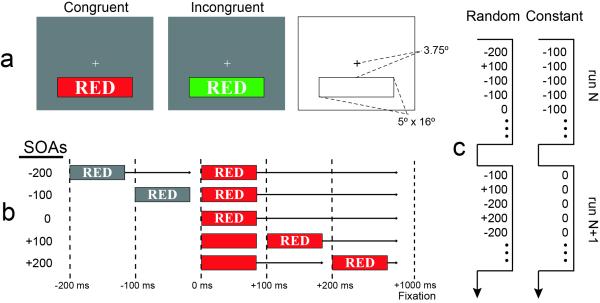
Figure 1
Figure 1. Schematic illustration of stimuli and tasks
a) Example congruent and incongruent stimuli with stimulus dimensions. b) Schematic illustration of the timing sequence for the two stimulus components at each SOA condition. Each temporal separation (−200, −100, 0, +100, and +200 ms) is shown in a separate row with vertical, dotted lines indicating times at which stimuli components were presented. Once both stimulus components were presented, they remained on the screen for an additional 1000 ms until the fixation screen reappeared. The participant’s task was always to report the color of the bar, which was defined as 0 ms in this schematic. c) Schematic of SOA trial-type arrangements over successive ~3 minute runs for the constant-SOA and random-SOA tasks.
Figure 2
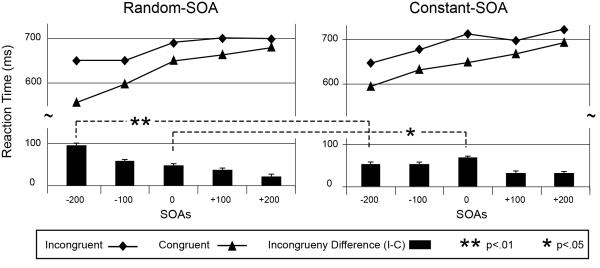
Figure 2. SOA arrangement alters the pattern of incongruency effects
Reaction times for the random-SOA, and constant-SOA variants of the Stroop task produced different profiles of SOA-incongruency interactions. While statistically significant behavioral incongruency effects were observed across all SOA conditions (see Table 1), incongruency effects were maximal at the earliest distracter-exposure condition for the random-SOA arrangement (−200 ms) but was largest at the simultaneous (0 ms) condition for the constant-SOA arrangement. Error bars indicate 1 standard error of the mean (SEM).
Figure 3
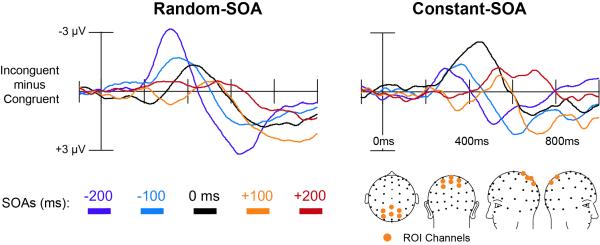
Figure 3. ERP incongruency difference waves for the random-SOA and constant-SOA variants of the Stroop task
Group average difference waves (incongruent minus congruent) computed over the 6-channel ROI (depicted in the lower right) are shown for the 5 SOAs in each task. The pattern of ERP incongruency effects, as a function of the SOA, differed between the random- and constant-SOA conditions, indicating that Stroop incongruency depended on the contextual arrangement of SOA trials over the course of an experimental run.
Figure 4
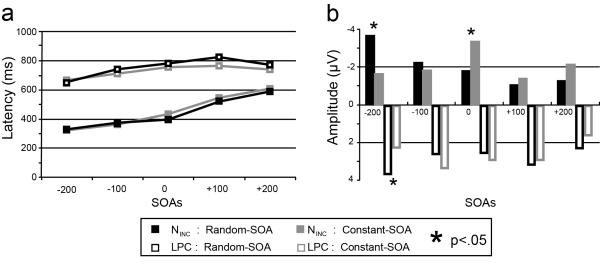
Figure 4. Quantitative summary of ERP measures
a) Peak latencies and b) peak amplitudes and for the random-SOA and constant-SOA task variants across the five SOAs. Average NINC (filled symbols) and LPC (open symbols) latencies did not differ for the two tasks at any SOA. In close agreement with the behavioral effects, however (see Figure 2), the incongruency-effect amplitudes produced differing SOA by SOA-arrangement profiles. In particular, at the −200 ms SOA, the random-SOA arrangements produced greater activity for both the NINC and the LPC, while at the 0 ms SOA NINC activity was larger for the constant-SOA task. Significant paired t-test results are indicated with asterisks.
Figure 5
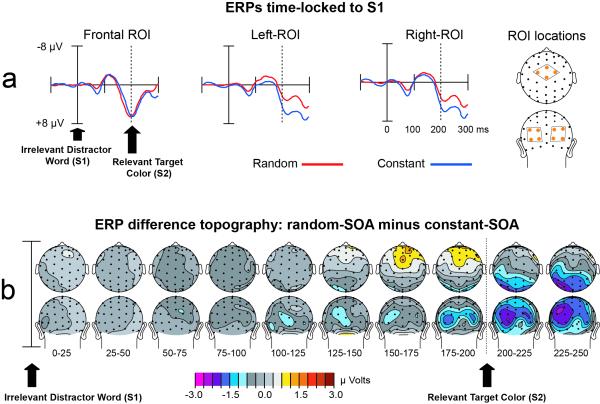
Figure 5. Distracter predictability modulates sensory stimulus processing
In order to visualize task differences due to the arrangement of SOAs, random- and constant-SOA waveforms, along with topographic distributions of the difference between these two conditions, are shown for the −200ms SOA (i.e., when the distracter word occurred 200 ms before the target color bar to be named). a) ERPs time-locked to the distracter-word (S1) are shown for the random-SOA (red) and constant-SOA (blue) task variants. Each of these waveforms is collapsed over congruent and incongruent trial types as congruency has no meaning prior to the presentation of the S2 stimulus. b) Topographic distribution of the random-SOA minus constant-SOA difference for the S1-elicited ERP in the −200ms SOA condition. This subtraction produces a frontal-positive/occipital-negative difference that initiates prior to the S2 stimulus presentation, indicating modulations in visual processing of the distracter word stimulus due to the SOA arrangement of the task.

References

    1. Anllo-Vento L, Hillyard SA. Selective attention to the color and direction of moving stimuli: electrophysiological correlates of hierarchical feature selection. Percept Psychophys. 1996;58(2):191–206. - PubMed
    1. Appelbaum LG, Liotti M, Perez R, Fox SP, Woldorff MG. The temporal dynamics of implicit processing of non-letter, letter, and word-forms in the human visual cortex. Front Hum Neurosci. 2009;3:56. - PMC - PubMed
    1. Appelbaum LG, Meyerhoff KL, Woldorff MG. Priming and backward influences in the human brain: processing interactions during the stroop interference effect. Cereb Cortex. 2009;19(11):2508–2521. - PMC - PubMed
    1. Atkinson CM, Drysdale KA, Fulham WR. Event-related potentials to Stroop and reverse Stroop stimuli. Int J Psychophysiol. 2003;47(1):1–21. - PubMed
    1. Badzakova-Trajkov G, Barnett KJ, Waldie KE, Kirk IJ. An ERP investigation of the Stroop task: the role of the cingulate in attentional allocation and conflict resolution. Brain Res. 2009;1253:139–148. - PubMed

Publication types