The food environment and student weight status, Los Angeles County, 2008-2009
- PMID: 22360872
- PMCID: PMC3362407
The food environment and student weight status, Los Angeles County, 2008-2009
Abstract
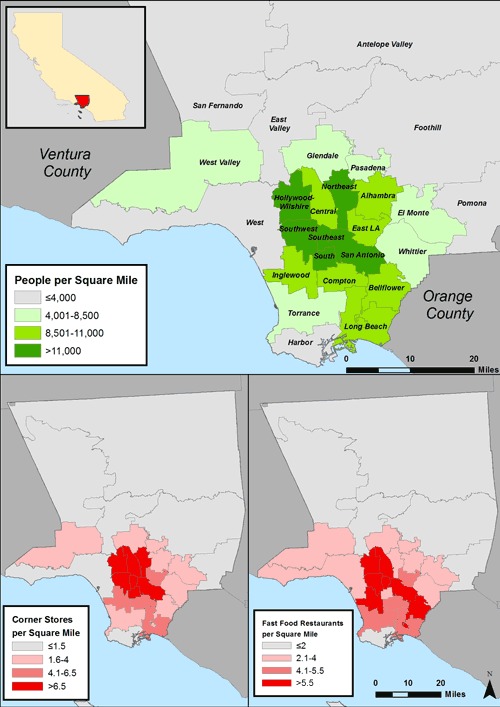
Introduction: One factor believed to affect overweight status is the food environment, or the distribution of outlets that serve healthful or unhealthful foods in residential areas, workplaces, and schools. Few studies have investigated the association between the food environment and the prevalence of overweight among children and adolescents. The objective of this study was to investigate the association between the distribution of corner stores and fast food restaurants around Los Angeles County public schools and the prevalence of overweight among students.
Methods: Hierarchical linear models were used to assess the association between the presence of corner stores or fast food restaurants within a half-mile of Los Angeles County schools (N = 1,694) and overweight prevalence among students in grades 5, 7, and 9.
Results: The presence of corner stores and fast food restaurants varied significantly by schools' racial/ethnic composition, Title 1 eligibility, and rural/suburban vs urban location. After adjustment for other factors, overweight prevalence was 1.6 percentage points higher at majority-Latino schools that had at least 1 corner store within a half-mile than at majority-Latino schools that did not have a corner store within a half-mile. The association between corner stores and overweight prevalence varied significantly between majority-Latino schools and schools that were majority-white or that had no racial/ethnic majority. The presence of fast food restaurants within a half-mile of schools was not associated with overweight prevalence among students.
Conclusion: This study underscores the importance of interventions that seek to improve the healthfulness of corner store inventories and of student purchases.
Figures
References
-
- Flegal KM, Carroll MD, Ogden CL, Curtin LR. Prevalence and trends in obesity among US adults, 1999-2008. JAMA. 2010;303(3):235–241. - PubMed
-
- Ogden CL, Carroll MD, Curtin LR, McDowell MA, Tabak CJ, Flegal KM. Prevalence of overweight and obesity in the United States, 1999-2004. JAMA. 2006;295(13):1549–1555. - PubMed
-
- Dietz WH. Health consequences of obesity in youth: childhood predictors of adult disease. Pediatrics. 1998;101(3):518–525. - PubMed
-
- Ogden CL, Carroll MD, Curtin LR, Lamb MM, Flegal KM. Prevalence of high body mass index in US children and adolescents, 2007-2008. JAMA. 2010;303(3):242–249. - PubMed
Publication types
MeSH terms
Grants and funding
LinkOut - more resources
Full Text Sources