


Prediction of long-term mortality after percutaneous coronary intervention in older adults: results from the National Cardiovascular Data Registry
- PMID: 22361329
- PMCID: PMC3356775
- DOI: 10.1161/CIRCULATIONAHA.111.066969
Prediction of long-term mortality after percutaneous coronary intervention in older adults: results from the National Cardiovascular Data Registry
Abstract
Background: The purpose of this study was to develop a long-term model to predict mortality after percutaneous coronary intervention in both patients with ST-segment elevation myocardial infarction and those with more stable coronary disease.
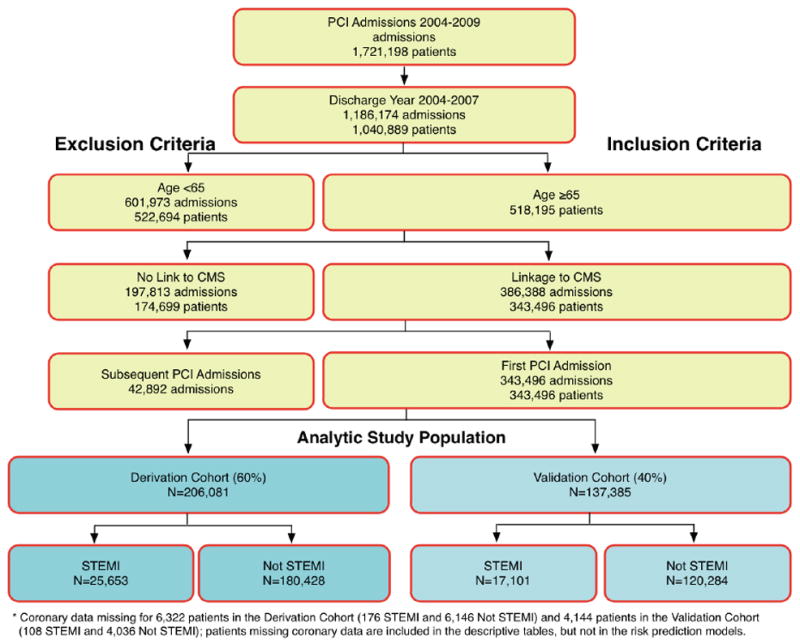
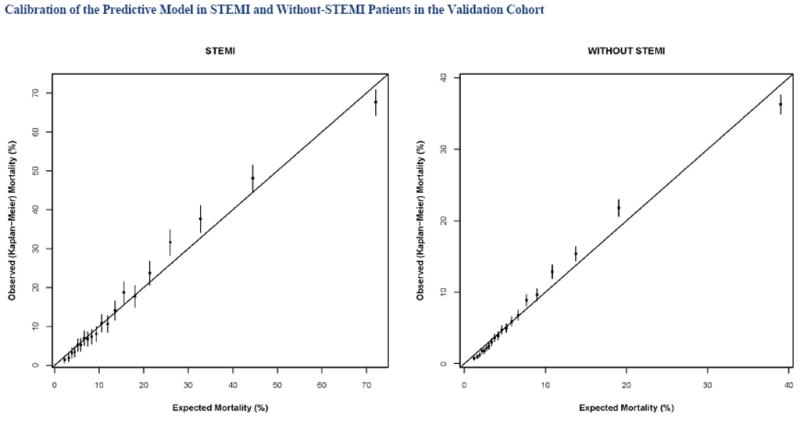
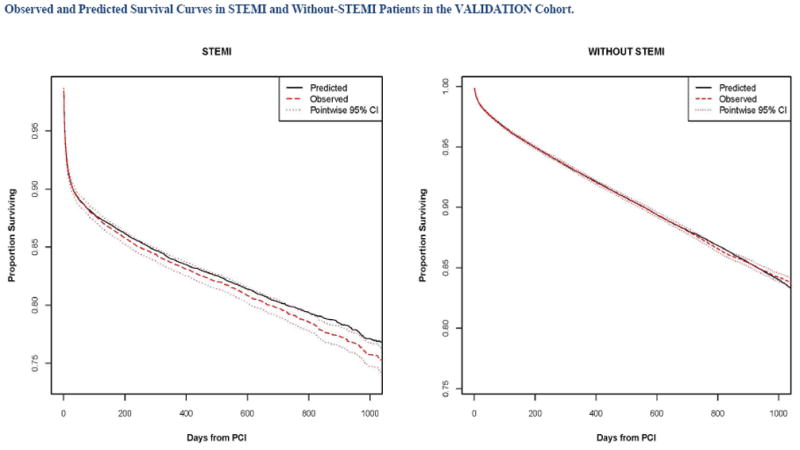
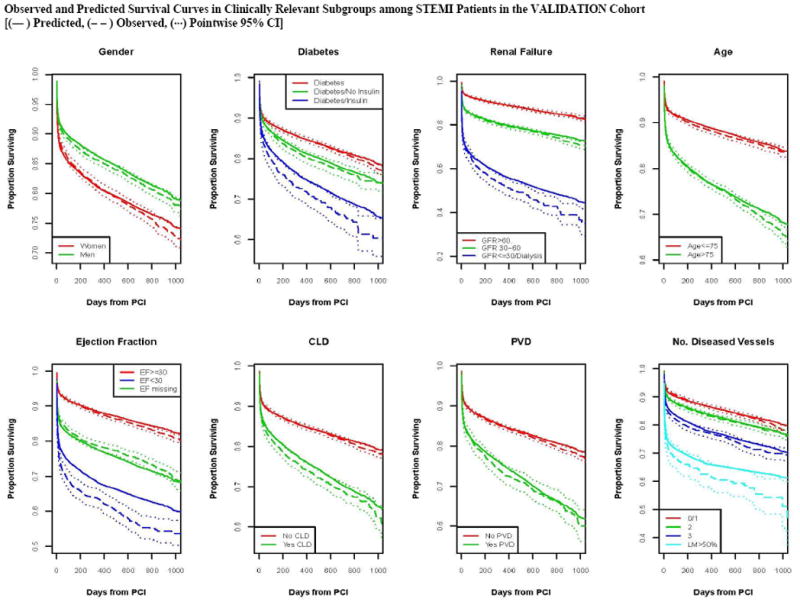
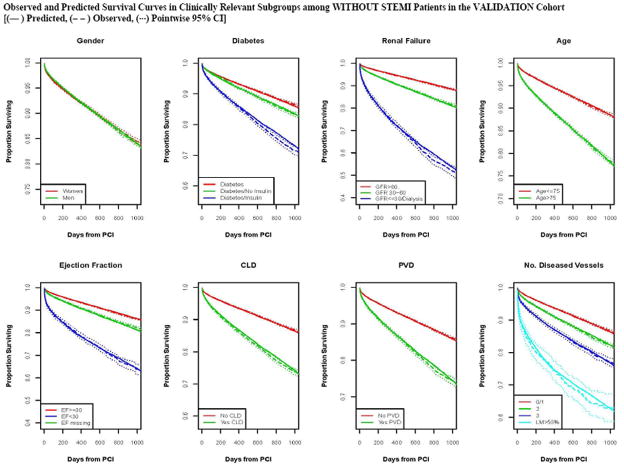
Methods and results: The American College of Cardiology Foundation CathPCI Registry data were linked to the Centers for Medicare and Medicaid Services 100% denominator file by probabilistic matching. Preprocedure demographic and clinical variables from the CathPCI Registry were used to predict the probability of death over 3 years as recorded in the Centers for Medicare and Medicaid Services database. Between 2004 and 2007, 343 466 patients (66%) of 518 195 patients aged ≥65 years undergoing first percutaneous coronary intervention in the CathPCI Registry were successfully linked to Centers for Medicare and Medicaid Services data. This study population was randomly divided into 60% derivation and 40% validation cohorts. Median follow-up was 15 months, with mortality of 3.0% at 30 days and 8.7%, 13.4%, and 18.7% at 1, 2, and 3 years, respectively. Twenty-four characteristics related to demographics, clinical comorbidity, prior history of disease, and indices of disease severity and acuity were identified as being associated with mortality. The C indices in the validation cohorts for patients with and without ST-segment elevation myocardial infarction were 0.79 and 0.78. The model calibrated well across a wide range of predicted probabilities.
Conclusions: On the basis of the large and nationally representative CathPCI Registry, we have developed a model that has excellent discrimination, calibration, and validation to predict survival up to 3 years after percutaneous coronary intervention.
Figures
Comment in
-
Predicting long-term survival for coronary artery bypass graft surgery and percutaneous coronary intervention: another important step forward.Circulation. 2012 Mar 27;125(12):1475-6. doi: 10.1161/CIRCULATIONAHA.112.095943. Epub 2012 Feb 23. Circulation. 2012. PMID: 22361328 No abstract available.
References
-
- Shaw RE, Anderson HV, Brindis RG, Krone RJ, Klein LW, McKay CR, Block PC, Shaw LJ, Hewitt K, Weintraub WS. Development of a risk adjustment mortality model using the American College of Cardiology-National Cardiovascular Data Registry (ACC-NCDR) experience: 1998–2000. J Am Coll Cardiol. 2002;39:1104–1112. - PubMed
-
- Peterson ED, Dai D, DeLong ER, Brennan JM, Singh M, Rao SV, Shaw RE, Roe MT, Ho KK, Klein LW, Krone RJ, Weintraub WS, Brindis RG, Rumsfeld JS, Spertus JA. NCDR Registry Participants. Contemporary mortality risk prediction for percutaneous coronary intervention: results from 588,398 procedures in the National Cardiovascular Data Registry. J Am Coll Cardiol. 2010;55:1923–1932. - PMC - PubMed
-
- Brindis RG, Fitzgerald S, Anderson HV, Shaw RE, Weintraub WS, Williams JF. The American College of Cardiology-National Cardiovascular Data Registry (ACC-NCDR): building a national clinical data repository. J Am Coll Cardiol. 2001;37:2240–2245. - PubMed
-
- Douglas PS, Brennan JM, Anstrom KJ, Sedrakyan A, Eisenstein EL, Haque G, Dai D, Kong DF, Hammill B, Curtis L, Matchar D, Brindis R, Peterson ED. Clinical effectiveness of coronary stents in elderly persons: results from 262,700 Medicare patients in the American College of Cardiology-National Cardiovascular Data Registry. J Am Coll Cardiol. 2009;53:1629–1641. - PMC - PubMed
Publication types
MeSH terms
Grants and funding
LinkOut - more resources
Full Text Sources
