


Predictors of long-term survival after coronary artery bypass grafting surgery: results from the Society of Thoracic Surgeons Adult Cardiac Surgery Database (the ASCERT study)
- PMID: 22361330
- PMCID: PMC3350815
- DOI: 10.1161/CIRCULATIONAHA.111.066902
Predictors of long-term survival after coronary artery bypass grafting surgery: results from the Society of Thoracic Surgeons Adult Cardiac Surgery Database (the ASCERT study)
Abstract
Background: Most survival prediction models for coronary artery bypass grafting surgery are limited to in-hospital or 30-day end points. We estimate a long-term survival model using data from the Society of Thoracic Surgeons Adult Cardiac Surgery Database and Centers for Medicare and Medicaid Services.
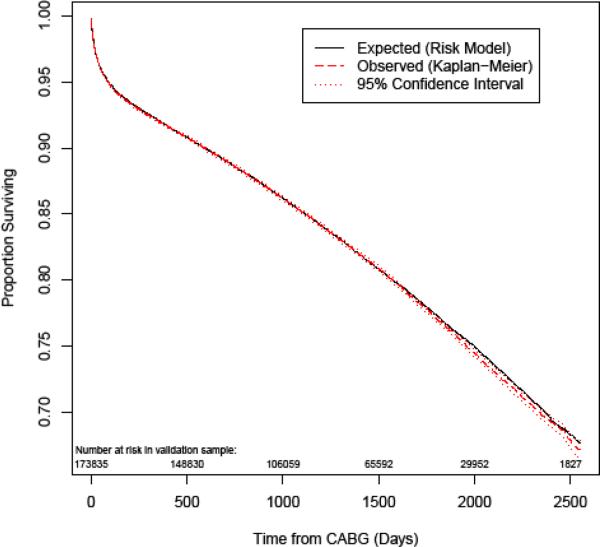
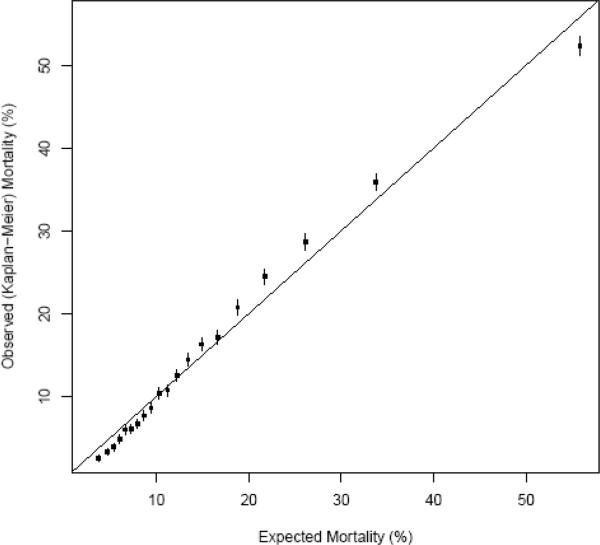
Methods and results: The final study cohort included 348 341 isolated coronary artery bypass grafting patients aged ≥65 years, discharged between January 1, 2002, and December 31, 2007, from 917 Society of Thoracic Surgeons-participating hospitals, randomly divided into training (n=174 506) and validation (n=173 835) samples. Through linkage with Centers for Medicare and Medicaid Services claims data, we ascertained vital status from date of surgery through December 31, 2008 (1- to 6-year follow-up). Because the proportional hazards assumption was violated, we fit 4 Cox regression models conditional on being alive at the beginning of the following intervals: 0 to 30 days, 31 to 180 days, 181 days to 2 years, and >2 years. Kaplan-Meier-estimated mortality was 3.2% at 30 days, 6.4% at 180 days, 8.1% at 1 year, and 23.3% at 3 years of follow-up. Harrell's C statistic for predicting overall survival time was 0.732. Some risk factors (eg, emergency status, shock, reoperation) were strong predictors of short-term outcome but, for early survivors, became nonsignificant within 2 years. The adverse impact of some other risk factors (eg, dialysis-dependent renal failure, insulin-dependent diabetes mellitus) continued to increase.
Conclusions: Using clinical registry data and longitudinal claims data, we developed a long-term survival prediction model for isolated coronary artery bypass grafting. This provides valuable information for shared decision making, comparative effectiveness research, quality improvement, and provider profiling.
Figures


Comment in
-
Predicting long-term survival for coronary artery bypass graft surgery and percutaneous coronary intervention: another important step forward.Circulation. 2012 Mar 27;125(12):1475-6. doi: 10.1161/CIRCULATIONAHA.112.095943. Epub 2012 Feb 23. Circulation. 2012. PMID: 22361328 No abstract available.
-
Letter by Poullis regarding article, "Predictors of long-term survival after coronary artery bypass grafting surgery: results from the Society of Thoracic Surgeons Adult Cardiac Surgery Database (the ASCERT study)".Circulation. 2012 Oct 16;126(16):e258. doi: 10.1161/CIRCULATIONAHA.112.108928. Circulation. 2012. PMID: 23071181 No abstract available.
References
-
- Jacobs JP, Edwards FH, Shahian DM, Haan CK, Puskas JD, Morales DL, Gammie JS, Sanchez JA, Brennan JM, O'Brien SM, Dokholyan RS, Hammill BG, Curtis LH, Peterson ED, Badhwar V, George KM, Mayer JE, Jr., Chitwood WR, Jr., Murray GF, Grover FL. Successful linking of the Society of Thoracic Surgeons adult cardiac surgery database to Centers for Medicare and Medicaid Services Medicare data. Ann Thorac Surg. 2010;90:1150–1156. - PubMed
-
- [accessed Aug 3, 2011]; http://www.sts.org/quality-research-patient-safety/national-database/dat...,
-
- Welke KF, Ferguson TB, Jr., Coombs LP, Dokholyan RS, Murray CJ, Schrader MA, Peterson ED. Validity of the Society of Thoracic Surgeons National Adult Cardiac Surgery Database. Ann Thorac Surg. 2004;77:1137–1139. - PubMed
Publication types
MeSH terms
Grants and funding
LinkOut - more resources
Full Text Sources
Medical
