A bimodal influence of thyroid hormone on cerebellum oligodendrocyte differentiation
- PMID: 22361821
- PMCID: PMC5417134
- DOI: 10.1210/me.2011-1316
A bimodal influence of thyroid hormone on cerebellum oligodendrocyte differentiation
Abstract
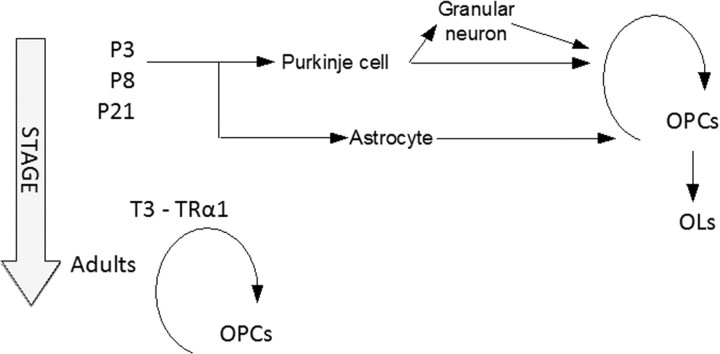
Thyroid hormone (T(3)) can trigger a massive differentiation of cultured oligodendrocytes precursor cells (OPC) by binding the nuclear T(3) receptor α1 (TRα1). Whether this reflects a physiological function of TRα1 remains uncertain. Using a recently generated mouse model, in which CRE/loxP recombination is used to block its function, we show that TRα1 acts at two levels for the in vivo differentiation of OPC in mouse cerebellum. At the early postnatal stage, it promotes the secretion of several neurotrophic factors by acting in Purkinje neurons and astrocytes, defining an environment suitable for OPC differentiation. At later stages, TRα1 acts in a cell-autonomous manner to ensure the complete arrest of OPC proliferation. These data explain contradictory observations made on various models and outline the importance of T(3) signaling both for synchronizing postnatal neurodevelopment and restraining OPC proliferation in adult brain.
Figures
References
-
- Calver AR , Hall AC , Yu WP , Walsh FS , Heath JK , Betsholtz C , Richardson WD. 1998. Oligodendrocyte population dynamics and the role of PDGF in vivo. Neuron 20:869–882 - PubMed
-
- Barres BA , Raff MC , Gaese F , Bartke I , Dechant G , Barde YA. 1994. A crucial role for neurotrophin-3 in oligodendrocyte development. Nature 367:371–375 - PubMed