


Enzymatic mechanisms regulating protein S-nitrosylation: implications in health and disease
- PMID: 22361849
- PMCID: PMC3379879
- DOI: 10.1007/s00109-012-0878-z
Enzymatic mechanisms regulating protein S-nitrosylation: implications in health and disease
Abstract
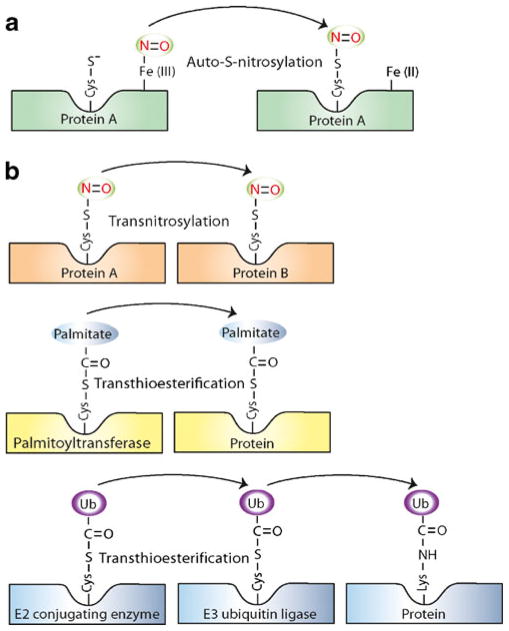
Nitric oxide participates in cellular signal transduction largely through S-nitrosylation of allosteric and active-site cysteine thiols within proteins, forming S-nitroso-proteins (SNO-proteins). S-nitrosylation of proteins has been demonstrated to affect a broad range of functional parameters including enzymatic activity, subcellular localization, protein-protein interactions, and protein stability. Analogous to other ubiquitous posttranslational modifications that are regulated enzymatically, including phosphorylation and ubiquitinylation, accumulating evidence suggests the existence of enzymatic mechanisms for regulating protein S-nitrosylation. In particular, studies have led to the identification of multiple enzymes (nitrosylases and denitrosylases) that participate in targeted S-nitrosylation or denitrosylation of proteins in physiological settings. Nitrosylases are best characterized in the context of transnitrosylation in which a SNO-protein transfers an NO group to an acceptor protein (Cys-to-Cys transfer), but examples of transnitrosylation catalyzed by metalloproteins (Metal-to-Cys transfer) also exist. By contrast, denitrosylases remove the NO group from SNO-proteins, ultimately using reducing equivalents derived from NADH or NADPH. Here, we focus on the recent discoveries of nitrosylases and denitrosylases and the notion that their aberrant activities may play roles in health and disease.
Figures
References
-
- Benhar M, Forrester MT, Stamler JS. Protein denitrosylation: enzymatic mechanisms and cellular functions. Nat Rev Mol Cell Biol. 2009;10:721–732. - PubMed
-
- Hess DT, Matsumoto A, Kim SO, Marshall HE, Stamler JS. Protein S-nitrosylation: purview and parameters. Nat Rev Mol Cell Biol. 2005;6:150–166. - PubMed
-
- Foster MW, McMahon TJ, Stamler JS. S-nitrosylation in health and disease. Trends Mol Med. 2003;9:160–168. - PubMed
-
- Perez-Mato I, Castro C, Ruiz FA, Corrales FJ, Mato JM. Methionine adenosyltransferase S-nitrosylation is regulated by the basic and acidic amino acids surrounding the target thiol. J Biol Chem. 1999;274:17075–17079. - PubMed
Publication types
MeSH terms
Substances
Grants and funding
LinkOut - more resources
Full Text Sources
Other Literature Sources
