


Reactive hyperemia is not responsible for stimulating muscle protein synthesis following blood flow restriction exercise
- PMID: 22362401
- PMCID: PMC3362234
- DOI: 10.1152/japplphysiol.01267.2011
Reactive hyperemia is not responsible for stimulating muscle protein synthesis following blood flow restriction exercise
Abstract
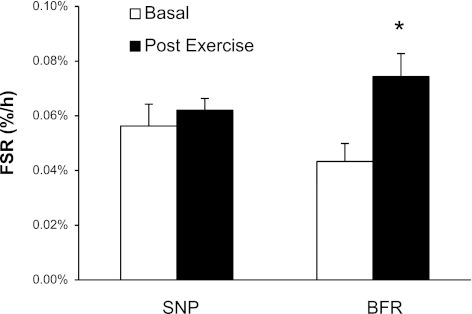
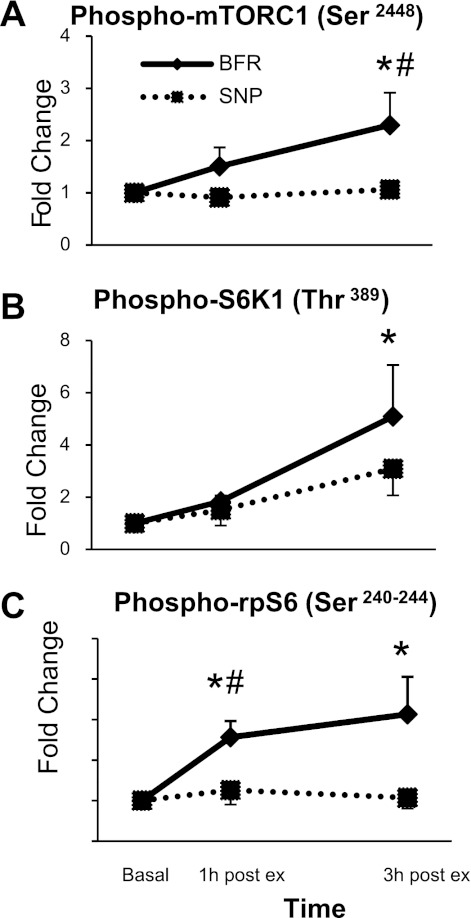
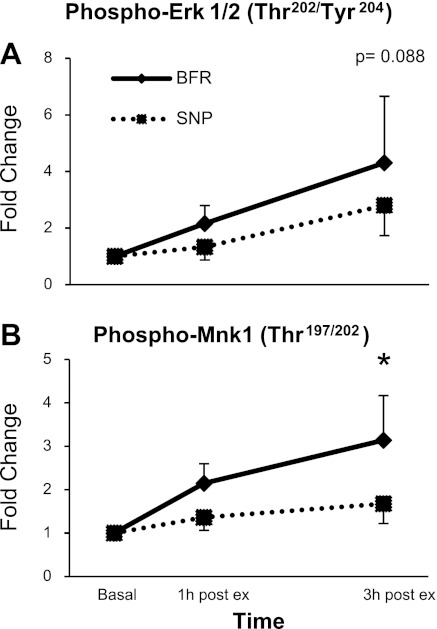
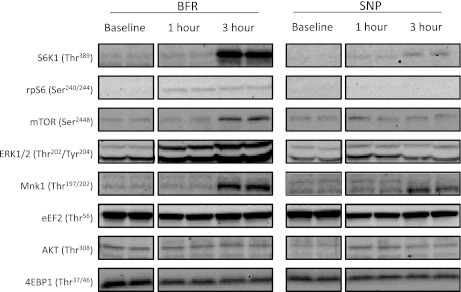
Blood flow restriction (BFR) to contracting skeletal muscle during low-intensity resistance exercise training increases muscle strength and size in humans. However, the mechanism(s) underlying these effects are largely unknown. We have previously shown that mammalian target of rapamycin complex 1 (mTORC1) signaling and muscle protein synthesis (MPS) are stimulated following an acute bout of BFR exercise. The purpose of this study was to test the hypothesis that reactive hyperemia is the mechanism responsible for stimulating mTORC1 signaling and MPS following BFR exercise. Six young men (24 ± 2 yr) were used in a randomized crossover study consisting of two exercise trials: low-intensity resistance exercise with BFR (BFR trial) and low-intensity resistance exercise with sodium nitroprusside (SNP), a pharmacological vasodilator infusion into the femoral artery immediately after exercise to simulate the reactive hyperemia response after BFR exercise (SNP trial). Postexercise mixed-muscle fractional synthetic rate from the vastus lateralis increased by 49% in the BFR trial (P < 0.05) with no change in the SNP trial (P > 0.05). BFR exercise increased the phosphorylation of mTOR, S6 kinase 1, ribosomal protein S6, ERK1/2, and Mnk1-interacting kinase 1 (P < 0.05) with no changes in mTORC1 signaling in the SNP trial (P > 0.05). We conclude that reactive hyperemia is not a primary mechanism for BFR exercise-induced mTORC1 signaling and MPS. Further research is necessary to elucidate the cellular mechanism(s) responsible for the increase in mTOR signaling, MPS, and hypertrophy following acute and chronic BFR exercise.
Figures
References
-
- Abe T, Kearns CF, Sato Y. Muscle size and strength are increased following walk training with restricted venous blood flow from the leg muscle, Kaatsu-walk training. J Appl Physiol 100: 1460–1466, 2006 - PubMed
-
- Abe T, Sakamaki M, Fujita S, Ozaki H, Sugaya M, Sato Y, Nakajima T. Effects of low-intensity walk training with restricted leg blood flow on muscle strength and aerobic capacity in older adults. J Geriatr Phys Ther 33: 34–40, 2010 - PubMed
-
- Abe T, Sato Y, Inoue K, Midorikawa T, Yasuda T, Kearns CF, Koizumi K, Ishii N. Muscle size and IGF-1 increased after two weeks of low-intensity “Kaatsu” resistance training. Med Sci Sports Exerc 36: S353–S353, 2004
Publication types
MeSH terms
Substances
Grants and funding
LinkOut - more resources
Full Text Sources
Medical
Miscellaneous
