. 2012 Feb 24;335(6071):977-81.
doi: 10.1126/science.1214270.

Botulinum neurotoxin is shielded by NTNHA in an interlocked complex

Affiliations

Botulinum neurotoxin is shielded by NTNHA in an interlocked complex

Shenyan Gu et al. Science. .

Abstract

Botulinum neurotoxins (BoNTs) are highly poisonous substances that are also effective medicines. Accidental BoNT poisoning often occurs through ingestion of Clostridium botulinum-contaminated food. Here, we present the crystal structure of a BoNT in complex with a clostridial nontoxic nonhemagglutinin (NTNHA) protein at 2.7 angstroms. Biochemical and functional studies show that NTNHA provides large and multivalent binding interfaces to protect BoNT from gastrointestinal degradation. Moreover, the structure highlights key residues in BoNT that regulate complex assembly in a pH-dependent manner. Collectively, our findings define the molecular mechanisms by which NTNHA shields BoNT in the hostile gastrointestinal environment and releases it upon entry into the circulation. These results will assist in the design of small molecules for inhibiting oral BoNT intoxication and of delivery vehicles for oral administration of biologics.


Figures

Fig. 1
Fig. 1
The architecture of the M-PTC. (A) NTNHA-A protects BoNT/Ai against trypsin and pepsin digestion when they assemble into the M-PTC in an acidic environment. (B) NTNHA-A protects active BoNT/A against low pH-mediated inactivation. It also protects BoNT/A against trypsin inactivation at pH 6.0, but not at pH 8.0. (C) Cartoon presentation of the M-PTC. BoNT/Ai domains are blue (LC), orange (HN), and green (HC). NTNHA-A domains are yellow (nLC), cyan (nHN), and red (nHC). (D) Individual structures of BoNT/Ai and NTNHA-A in the M-PTC.
Fig. 2
Fig. 2
The HC fragment of BoNT/A can rotate around a linker connecting HN and HC. (A) Superposition of the free and complex forms of BoNT/A based on Cα atoms in LC and HN. HC of free BoNT/A is violet; LC and HN are omitted for clarity. Linkers in the free and complex forms of BoNT/A are gray and red, respectively. (B) Cartoon model showing two distinct conformations of BoNT/A that bring the receptor-binding site in HC (red star) close to the opposite tip of the long helical HN.
Fig. 3
Fig. 3
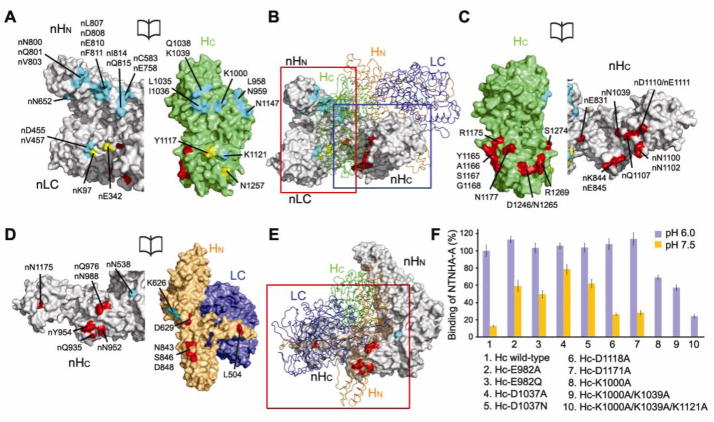
The M-PTC is stabilized by extensive intermolecular interactions. (A–C) HC interacts with all three domains of NTNHA-A. The overall structure of the M-PTC is shown in (B) where NTNHA-A is in surface representation (gray) and BoNT/Ai is blue, orange, and green for LC, HN, and HC, respectively. Open-book views of the interfaces highlighted in the red or blue boxes are shown in (A) and (C), respectively. Residues in HC that form hydrogen bonds or salt bridges with nLC, nHN, or nHC are yellow, cyan, and red, respectively. (D) Open-book view of the interface highlighted in the red box of panel E. HN directly contacts nHC (interacting residues shown in red) and nHN (cyan), but not nLC. (F) Pull-down assays between full-length NTNHA-A (prey) and HC variants (baits). Bar graph shows mean ± SD, n=3. Binding of samples 8–10 at pH 7.5 was not detectable.
Fig. 4
Fig. 4
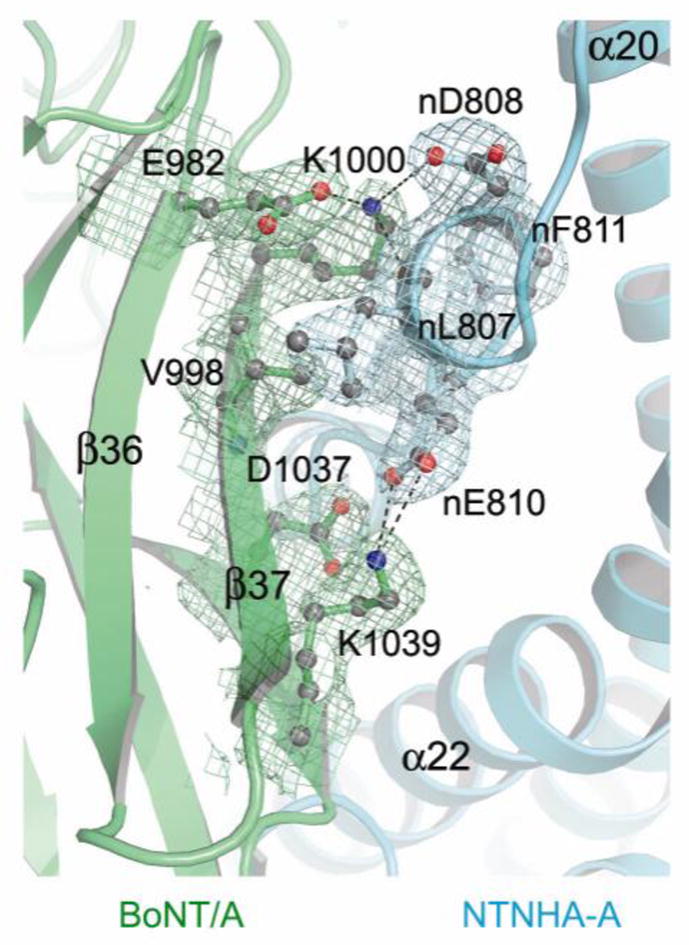
A pH-sensing mechanism. A close-up view of pH-sensing residues Glu982 and Asp1037, which are buried in the M-PTC in the vicinity of intra-PTC charge-charge interactions. Key residues in the interface are shown as ball-and-stick models. Hydrogen bonds and charge-charge interactions are indicated by dotted lines. A simulated-annealing omit map of the M-PTC contoured at 1 σ was overlaid with the final refined model.

Comment in

Similar articles

Cited by

References

    1. Montecucco C, Schiavo G. Q Rev Biophys. 1995;28:423. - PubMed
    1. Collins MD, East AK. J Appl Microbiol. 1998;84:5. - PubMed
    1. Ito H, et al. FEMS Immunol Med Microbiol. 2011:1. - PubMed
    1. Ohishi I, Sugii S, Sakaguchi G. Infect Immun. 1977;16:107. - PMC - PubMed
    1. Cheng LW, et al. Toxicology. 2008;249:123. - PubMed

Publication types