. 2012 Feb 21:6:5.
doi: 10.3389/fncel.2012.00005. eCollection 2012.

Role of the neuronal K-Cl co-transporter KCC2 in inhibitory and excitatory neurotransmission

Affiliations

Role of the neuronal K-Cl co-transporter KCC2 in inhibitory and excitatory neurotransmission

Ingrid Chamma et al. Front Cell Neurosci. .

Abstract

The K-Cl co-transporter KCC2 plays multiple roles in the physiology of central neurons and alterations of its function and/or expression are associated with several neurological conditions. By regulating intraneuronal chloride homeostasis, KCC2 strongly influences the efficacy and polarity of the chloride-permeable γ-aminobutyric acid (GABA) type A and glycine receptor (GlyR) mediated synaptic transmission. This appears particularly critical for the development of neuronal circuits as well as for the dynamic control of GABA and glycine signaling in mature networks. The activity of the transporter is also associated with transmembrane water fluxes which compensate solute fluxes associated with synaptic activity. Finally, KCC2 interaction with the actin cytoskeleton appears critical both for dendritic spine morphogenesis and the maintenance of glutamatergic synapses. In light of the pivotal role of KCC2 in the maturation and function of central synapses, it is of particular importance to understand the cellular and molecular mechanisms underlying its regulation. These include development and activity-dependent modifications both at the transcriptional and post-translational levels. We emphasize the importance of post-translational mechanisms such as phosphorylation and dephosphorylation, oligomerization, cell surface stability, clustering and membrane diffusion for the rapid and dynamic regulation of KCC2 function.

Keywords: KCC2; excitatory and inhibitory synapses; neuronal activity; post-translational regulation.


Figures
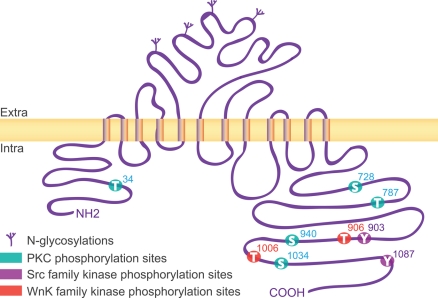
Figure 1
Figure 1
Structure of KCC2. The rat KCC2 co-transporter is a large size (∼140 kDa) protein with a predicted topology of 12 membrane spanning segments, a N-linked glycosylated extracellular domain between transmembrane domains 5 and 6, and is flanked by two cytoplasmic carboxy- and amino-terminal domains of 104 and 481 amino acids, respectively. As indicated, the intracellular regions are the targets of several kinases that regulate the function of the co-transporter.
Figure 2
Figure 2
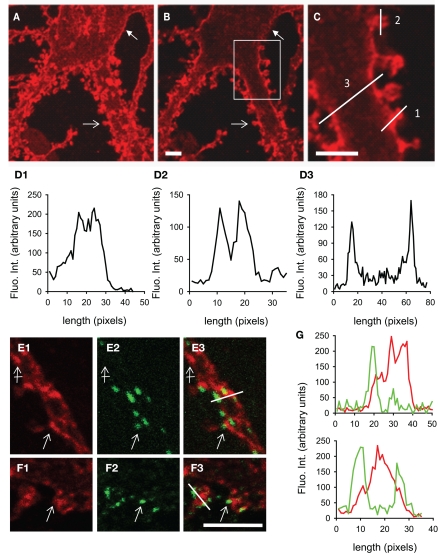
KCC2 clustering in rat hippocampal neurons at 29DIV. (A) Maximum intensity projection of confocal optical sections showing KCC2 at the periphery of somata (filled arrow) and in spines (empty arrow). (B,C) optical sectioning from the same neuron as in (A). Boxed region in (B) is shown enlarged in (C). Adapted from Gauvain et al. (2011) with permission. Scale bars, 5μm. (D) Fluorescence intensity in arbitrary units per pixel along the lines drawn in (C) showing enrichment of KCC2 in dendritic spines (D1), preferential plasma membrane localization of KCC2 in dendritic spines (D2) and shafts (D3) as compared with the cytoplasm. (E1–F3) Dual labeling of KCC2 (red in E1, E3, F1, F3) and the GABA and glutamate receptor anchoring proteins gephyrin (green in E2, E3) or PSD-95 (green in F2, F3). Scale bars, 5μm. KCC2 forms many clusters on dendritic shafts and spines (empty arrows). Clusters are found at distance from synapses (crossed arrow) as well as near gephyrin-labeled inhibitory synapses (empty arrow in E1–3) and PSD95-stained excitatory PSD (empty arrow in F1–3). (G) Fluorescence intensity in arbitrary units per pixel along the lines drawn in (E3) and (F3) showing juxtaposition but no colocalization of KCC2 (red) with gephyrin (green, top) or PSD95 (green, bottom).
Figure 3
Figure 3
Ions and water transport properties of the co-transporters NKCC1 and KCC2. The secondary active transporters NKCC1 and KCC2 use the energy of the electrochemical Na+ and K+ gradients generated by the primary active transporter Na-K ATPase to trigger a net inflow of 1K+, 1Na+, 2Cl, and a net outflow of 1K+, 1Cl ions, respectively. The activity of each transporter is associated with water influx (NKCC1) or efflux (KCC2). NKCC1 and KCC2 are reciprocally expressed and regulated during development. NKCC1 predominates in early development while KCC2 is the main Cl extruder in mature neurons. This expression profile impacts both cell volume regulation and the efficacy and polarity of GlyR and GABAAR mediated synaptic transmission (see text).
Figure 4
Figure 4
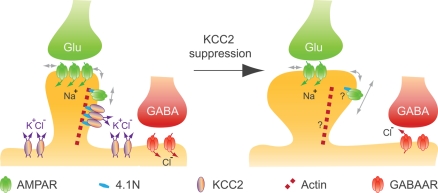
KCC2 controls spine volume and efficacy of glutamatergic AMPAR-mediated synaptic transmission in mature neurons. KCC2 suppression in mature neurons indicates that KCC2 is not required for spine maintenance, while it contributes to both spine head volume regulation and the efficacy of excitatory synapses by physically constraining AMPAR GluA1 subunit in spine head, likely through its interaction with submembrane actin cytoskeleton [adapted from Gauvain et al. (2011)]. A loss of KCC2 clusters induced by sustained excitatory synaptic activity or under pathological conditions may induce a rapid homeostatic adjustment of the efficacy of AMPAR mediated synaptic transmission as well as a reduction in the efficacy of GABAAR-dependent synaptic transmission.
Figure 5
Figure 5
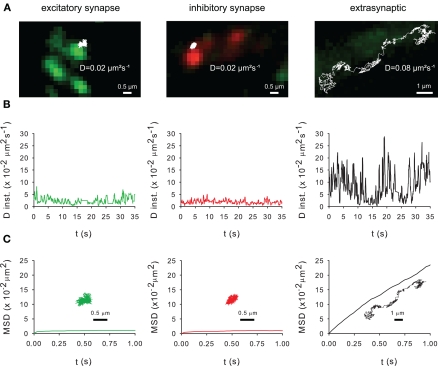
Membrane dynamics of the KCC2 transporter studied with Single Particle Tracking. (A) Representative trajectories of Quantum Dot-bound Flag tagged recombinant KCC2 reconstructed from 35 s recording sequences (Δ t = 0.03 s). QD trajectories were overlaid with fluorescent images of recombinant homer1c-GFP (green) and gephyrin-mRFP (red) clusters in order to identify excitatory and inhibitory synapses, respectively. Note that extrasynaptic QD-bound KCC2 explored larger area of membrane than synaptic/perisynaptic ones. Scale bars for synaptic/perisynaptic and extrasynaptic trajectories, 0.5 μm and 1 μm, respectively. (B) Instantaneous diffusion coefficients of the trajectories shown in (A). Note the reduction in diffusion coefficient values and fluctuations for synaptic/perisynaptic QDs as compared with the extrasynaptic QD. (C) Time-averaged MSD functions of the trajectories shown in (A). Extrasynaptic and synaptic QDs display linear and negatively bent MSD curves, characteristic of random walk and confined movement, respectively. In all graphs: green and red curves, trajectories at/near excitatory and inhibitory synapses, respectively; black, extrasynaptic trajectory.

References

    1. Aguado F., Carmona M. A., Pozas E., Aguilo A., Martinez-Guijarro F. J., Alcantara S., Borrell V., Yuste R., Ibanez C. F., Soriano E. (2003). BDNF regulates spontaneous correlated activity at early developmental stages by increasing synaptogenesis and expression of the K+/Cl co-transporter KCC2. Development 130, 1267–1280 10.1242/dev.00351 - DOI - PubMed
    1. Akerman C. J., Cline H. T. (2006). Depolarizing GABAergic conductances regulate the balance of excitation to inhibition in the developing retinotectal circuit in vivo. J. Neurosci. 26, 5117–5130 10.1523/JNEUROSCI.0319-06.2006 - DOI - PMC - PubMed
    1. Amiry-Moghaddam M., Ottersen O. P. (2003). The molecular basis of water transport in the brain. Nat. Rev. Neurosci. 4, 991–1001 10.1038/nrn1252 - DOI - PubMed
    1. Andrew R. D., Labron M. W., Boehnke S. E., Carnduff L., Kirov S. A. (2007). Physiological evidence that pyramidal neurons lack functional water channels. Cereb. Cortex 17, 787–802 10.1093/cercor/bhk032 - DOI - PubMed
    1. Baines A. J., Bennett P. M., Carter E. W., Terracciano C. (2009). Protein 4.1 and the control of ion channels. Blood Cells Mol. Dis. 42, 211–215 10.1016/j.bcmd.2009.01.016 - DOI - PubMed

LinkOut - more resources