


A switch in hepatic cortisol metabolism across the spectrum of non alcoholic fatty liver disease
- PMID: 22363403
- PMCID: PMC3282715
- DOI: 10.1371/journal.pone.0029531
A switch in hepatic cortisol metabolism across the spectrum of non alcoholic fatty liver disease
Abstract
Context: Non alcoholic fatty liver disease (NAFLD) is the hepatic manifestation of the metabolic syndrome. NAFLD represents a spectrum of liver disease ranging from reversible hepatic steatosis, to non alcoholic steato-hepatitis (NASH) and cirrhosis. The potential role of glucocorticoids (GC) in the pathogenesis of NAFLD is highlighted in patients with GC excess, Cushing's syndrome, who develop central adiposity, insulin resistance and in 20% of cases, NAFLD. Although in most cases of NAFLD, circulating cortisol levels are normal, hepatic cortisol availability is controlled by enzymes that regenerate cortisol (F) from inactive cortisone (E) (11β-hydroxysteroid dehydrogenase type 1, 11β-HSD1), or inactivate cortisol through A-ring metabolism (5α- and 5β-reductase, 5αR and 5βR).
Objective and methods: In vitro studies defined 11β-HSD1 expression in normal and NASH liver samples. We then characterised hepatic cortisol metabolism in 16 patients with histologically proven NAFLD compared to 32 obese controls using gas chromatographic analysis of 24 hour urine collection and plasma cortisol generation profile following oral cortisone.
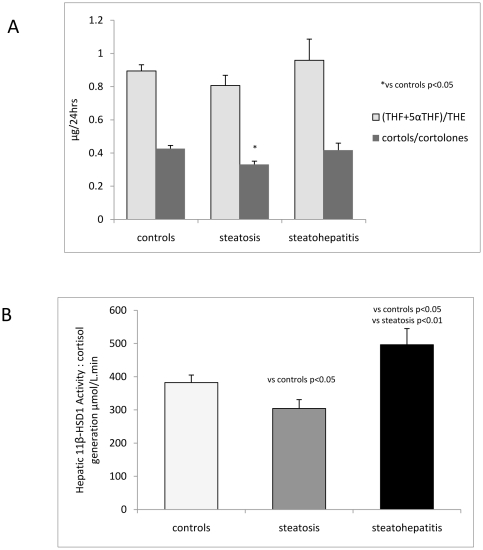
Results: In patients with steatosis 5αR activity was increased, with a decrease in hepatic 11β-HSD1 activity. Total cortisol metabolites were increased in this group consistent with increased GC production rate. In contrast, in patients with NASH, 11β-HSD1 activity was increased both in comparison to patients with steatosis, and controls. Endorsing these findings, 11β-HSD1 mRNA and immunostaining was markedly increased in NASH patients in peri septal hepatocytes and within CD68 positive macrophages within inflamed cirrhotic septa.
Conclusion: Patients with hepatic steatosis have increased clearance and decreased hepatic regeneration of cortisol and we propose that this may represent a protective mechanism to decrease local GC availability to preserve hepatic metabolic phenotype. With progression to NASH, increased 11β-HSD1 activity and consequent cortisol regeneration may serve to limit hepatic inflammation.
Conflict of interest statement
Figures



References
-
- de Alwis NM, Day CP. Non-alcoholic fatty liver disease: the mist gradually clears. J Hepatol. 2008;48(Suppl 1):S104–S112. - PubMed
-
- Rockall AG, Sohaib SA, Evans D, Kaltsas G, Isidori AM, et al. Hepatic steatosis in Cushing's syndrome: a radiological assessment using computed tomography. Eur J Endocrinol. 2003;149:543–548. - PubMed
-
- Dourakis SP, Sevastianos VA, Kaliopi P. Acute severe steatohepatitis related to prednisolone therapy. Am J Gastroenterol. 2002;97:1074–1075. - PubMed
-
- Nanki T, Koike R, Miyasaka N. Subacute severe steatohepatitis during prednisolone therapy for systemic lupus erythematosis. Am J Gastroenterol. 1999;94:3379. - PubMed
-
- Hellerstein MK. De novo lipogenesis in humans: metabolic and regulatory aspects. Eur J Clin Nutr. 1999;53(Suppl 1):S53–S65. - PubMed
Publication types
MeSH terms
Substances
Grants and funding
LinkOut - more resources
Full Text Sources
Medical
Miscellaneous
