


Are long-term non-progressors very slow progressors? Insights from the Chelsea and Westminster HIV cohort, 1988-2010
- PMID: 22363409
- PMCID: PMC3282685
- DOI: 10.1371/journal.pone.0029844
Are long-term non-progressors very slow progressors? Insights from the Chelsea and Westminster HIV cohort, 1988-2010
Abstract
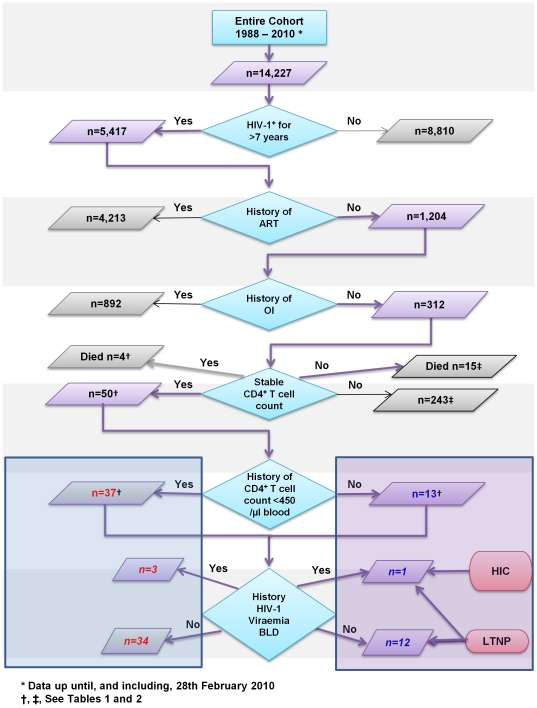
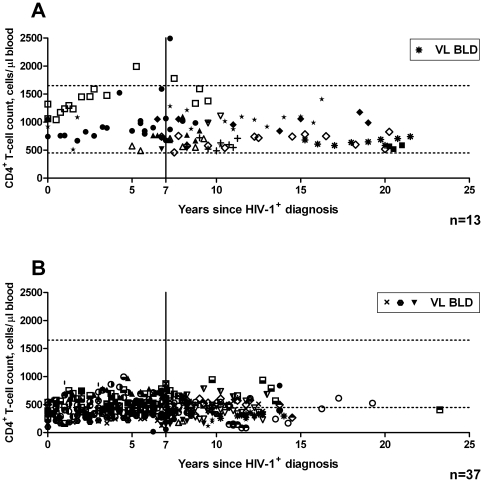
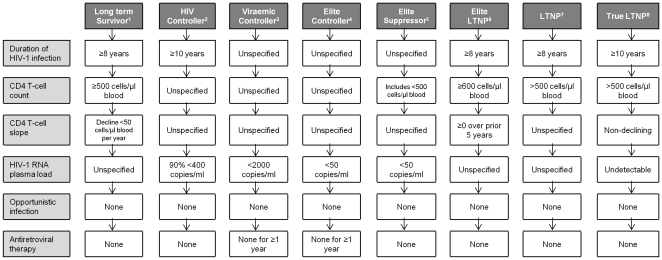
Define and identify long-term non-progressors (LTNP) and HIV controllers (HIC), and estimate time until disease progression. LTNP are HIV-1(+) patients who maintain stable CD4(+) T-cell counts, with no history of opportunistic infection or antiretroviral therapy (ART). HIC are a subset of LTNP who additionally have undetectable viraemia. These individuals may provide insights for prophylactic and therapeutic development. Records of HIV-1(+) individuals attending Chelsea and Westminster Hospital (1988-2010), were analysed. LTNP were defined as: HIV-1(+) for >7 years; ART-naïve; no history of opportunistic infection and normal, stable CD4(+) T-cell counts. MIXED procedure in SAS using random intercept model identified long-term stable CD4(+) T-cell counts. Survival analysis estimated time since diagnosis until disease progression. Subjects exhibiting long-term stable CD4(+) T-cell counts with history below the normal range (<450 cells/µl blood) were compared to LTNP whose CD4(+) T-cell count always remained normal. Within these two groups subjects with HIV-1 RNA load below limit of detection (BLD) were identified. Of 14,227 patients, 1,204 were diagnosed HIV-1(+) over 7 years ago and were ART-naïve. Estimated time until disease progression for the 20% (239) whose CD4(+) T-cell counts remained within the normal range, was 6.2 years (IQR: 2.0 to 9.6); significantly longer than 4.0 years (IQR: 1.0 to 7.3) for patients with historical CD4(+) T-cell count below normal (Logrank chi-squared = 21.26; p<0.001). Within a subpopulation of 312 asymptomatic patients, 50 exhibited long-term stable CD4(+) T-cell counts. Of these, 13 were LTNP, one of whom met HIC criteria. Of the remaining 37 patients with long-term stable low CD4(+) T-cell counts, 3 controlled HIV-1 RNA load BLD. Individuals with stable, normal CD4(+) T-cell counts progressed less rapidly than those with low CD4(+) T-cell counts. Few LTNP and HIC identified in this and other studies, endorse the need for universal definitions to facilitate comparison.
Conflict of interest statement
Figures
References
-
- Clerici M, Stocks NI, Zajac RA, Boswell RN, Lucey DR, et al. Detection of three distinct patterns of T helper cell dysfunction in asymptomatic, human immunodeficiency virus-seropositive patients. Independence of CD4+ cell numbers and clinical staging. J Clin Invest. 1989;84(6):1892–1899. - PMC - PubMed
-
- Imami N, Hardy G, Burton C, Pires A, Pido-Lopez J, et al. Immune responses and reconstitution in HIV-1 infected individuals: impact of anti-retroviral therapy, cytokines and therapeutic vaccination. Immunol Lett. 2001;79(1–2):63–76. - PubMed
-
- Pantaleo G, Fauci AS. Immunopathogenesis of HIV infection. Annu Rev Microbiol. 1996;50:825–854. - PubMed
-
- CDC. From the Centers for Disease Control and Prevention. 1993 revised classification system for HIV infection and expanded surveillance case definition for AIDS among adolescents and adults. JAMA. 1993;269(6):729–730. - PubMed
Publication types
MeSH terms
Grants and funding
LinkOut - more resources
Full Text Sources
Medical
Research Materials
Miscellaneous
