


Ethnic differences in survival after breast cancer in South East Asia
- PMID: 22363531
- PMCID: PMC3283591
- DOI: 10.1371/journal.pone.0030995
Ethnic differences in survival after breast cancer in South East Asia
Abstract
Background: The burden of breast cancer in Asia is escalating. We evaluated the impact of ethnicity on survival after breast cancer in the multi-ethnic region of South East Asia.
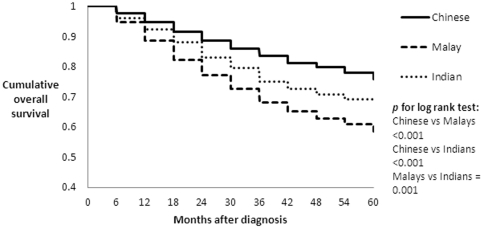
Methodology/principal findings: Using the Singapore-Malaysia hospital-based breast cancer registry, we analyzed the association between ethnicity and mortality following breast cancer in 5,264 patients diagnosed between 1990 and 2007 (Chinese: 71.6%, Malay: 18.4%, Indian: 10.0%). We compared survival rates between ethnic groups and calculated adjusted hazard ratios (HR) to estimate the independent effect of ethnicity on survival. Malays (n = 968) presented at a significantly younger age, with larger tumors, and at later stages than the Chinese and Indians. Malays were also more likely to have axillary lymph node metastasis at similar tumor sizes and to have hormone receptor negative and poorly differentiated tumors. Five year overall survival was highest in the Chinese women (75.8%; 95%CI: 74.4%-77.3%) followed by Indians (68.0%; 95%CI: 63.8%-72.2%), and Malays (58.5%; 95%CI: 55.2%-61.7%). Compared to the Chinese, Malay ethnicity was associated with significantly higher risk of all-cause mortality (HR: 1.34; 95%CI: 1.19-1.51), independent of age, stage, tumor characteristics and treatment. Indian ethnicity was not significantly associated with risk of mortality after breast cancer compared to the Chinese (HR: 1.14; 95%CI: 0.98-1.34).
Conclusion: In South East Asia, Malay ethnicity is independently associated with poorer survival after breast cancer. Research into underlying reasons, potentially including variations in tumor biology, psychosocial factors, treatment responsiveness and lifestyle after diagnosis, is warranted.
Conflict of interest statement
Figures
References
-
- Wang PP, Cao Y. Incidence trends of female breast cancer in Saskatchewan, 1932–1990. Breast Cancer Res Treat. 1996;37:197–207. - PubMed
-
- Ravdin PM, Cronin KA, Howlader N, Berg CD, Chlebowski RT, et al. The decrease in breast cancer incidence in 2003 in the United States. N Eng J Med. 2007;356(16):1670–1674. - PubMed
-
- Coughlin SS, Ekwueme DU. Breast cancer as a global health concern. Cancer Epidemiology. 2009;33(5):315–318. - PubMed
-
- McKenzie F, Jeffreys M. Do lifestyle or social factors explain ethnic/racial inequalities in breast cancer survival? Epidemiol Rev. 2009;31(1):52–66. - PubMed
-
- Acuin J, Firestone R, Htay TT, Khor GL, Thabrany H, et al. Southeast Asia: an emerging focus for global health. The Lancet. 2011;377(9765):534–535. - PubMed
Publication types
MeSH terms
LinkOut - more resources
Full Text Sources
Medical
