


Pneumococcal antibody concentrations and carriage of pneumococci more than 3 years after infant immunization with a pneumococcal conjugate vaccine
- PMID: 22363544
- PMCID: PMC3282700
- DOI: 10.1371/journal.pone.0031050
Pneumococcal antibody concentrations and carriage of pneumococci more than 3 years after infant immunization with a pneumococcal conjugate vaccine
Abstract
Background: A 9-valent pneumococcal conjugate vaccine (PCV-9), given in a 3-dose schedule, protected Gambian children against pneumococcal disease and reduced nasopharyngeal carriage of pneumococci of vaccine serotypes. We have studied the effect of a booster or delayed primary dose of 7-valent conjugate vaccine (PCV-7) on antibody and nasopharyngeal carriage of pneumococci 3-4 years after primary vaccination.
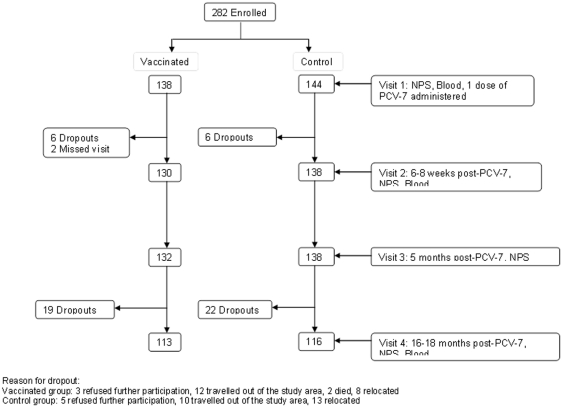
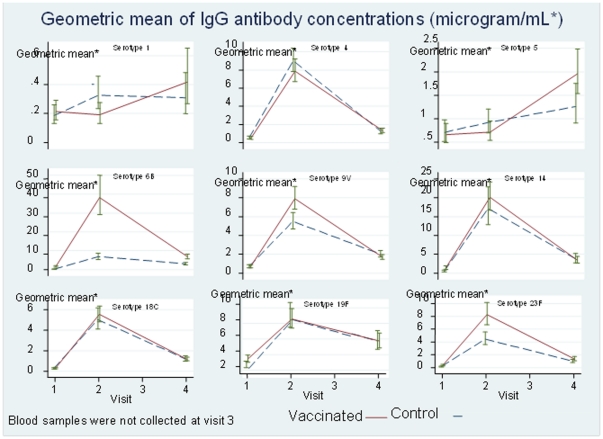
Methodology/principal findings: We recruited a subsample of children who had received 3 doses of either PCV-9 or placebo (controls) into this follow-up study. Pre- and post- PCV-7 pneumococcal antibody concentrations to the 9 serotypes in PCV-9 and nasopharyngeal carriage of pneumococci were determined before and at intervals up to 18 months post-PCV-7. We enrolled 282 children at a median age of 45 months (range, 38-52 months); 138 had received 3 doses of PCV-9 in infancy and 144 were controls. Before receiving PCV-7, a high proportion of children had antibody concentrations >0.35 µg/mL to most of the serotypes in PCV-9 (average of 75% in the PCV-9 and 66% in the control group respectively). The geometric mean antibody concentrations in the vaccinated group were significantly higher compared to controls for serotypes 6B, 14, and 23F. Antibody concentrations were significantly increased to serotypes in the PCV-7 vaccine both 6-8 weeks and 16-18 months after PCV-7. Antibodies to serotypes 6B, 9V and 23F were higher in the PCV-9 group than in the control group 6-8 weeks after PCV-7, but only the 6B difference was sustained at 16-18 months. There was no significant difference in nasopharyngeal carriage between the two groups.
Conclusions/significance: Pneumococcal antibody concentrations in Gambian children were high 34-48 months after a 3-dose primary infant vaccination series of PCV-9 for serotypes other than serotypes 1 and 18C, and were significantly higher than in control children for 3 of the 9 serotypes. Antibody concentrations increased after PCV-7 and remained raised for at least 18 months.
Conflict of interest statement
Figures
References
-
- O'Brien KL, Wolfson LJ, Watt JP, Henkle E, Deloria-Knoll M, et al. Burden of disease caused by Streptococcus pneumoniae in children younger than 5 years: global estimates. Lancet. 2009;374:893–902. - PubMed
-
- Goetghebuer T, West TE, Wemenbol V, Cadbury AL, Milligan P, et al. Outcome of meningitis caused by Streptococcus pneumoniae and Heamophilus influenzae type b in children in The Gambia. Trop Med Int Health. 2000;5:207–213. - PubMed
-
- Adegbola RA, Falade AG, Sam BE, Hazlet D, Baldeh I, et al. The etiology of pneumonia in malnourished and well-nourished Gambian children. Pediatr Infect Dis J. 1994;13:975–982. - PubMed
-
- O'Dempsey TJ, McArdle TF, Lloyd-Evans N, Baldeh I, Lawrence BE, et al. Pneumococcal disease among children in a rural area of west Africa. Pediatr Infect Dis J. 1996;15:431–437. - PubMed
-
- Usen S, Adegbola R, Mulholland K, Jaffar S, Hilton S, et al. Epidemiology of invasive pneumococcal disease in the Western Region, The Gambia. Pediatr Infect Dis J. 1998;17:23–28. - PubMed
Publication types
MeSH terms
Substances
Grants and funding
LinkOut - more resources
Full Text Sources
Medical
