


Asymptomatic carriage of plasmodium in urban Dakar: the risk of malaria should not be underestimated
- PMID: 22363558
- PMCID: PMC3283586
- DOI: 10.1371/journal.pone.0031100
Asymptomatic carriage of plasmodium in urban Dakar: the risk of malaria should not be underestimated
Abstract
Introduction: The objective of this study was to measure the rate of asymptomatic carriage of plasmodium in the Dakar region two years after the implementation of new strategies in clinical malaria management.
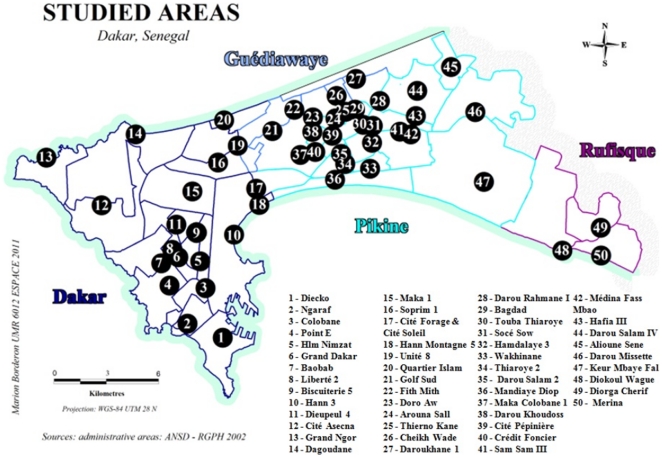
Methodology: Between October and December 2008, 2952 households selected in 50 sites of Dakar area, were visited for interviews and blood sampling. Giemsa-stained thick blood smears (TBS) were performed for microscopy in asymptomatic adult women and children aged 2 to 10 years. To ensure the quality of the microscopy, we performed a polymerase chain reaction (PCR) with real time qPCR in all positive TBS by microscopy and in a sample of negative TBS and filter paper blood spots.
Results: The analysis has concerned 2427 women and 2231 children. The mean age of the women was 35.6 years. The mean age of the children was 5.4 years. The parasite prevalence was 2.01% (49/2427) in women and 2.15% (48/2231) in children. Parasite prevalence varied from one study site to another, ranging from 0 to 7.41%. In multivariate analysis, reporting a malaria episode in 2008 was associated with plasmodium carriage (OR = 2.57, P = 0.002) in women; in children, a malaria episode (OR = 6.19, P<0.001) and a travel out of Dakar during last 3 months (OR = 2.27, P = 0.023) were associated with plasmodium carriage. Among the positive TBS, 95.8% (93/97) were positive by plasmodium PCR. Among the negative TBS, 13.9% (41/293) were positive by PCR. In blood spots, 15.2% (76/500) were positive by PCR. We estimated at 16.5% the parasite prevalence if PCR were performed in 4658 TBS.
Conclusion: Parasite prevalence in Dakar area seemed to be higher than the rate found by microscopy. PCR may be the best tool for measuring plasmodium prevalence in the context of low transmission. Environmental conditions play a major role in the heterogeneity of parasite prevalence within sites.
Conflict of interest statement
Figures

References
-
- Sabatinelli G, Bosman A, Lamizana L, Rossi P. [Prevalence of malaria in Ouagadougou and the surrounding rural environment during the period of maximal transmission]. Parassitologia. 1986;28:17–31. - PubMed
-
- Watts TE, Wray JR, Ng'andu NH, Draper CC. Malaria in an urban and a rural area of Zambia. Trans R Soc Trop Med Hyg. 1990;84:196–200. - PubMed
-
- Robert V, Macintyre K, Keating J, Trape JF, Duchemin JB, et al. Malaria transmission in urban sub-Saharan Africa. Am J Trop Med Hyg. 2003;68:169–176. - PubMed
-
- Keiser J, Utzinger J, Caldas de Castro M, Smith TA, Tanner M, et al. Urbanization in sub-saharan Africa and implication for malaria control. Am J Trop Med Hyg. 2004;71:118–127. - PubMed
Publication types
MeSH terms
LinkOut - more resources
Full Text Sources
Medical
