


Identification of mammalian protein quality control factors by high-throughput cellular imaging
- PMID: 22363705
- PMCID: PMC3282772
- DOI: 10.1371/journal.pone.0031684
Identification of mammalian protein quality control factors by high-throughput cellular imaging
Abstract
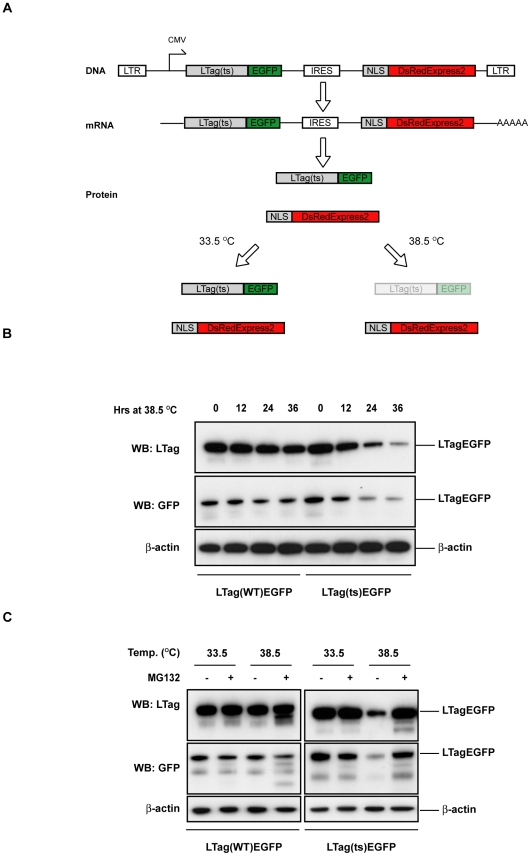
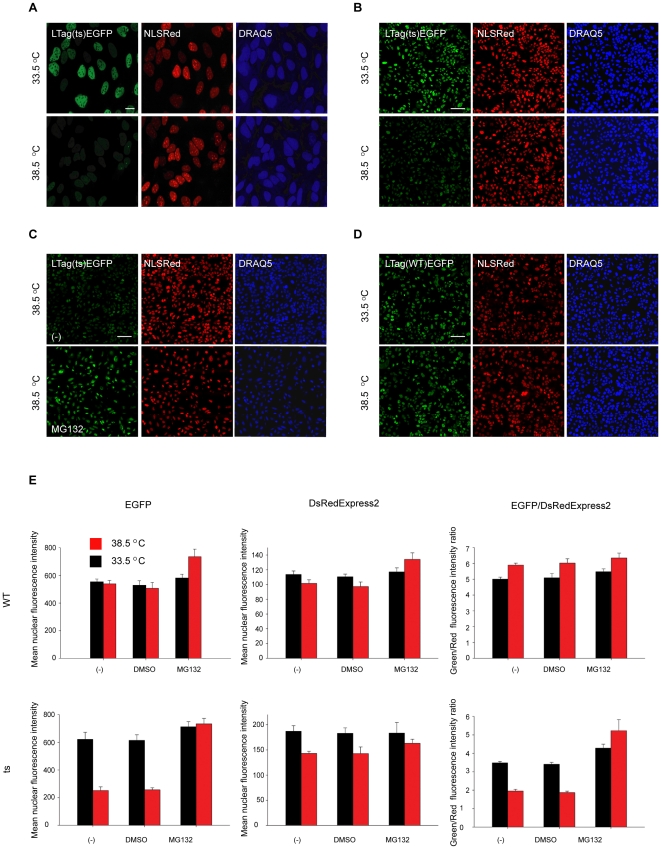
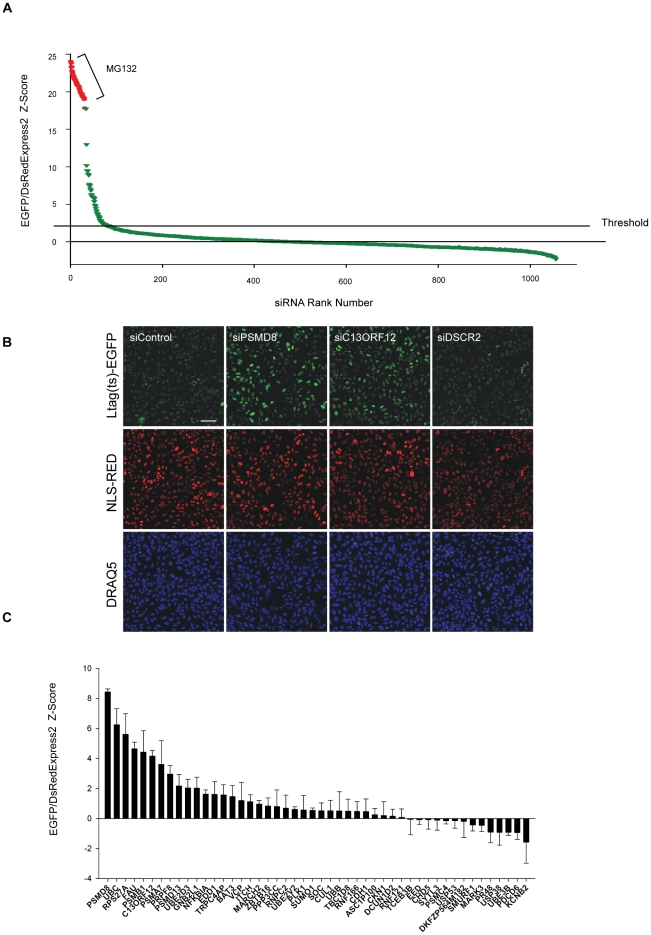
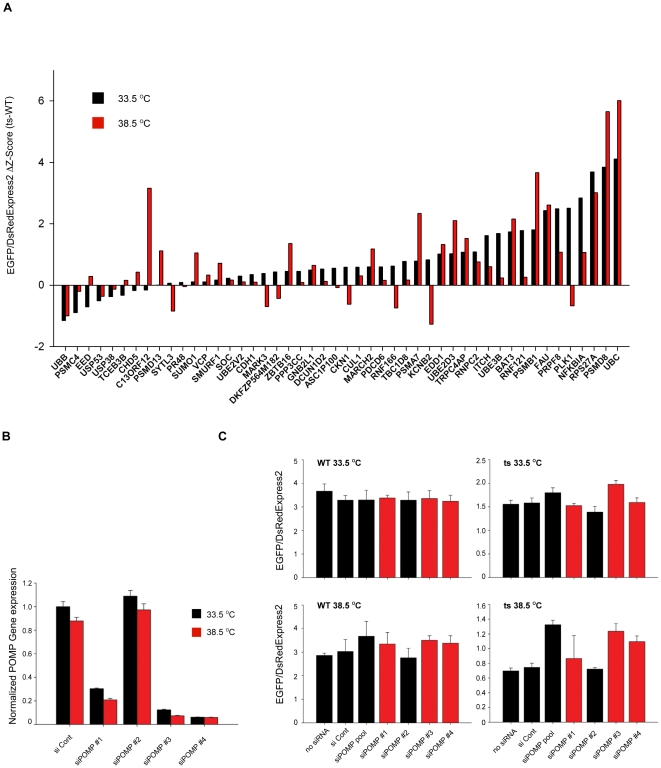
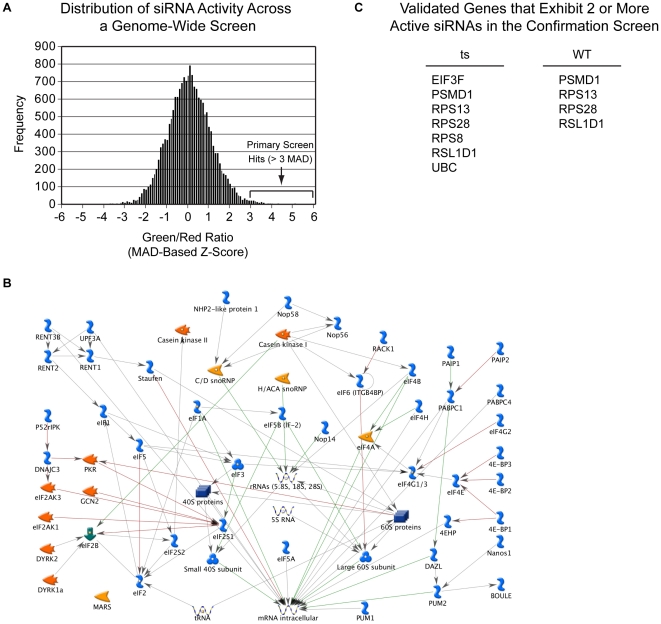
Protein Quality Control (PQC) pathways are essential to maintain the equilibrium between protein folding and the clearance of misfolded proteins. In order to discover novel human PQC factors, we developed a high-content, high-throughput cell-based assay to assess PQC activity. The assay is based on a fluorescently tagged, temperature sensitive PQC substrate and measures its degradation relative to a temperature insensitive internal control. In a targeted screen of 1591 siRNA genes involved in the Ubiquitin-Proteasome System (UPS) we identified 25 of the 33 genes encoding for 26S proteasome subunits and discovered several novel PQC factors. An unbiased genome-wide siRNA screen revealed the protein translation machinery, and in particular the EIF3 translation initiation complex, as a novel key modulator of misfolded protein stability. These results represent a comprehensive unbiased survey of human PQC components and establish an experimental tool for the discovery of genes that are required for the degradation of misfolded proteins under conditions of proteotoxic stress.
Conflict of interest statement
Figures
Similar articles
-
The extent of Ssa1/Ssa2 Hsp70 chaperone involvement in nuclear protein quality control degradation varies with the substrate.Mol Biol Cell. 2020 Feb 1;31(3):221-233. doi: 10.1091/mbc.E18-02-0121. Epub 2019 Dec 11. Mol Biol Cell. 2020. PMID: 31825716 Free PMC article.
-
Protein quality control machinery: regulators of condensate architecture and functionality.Trends Biochem Sci. 2025 Feb;50(2):106-120. doi: 10.1016/j.tibs.2024.12.003. Epub 2025 Jan 3. Trends Biochem Sci. 2025. PMID: 39755440 Review.
-
Distinct proteostasis circuits cooperate in nuclear and cytoplasmic protein quality control.Nature. 2018 Nov;563(7731):407-411. doi: 10.1038/s41586-018-0678-x. Epub 2018 Oct 31. Nature. 2018. PMID: 30429547 Free PMC article.
-
High-Throughput siRNA Screening Applied to the Ubiquitin-Proteasome System.Methods Mol Biol. 2016;1449:421-39. doi: 10.1007/978-1-4939-3756-1_28. Methods Mol Biol. 2016. PMID: 27613054
-
Ubiquitin receptors and protein quality control.J Mol Cell Cardiol. 2013 Feb;55:73-84. doi: 10.1016/j.yjmcc.2012.09.012. Epub 2012 Oct 6. J Mol Cell Cardiol. 2013. PMID: 23046644 Free PMC article. Review.
Cited by
-
A high-content imaging-based screening pipeline for the systematic identification of anti-progeroid compounds.Methods. 2016 Mar 1;96:46-58. doi: 10.1016/j.ymeth.2015.08.024. Epub 2015 Sep 1. Methods. 2016. PMID: 26341717 Free PMC article.
-
eIF-Three to Tango: emerging functions of translation initiation factor eIF3 in protein synthesis and disease.J Mol Cell Biol. 2020 Jul 3;12(6):403-409. doi: 10.1093/jmcb/mjaa018. J Mol Cell Biol. 2020. PMID: 32279082 Free PMC article. Review.
-
Reporter-Based Screens for the Ubiquitin/Proteasome System.Front Chem. 2020 Feb 11;8:64. doi: 10.3389/fchem.2020.00064. eCollection 2020. Front Chem. 2020. PMID: 32117887 Free PMC article. Review.
-
HUWE1 and TRIP12 collaborate in degradation of ubiquitin-fusion proteins and misframed ubiquitin.PLoS One. 2012;7(11):e50548. doi: 10.1371/journal.pone.0050548. Epub 2012 Nov 27. PLoS One. 2012. PMID: 23209776 Free PMC article.
-
Hypoxia and the Kynurenine Pathway: Implications and Therapeutic Prospects in Alzheimer's Disease.Oxid Med Cell Longev. 2021 Nov 10;2021:5522981. doi: 10.1155/2021/5522981. eCollection 2021. Oxid Med Cell Longev. 2021. PMID: 34804368 Free PMC article. Review.
References
-
- Hartl FU, Hayer-Hartl M. Converging concepts of protein folding in vitro and in vivo. Nat Struct Mol Biol. 2009;16:574–581. - PubMed
-
- Dobson CM. Protein folding and misfolding. Nature. 2003;426:884–890. - PubMed
-
- Balch WE, Morimoto RI, Dillin A, Kelly JW. Adapting proteostasis for disease intervention. Science. 2008;319:916–919. - PubMed
Publication types
MeSH terms
Substances
Grants and funding
LinkOut - more resources
Full Text Sources
Research Materials
