Review
. 2012 Feb 24:20:15.
doi: 10.1186/1757-7241-20-15.

Early and individualized goal-directed therapy for trauma-induced coagulopathy

Affiliations
Review

Early and individualized goal-directed therapy for trauma-induced coagulopathy

Herbert Schöchl et al. Scand J Trauma Resusc Emerg Med. .

Abstract

Severe trauma-related bleeding is associated with high mortality. Standard coagulation tests provide limited information on the underlying coagulation disorder. Whole-blood viscoelastic tests such as rotational thromboelastometry or thrombelastography offer a more comprehensive insight into the coagulation process in trauma. The results are available within minutes and they provide information about the initiation of coagulation, the speed of clot formation, and the quality and stability of the clot. Viscoelastic tests have the potential to guide coagulation therapy according to the actual needs of each patient, reducing the risks of over- or under-transfusion. The concept of early, individualized and goal-directed therapy is explored in this review and the AUVA Trauma Hospital algorithm for managing trauma-induced coagulopathy is presented.


Figures
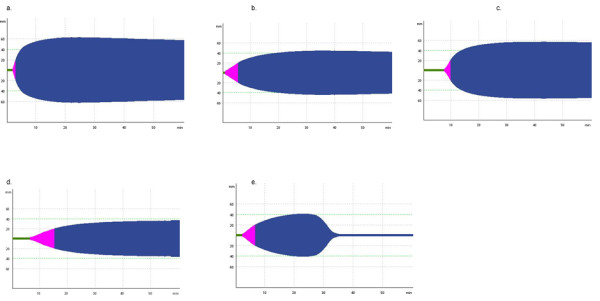
Figure 1
Figure 1
Examples of ROTEM traces using the EXTEM test: a. normal test result. b. reduced maximum clot firmness (MCF). c. delayed initiation of coagulation (prolonged coagulation time [CT]). d. prolonged CT and reduced MCF. e. hyperfibrinolysis.
Figure 2
Figure 2
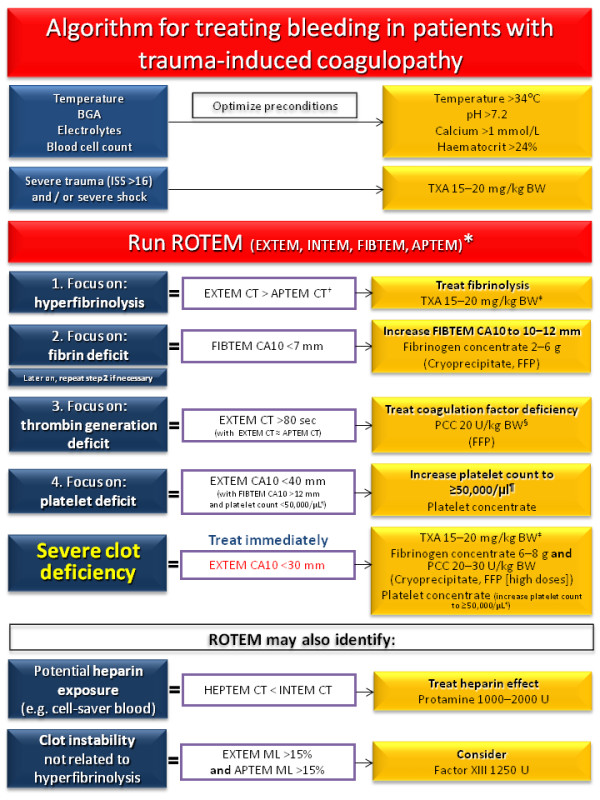
ROTEM-guided treatment algorithm: managing trauma-induced coagulopathy and diffuse microvascular bleeding (AUVA Trauma Hospital, Salzburg, Austria). The algorithm represents standard operating procedure for ROTEM-guided haemostatic therapy upon admission of trauma patients to the emergency room. In parentheses: haemostatic agents suggested for use in clinics where coagulation factor concentrates are not available. * For patients who are unconscious or known to be taking platelet inhibitor medication, Multiplate tests (adenosine diphosphate [ADP] test, arachidonic acid [ASPI] test, and thrombin receptor activating peptide-6 [TRAP] test) are also performed. § If decreased ATIII is suspected or known, consider co-administration of ATIII. Any major improvement in APTEM parameters compared to corresponding EXTEM parameters may be interpreted as a sign of hyperfibrinolysis. Only for patients not receiving TXA at an earlier stage of the algorithm. Traumatic brain injury: platelet count 80,000-100,000/μl. Normal values: EXTEM/APTEM coagulation time (CT): 38-79 seconds; EXTEM/APTEM clot amplitude at 10 minutes (CA10): 43-65 mm; EXTEM/APTEM maximum lysis (ML) < 15%; FIBTEM CA10: 7-23 mm; INTEM CT: 100-240 seconds. CA10, clot amplitude at 10 minutes; BGA, blood gas analysis; BW, body weight; Ca, calcium; CT, clotting time; FFP, fresh frozen plasma; ISS, injury severity score; MCF, maximum clot firmness; ML, maximum lysis; PCC, prothrombin complex concentrate; TXA, tranexamic acid.
Figure 3
Figure 3
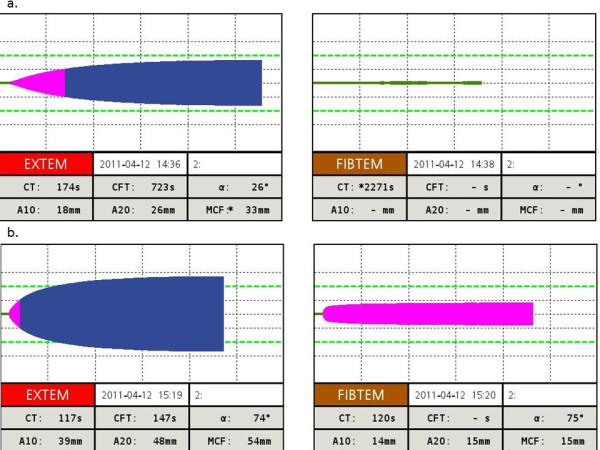
ROTEM traces from a trauma patient treated according to the AUVA Trauma Hospital algorithm: a. upon admission to the ER (EXTEM coagulation time and clot formation time are prolonged; maximum clot firmness is reduced; no clot formation in the FIBTEM test). b. 40 minutes after treatment with 2 g tranexamic acid, 10 g fibrinogen concentrate, 1800 U prothrombin complex concentrate and 1250 U factor XIII (normal coagulation).

References

    1. Kauvar DS, Wade CE. The epidemiology and modern management of traumatic hemorrhage: US and international perspectives. Crit Care. 2005;9(Suppl 5):S1–9. - PMC - PubMed
    1. Sauaia A, Moore FA, Moore EE, Moser KS, Brennan R, Read RA, Pons PT. Epidemiology of trauma deaths: a reassessment. J Trauma. 1995;38(2):185–193. - PubMed
    1. Tien HC, Spencer F, Tremblay LN, Rizoli SB, Brenneman FD. Preventable deaths from hemorrhage at a level I Canadian trauma center. J Trauma. 2007;62(1):142–146. - PubMed
    1. Brohi K, Singh J, Heron M, Coats T. Acute traumatic coagulopathy. J Trauma. 2003;54(6):1127–1130. - PubMed
    1. Maegele M, Lefering R, Yucel N, Tjardes T, Rixen D, Paffrath T, Simanski C, Neugebauer E, Bouillon B. Early coagulopathy in multiple injury: an analysis from the German Trauma Registry on 8724 patients. Injury. 2007;38(3):298–304. - PubMed

Publication types