


Acanthamoeba keratitis in South India: a longitudinal analysis of epidemics
- PMID: 22364672
- PMCID: PMC3830554
- DOI: 10.3109/09286586.2011.645990
Acanthamoeba keratitis in South India: a longitudinal analysis of epidemics
Abstract
Purpose: In light of the increased incidence of contact lens associated Acanthamoeba keratitis in recent years, this study analyzed longitudinal trends of its incidence among predominantly non-contact lens wearers in a high-volume referral center in South India.
Methods: A retrospective analysis of microbiology laboratory records at the Aravind Eye Hospital from 1988-2009 was performed. The Maximum Excess Events Test (MEET) was used to identify epidemics of Acanthamoeba keratitis.
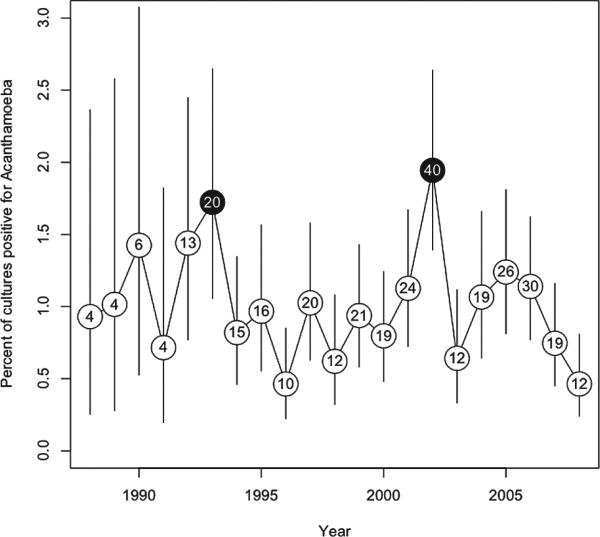
Results: There were a total of 38,529 unique cases of infectious keratitis evaluated over this time period, of which 372 were culture-positive for Acanthamoeba. Only three cases (0.9%) of Acanthamoeba keratitis occurred among contact lens wearers. MEET identified unique Acanthamoeba keratitis epidemics in 1993 and 2002.
Conclusion: Discrete epidemics of Acanthamoeba keratitis occurred among a rural, non-contact lens wearing, population in South India in 1993 and 2002.
Figures
References
-
- Acanthamoeba keratitis multiple states, 2005–2007. MMWR Morb Mortal Wkly Rep. 2007;56(21):532–534. - PubMed
-
- Thebpatiphat N, Hammersmith KM, Rocha FN, et al. Acanthamoeba keratitis: a parasite on the rise. Cornea. 2007;26(6):701–706. - PubMed
-
- Ku JY, Chan FM, Beckingsale P. Acanthamoeba keratitis cluster: an increase in Acanthamoeba keratitis in Australia. Clin Experiment Ophthalmol. 2009;37(2):181–90. - PubMed
Publication types
MeSH terms
Grants and funding
LinkOut - more resources
Full Text Sources
