


A phase II evaluation of belinostat and carboplatin in the treatment of recurrent or persistent platinum-resistant ovarian, fallopian tube, or primary peritoneal carcinoma: a Gynecologic Oncology Group study
- PMID: 22366594
- PMCID: PMC3330705
- DOI: 10.1016/j.ygyno.2012.02.019
A phase II evaluation of belinostat and carboplatin in the treatment of recurrent or persistent platinum-resistant ovarian, fallopian tube, or primary peritoneal carcinoma: a Gynecologic Oncology Group study
Abstract
Background: Patients with recurrent ovarian cancer have limited options, especially in the context of relapse less than six months from primary platinum-based therapy. This Gynecologic Oncology Group (GOG) study was conducted to evaluate the impact of the histone deacetylase inhibitor, belinostat, in combination with carboplatin in women with platinum-resistant ovarian cancer.
Methods: Eligible patients had measurable, recurrent disease within six months of their last dose of a platinum-based combination. Belinostat was dosed at 1000 mg/m(2) daily for five days with carboplatin AUC 5 on day three of 21-day cycles. The primary endpoint was overall response rate (ORR), using a two-stage design.
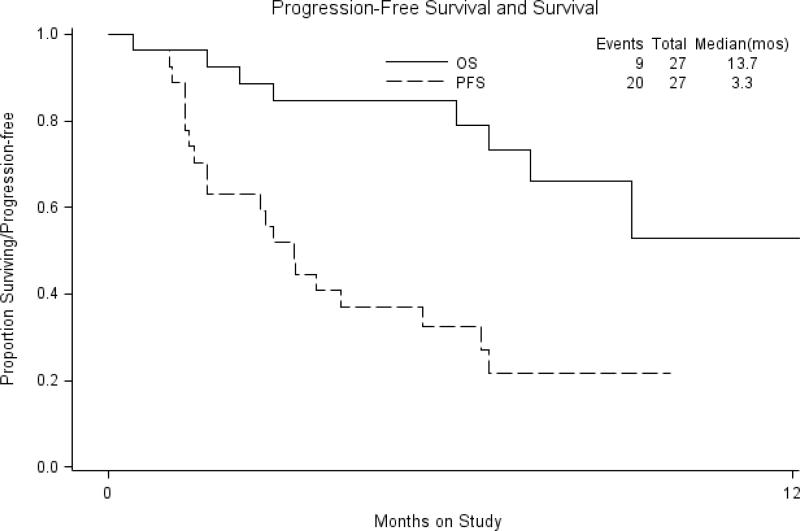
Results: Twenty-nine women enrolled on study and 27 were evaluable. The median number of cycles given was two (range 1-10). One patient had a complete response and one had a partial response, for an ORR of 7.4% (95% CI, .9%-24.3%). Twelve patients had stable disease while eight had increasing disease. Response could not be assessed in five (18.5%). Grade 3 and 4 events occurring in more than 10% of treated patients were uncommon and limited to neutropenia (22.2%), thrombocytopenia (14.8%), and vomiting (11.1%). The median progression-free survival (PFS) was 3.3 months and overall survival was 13.7 months. PFS of at least six months was noted in 29.6% of patients. Due to the lack of drug activity, the study was closed after the first-stage.
Conclusions: The addition of belinostat to carboplatin had little activity in a population with platinum-resistant ovarian cancer.
Copyright © 2012 Elsevier B.V. All rights reserved.
References
-
- American Cancer Society Cancer Facts & Figures 2010. 2010.
-
- Parmar MK, Ledermann JA, Colombo N, du Bois A, Delaloye JF, Kristensen GB, et al. Paclitaxel plus platinum-based chemotherapy versus conventional platinum-based chemotherapy in women with relapsed ovarian cancer: the ICON4/AGO-OVAR-2.2 trial. Lancet. 2003;361:2099–106. - PubMed
-
- Pfisterer J, Plante M, Vergote I, du Bois A, Hirte H, Lacave AJ, et al. Gemcitabine plus carboplatin compared with carboplatin in patients with platinum-sensitive recurrent ovarian cancer: an intergroup trial of the AGO-OVAR, the NCIC CTG, and the EORTC GCG. J Clin Oncol. 2006;24:4699–707. - PubMed
-
- Pujade-Lauraine E, Wagner U, Aavall-Lundquist E, Gebski V, Heywood M, Vasey PA, et al. Pegylated liposomal Doxorubicin and Carboplatin compared with Paclitaxel and Carboplatin for patients with platinum-sensitive ovarian cancer in late relapse. J Clin Oncol. 2010;28:3323–39. - PubMed
-
- Brewer CA, Blessing JA, Nagourney RA, Morgan M, Hanjani P. Cisplatin plus gemcitabine in platinum-refractory ovarian or primary peritoneal cancer: a phase II study of the Gynecologic Oncology Group. Gynecol. Oncol. 2006;103:446–50. - PubMed
Publication types
MeSH terms
Substances
Grants and funding
LinkOut - more resources
Full Text Sources
Other Literature Sources
Medical
