Review
. 2012 Mar;14(2):204-21.
doi: 10.1038/aja.2011.104. Epub 2012 Feb 27.

Muscle function, physical performance and body composition changes in men with prostate cancer undergoing androgen deprivation therapy

Affiliations
Review

Muscle function, physical performance and body composition changes in men with prostate cancer undergoing androgen deprivation therapy

Thomas W Storer et al. Asian J Androl. 2012 Mar.

Abstract

Prostate cancer (PCa) is the most common visceral malignancy in men with androgen deprivation therapy (ADT) the preferred therapy to suppress testosterone production and hence tumor growth. Despite its effectiveness in lowering testosterone, ADT is associated with side effects including loss of muscle mass, diminished muscle strength, decrements in physical performance, earlier fatigue and declining quality of life. This review reports a survey of the literature with a focus on changes in muscle strength, physical function and body composition, due to short-term and long-term ADT. Studies in these areas are sparse, especially well-controlled, prospective randomized trials. Cross-sectional and longitudinal data (up to 2 years) for men with PCa treated with ADT as well as patients with PCa not receiving ADT and age-matched healthy men are presented when available. Based on limited longitudinal data, the adverse effects of ADT on muscle function, physical performance and body composition occur shortly after the onset of ADT and tend to persist and worsen over time. Exercise training is a safe and effective intervention for mitigating these changes and initial guidelines for exercise program design for men with PCa have been published by the American College of Sports Medicine. Disparities in study duration, types of studies and other patient-specific variables such as time since diagnosis, cancer stage and comorbidities may all affect an understanding of the influence of ADT on health, physical performance and mortality.


Figures
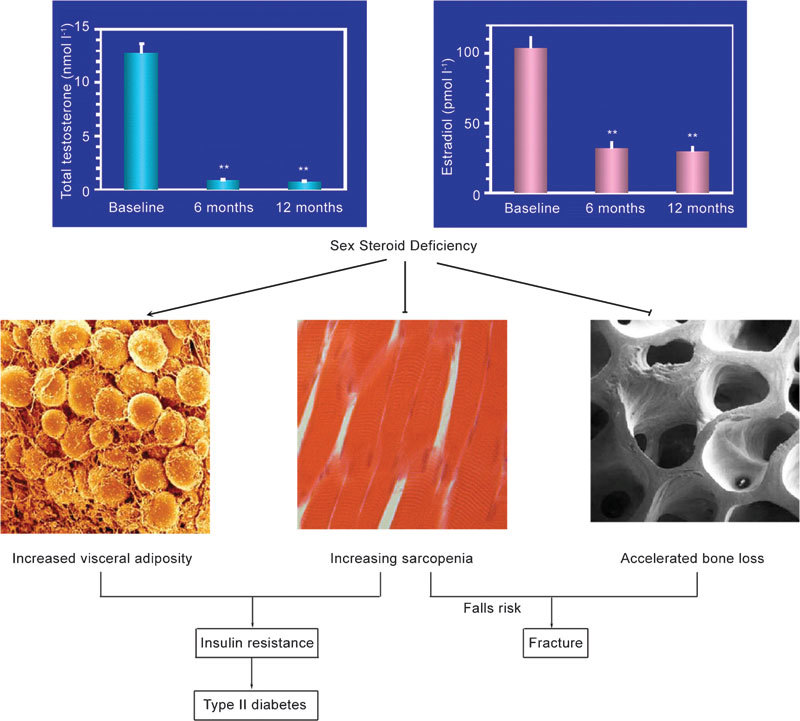
Figure 1
Figure 1
Consequences of androgen deprivation therapy (Courtesy of Mathis Grossmann, MD, University of Melbourne).
Figure 2
Figure 2
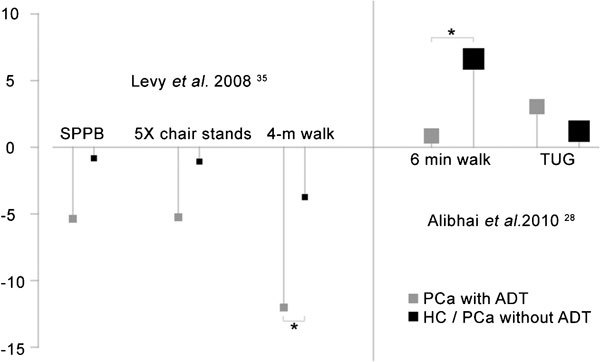
Annualized proportionate change in physical function outcomes in two longitudinal studies of at least 1-year duration, by treatment arm (ADT or control). Points are displayed with magnification proportionate to the square root of group sample size. Statistically significant differences between ADT (grey; PCa treated with ADT) and control (black; healthy control or PCa without ADT) are denoted with a star (*). ADT, androgen deprivation therapy; HC, healthy men; PCa, prostate cancer; SPPB, short physical performance battery; TUG, timed up-and-go test.
Figure 3
Figure 3
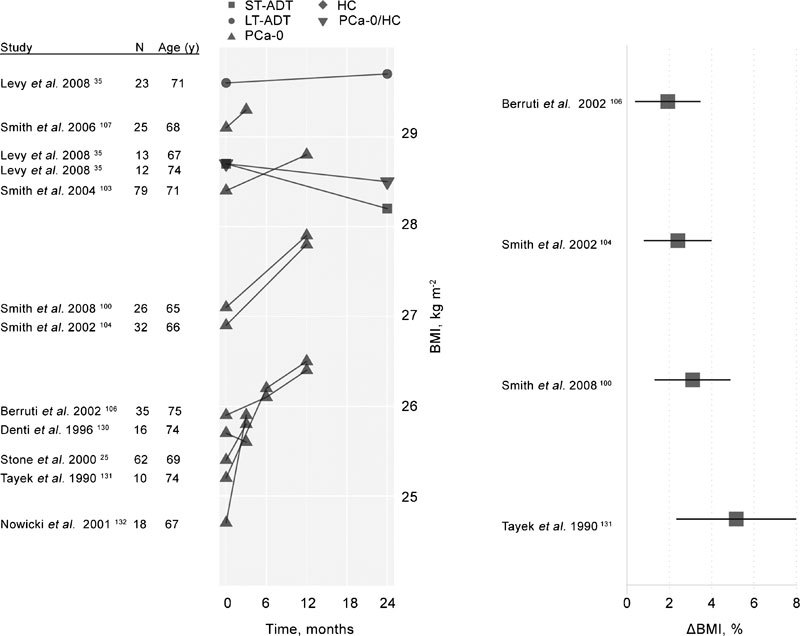
Left: Longitudinal changes in BMI among men enrolled in ADT studies. Untreated, healthy control participants are denoted as HC. A single mixed control group of healthy men and men with PCa not treated with ADT (HC/PCa-0) is also displayed. The remaining participants (all with PCa diagnoses and treated with ADT in the studies displayed) are classified according to their history of treatment with ADT prior to the current study. These groups include subjects with short-term (less than 6 months) previous exposure to ADT (ST-ADT groups), longer-term (six months or longer) previous exposure to ADT (LT-ADT groups) and subjects with no prior history of ADT exposure (PCa-0). Right: Annualized percent change in BMI among subjects treated with ADT in studies of at least 1-year duration reporting BMI change values, adapted from Haseen et al. ADT, androgen deprivation therapy; BMI, body mass index; HC, healthy men; PCa, prostate cancer.
Figure 4
Figure 4
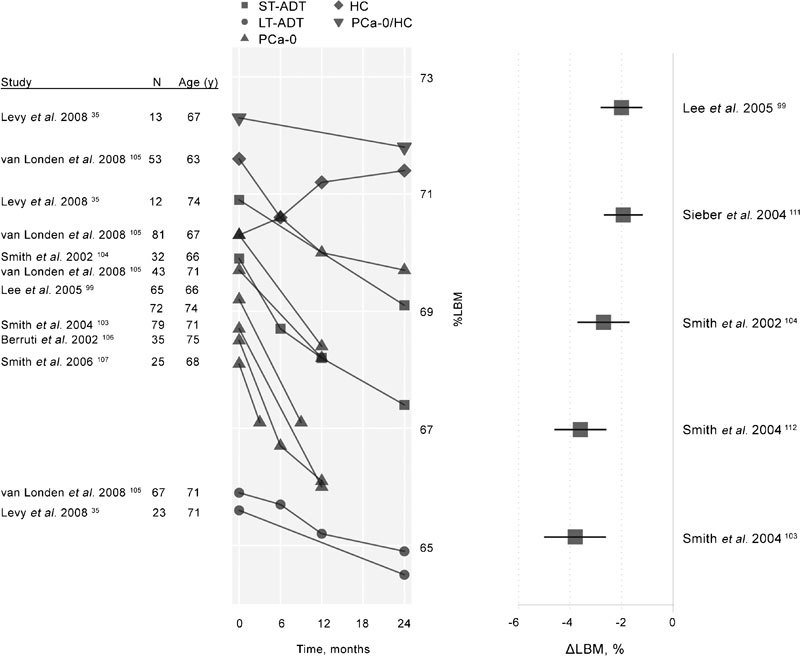
Left: Longitudinal changes in percent LBM among men enrolled in ADT studies. Untreated, healthy control participants are denoted as HC. A single mixed control group of healthy men and men with PCa not treated with ADT (HC/PCa-0) is also displayed. The remaining participants (all with PCa diagnoses and treated with ADT in the studies displayed) are classified according to their history of treatment with ADT prior to the current study. These groups include subjects with short-term (less than 6 months) previous exposure to ADT (ST-ADT groups), longer-term (6 months or longer) previous exposure to ADT (LT-ADT groups), and subjects with no prior history of ADT exposure (PCa-0). Right: Annualized percent change in percent lean body mass among subjects treated with ADT in studies of at least 1-year duration reporting LBM change values, adapted from Haseen et al. ADT, androgen deprivation therapy; HC, healthy men; LBM, lean body mass; PCa, prostate cancer.
Figure 5
Figure 5
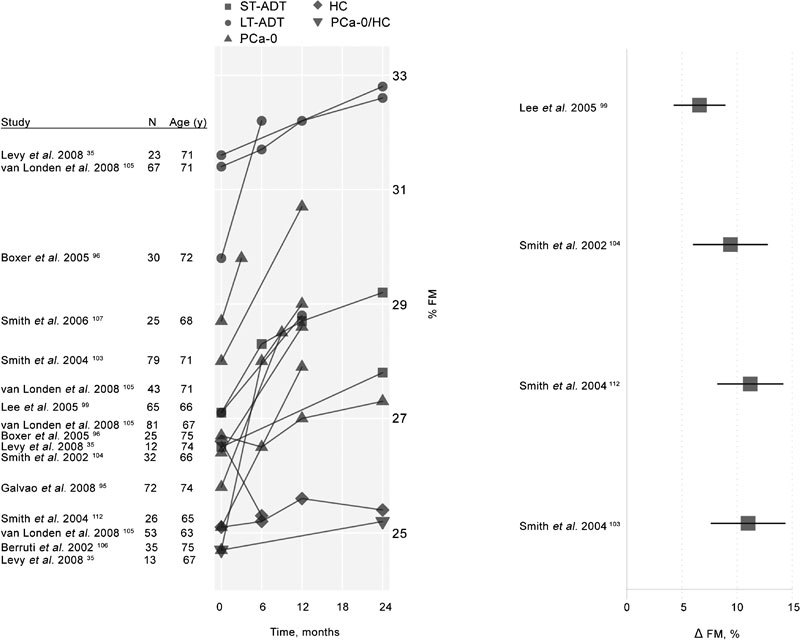
Left: Longitudinal changes in percent FM among men enrolled in ADT studies. Untreated, healthy control participants are denoted as HC. A single mixed control group of healthy men and men with PCa never treated with ADT (HC/PCa-0) is also displayed. The remaining participants (all with PCa diagnoses and treated with ADT in the studies displayed) are classified according to their history of treatment with ADT prior to the current study. These groups include subjects with short-term (less than 6 months) previous exposure to ADT (ST-ADT groups), longer-term (six months or longer) previous exposure to ADT (LT-ADT groups) and subjects with no prior history of ADT exposure (PCa-0). Right: Annualized percent change in percent FM among subjects treated with ADT in studies of at least 1-year duration reporting fat mass change values, adapted from Haseen et al. ADT, androgen deprivation therapy; FM, fat mass; HC, healthy men; LBM, lean body mass; PCa, prostate cancer.

References

    1. Stoch SA, Parker RA, Chen L, Bubley G, Ko YJ, et al. Bone loss in men with prostate cancer treated with gonadotropin-releasing hormone agonists. J Clin Endocrinol Metab. 2001;86:2787–91. - PubMed
    1. Smith MR. Therapy Insight: osteoporosis during hormone therapy for prostate cancer. Nat Clin Pract Urol. 2005;2:608–15; quiz 28. - PubMed
    1. Levine GN, D'Amico AV, Berger P, Clark PE, Eckel RH, et al. Androgen-deprivation therapy in prostate cancer and cardiovascular risk: a science advisory from the American Heart Association, American Cancer Society, and American Urological Association: endorsed by the American Society for Radiation Oncology. Circulation. 2010;121:833–40. - PMC - PubMed
    1. Nguyen PL, Je Y, Schutz FA, Hoffman KE, Hu JC, et al. Association of androgen deprivation therapy with cardiovascular death in patients with prostate cancer: a meta-analysis of randomized trials. JAMA. 2011;306:2359–66. - PubMed
    1. Mauras N, Hayes V, Welch S, Rini A, Helgeson K, et al. Testosterone deficiency in young men: marked alterations in whole body protein kinetics, strength, and adiposity. J Clin Endocrinol Metab. 1998;83:1886–92. - PubMed

MeSH terms

Substances