Review
. 2012 Mar;33(3):342-50.
doi: 10.1038/aps.2011.200. Epub 2012 Feb 27.

Role of G protein-coupled receptors in inflammation

Affiliations
Review

Role of G protein-coupled receptors in inflammation

Lei Sun et al. Acta Pharmacol Sin. 2012 Mar.

Abstract

G protein-coupled receptors (GPCRs) play important roles in inflammation. Inflammatory cells such as polymorphonuclear leukocytes (PMN), monocytes and macrophages express a large number of GPCRs for classic chemoattractants and chemokines. These receptors are critical to the migration of phagocytes and their accumulation at sites of inflammation, where these cells can exacerbate inflammation but also contribute to its resolution. Besides chemoattractant GPCRs, protease activated receptors (PARs) such as PAR1 are involved in the regulation of vascular endothelial permeability. Prostaglandin receptors play different roles in inflammatory cell activation, and can mediate both proinflammatory and anti-inflammatory functions. Many GPCRs present in inflammatory cells also mediate transcription factor activation, resulting in the synthesis and secretion of inflammatory factors and, in some cases, molecules that suppress inflammation. An understanding of the signaling paradigms of GPCRs in inflammatory cells is likely to facilitate translational research and development of improved anti-inflammatory therapies.


Figures
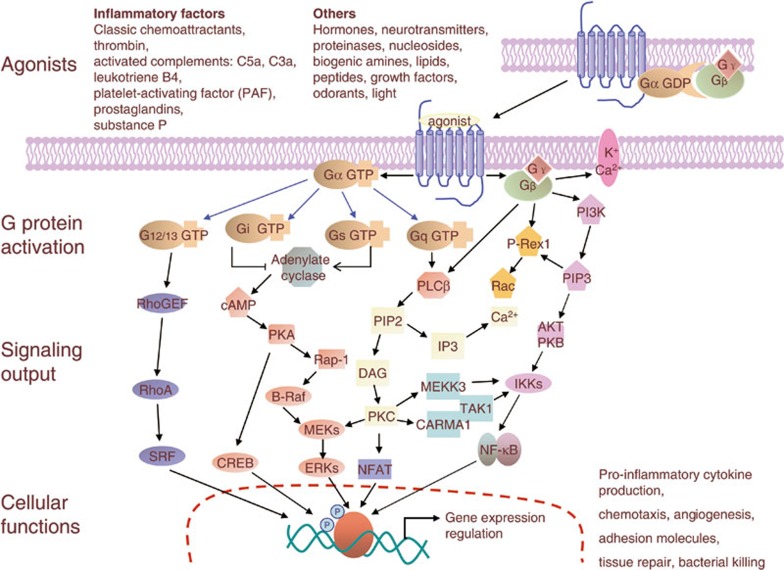
Figure 1
Figure 1
Signaling pathways of GPCRs involved in inflammation. Signaling by GPCRs is initiated by a specific ligand that binds and activates the receptor inducing conformational changes in the receptor. A partial list of the relevant ligands is given in the top panel. All 4 classes of G proteins are involved in the regulation of events that lead to inflammatory cell activation or inactivation. Major effectors, including second messengers and other signaling molecules involved in the regulation of inflammation are shown. These include Ca2+, cAMP, protein kinases, lipid kinases, lipases, phosphoinositides, small GTPases and the relevant guanine nucleotide exchange factors, and transcriptional factors. The final output is manifested as nuclear, cytoplasmic and extracellular activities such as expression of proinflammatory genes, production of oxidants, and generation of tissue damaging and repairing factors.

References

    1. Harris H. Role of chemotaxis in inflammation. Physiol Rev. 1954;34:529–62. - PubMed
    1. Ward PA, Cochrane CG, Muller-eberhard HJ. The role of serum complement in chemotaxis of leukocytes in vitro. J Exp Med. 1965;122:327–46. - PMC - PubMed
    1. Ward PA, Lepow IH, Newman LJ. Bacterial factors chemotactic for polymorphonuclear leukocytes. Am J Pathol. 1968;52:725–36. - PMC - PubMed
    1. Schiffmann E, Corcoran BA, Wahl SM. N-formylmethionyl peptides as chemoattractants for leucocytes. Proc Natl Acad Sci U S A. 1975;72:1059–62. - PMC - PubMed
    1. Koo C, Lefkowitz RJ, Snyderman R. Guanine nucleotides modulate the binding affinity of the oligopeptide chemoattractant receptor on human polymorphonuclear leukocytes. J Clin Invest. 1983;72:748–53. - PMC - PubMed

Publication types

Substances
